Key Takeaways Elon Musk declared on X that SpaceX’s value could exceed “the rest of Earth” if the company realizes its objectives Following its historic June 12 IPO at $135 that generated $86
Key Takeaways
- Elon Musk declared on X that SpaceX’s value could exceed “the rest of Earth” if the company realizes its objectives
- Following its historic June 12 IPO at $135 that generated $86 billion, SpaceX reached a peak of $225.64 before pulling back
- Shares have declined 26% from their all-time high, recovering to approximately $152; premarket trading Friday showed SPCX at $149.96, down 1.5%
- Wall Street’s price projections span dramatically from $75 (bearish scenario) to $900 (Citi’s optimistic case), averaging near $240
- Financial analysts forecast SpaceX requiring approximately $150 billion in additional capital from 2026 through 2031 for orbital AI infrastructure development
Elon Musk delivered his most audacious valuation forecast yet Thursday evening, declaring on X that SpaceX’s worth will surpass “the rest of Earth” should the aerospace company achieve its ambitious objectives.
Musk’s statement emerged during a discussion about a reportedly contentious arrangement involving Anthropic, xAI, and SpaceX centered on artificial intelligence computing resources. An X platform user characterized the partnership as potentially “the biggest unforced error of the AI era” for Anthropic. Musk redirected the dialogue toward SpaceX’s expansive long-term vision.
Premarket trading Friday saw SpaceX shares (SPCX) at $149.96, representing a 1.5% decline. Meanwhile, S&P 500 futures remained unchanged while Dow futures advanced 0.2%.
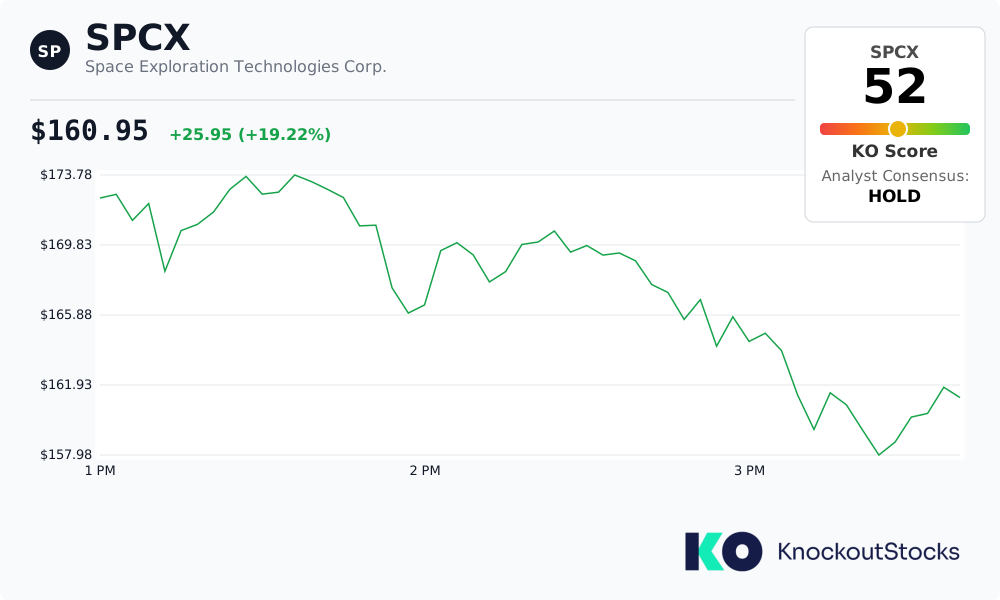 Space Exploration Technologies Corp., SPCX
This isn’t Musk’s inaugural venture into hyperbolic forecasting. During 2022, he projected Tesla’s market capitalization could exceed the combined worth of Apple and Saudi Aramco — companies collectively valued at approximately $4.4 trillion then. Tesla’s current market cap hovers around $1.8 trillion.
Musk frequently invokes the Kardashev Scale, a scientific framework categorizing civilizations based on their energy utilization capacity. His ultimate aspiration involves humanity capturing solar energy at planetary scales — vastly exceeding capabilities of Earth-based enterprises.
SpaceX launched its public offering June 12 at $135 per share, securing $86 billion in history’s most substantial IPO. Trading commenced at $150 and skyrocketed 50% to reach $225.64 on June 16, momentarily propelling the company’s market capitalization toward $3 trillion.
The euphoria proved temporary. Investor anxiety regarding bond issuance, substantial Terafab data center capital expenditures, and approaching insider share lockup expirations pressured the stock significantly. SPCX tumbled 26% from its zenith, bottoming at $145.20, before finding support around $152.
July 7 marked SpaceX’s inclusion in the Nasdaq-100 index, generating approximately $4.3 billion in passive investment flows as index-tracking funds acquired positions.
Wall Street’s Assessment
Over a dozen financial analysts published initial coverage following the public debut. The variance in price targets reveals divergent perspectives. Raymond James established the highest target at $800. Citi’s bullish scenario extends to $900, suggesting a potential $12 trillion valuation. Morgan Stanley positions its base case at $300, with optimistic and pessimistic scenarios at $600 and $75 respectively — the latter assuming Starship operational delays until 2029.
According to FactSet data, the consensus analyst price target approximates $240.
Wall Street forecasts indicate SpaceX generating revenues exceeding $630 billion by 2031, climbing from roughly $39 billion anticipated in 2026. Operating profitability is projected to surpass $340 billion by 2031, compared with approximately $1 billion in the current year.
Financing Requirements
Achieving this trajectory demands substantial capital infusion. Financial analysts calculate SpaceX requiring roughly $150 billion in supplementary financing throughout 2026-2031 to construct its orbital artificial intelligence infrastructure.
Regarding revenue generation, Anthropic currently compensates SpaceX $1.25 billion monthly for Colossus 1 AI supercluster access — encompassing over 220,000 NVIDIA GPUs and 300 MW power capacity — through an agreement potentially totaling $30 to $40 billion.
SpaceX simultaneously completed its 80th Falcon 9 launch this week, maintaining its aggressive satellite deployment schedule.
The post Musk’s Audacious Claim: SpaceX (SPCX) Could Surpass Earth’s Total Value appeared first on Blockonomi.