Nvidia's CEO quit on Nov. 12, and it rattled markets. Jensen Huang resigned effective immediately, the board named CFO Colette Kress interim CEO, and Bitcoin slid with tech stocks. Nvidia gav
Nvidia's CEO quit on Nov. 12, and it rattled markets. Jensen Huang resigned effective immediately, the board named CFO Colette Kress interim CEO, and Bitcoin slid with tech stocks.
Nvidia gave no reason, but said the board was looking into reports that a foreign intelligence effort had targeted Huang. That investigation is still underway.
11 days later, the board voted unanimously to bring him back.
Nvidia shares closed up more than 30% on Nov. 23, and Bitcoin briefly rallied above $63,000. The odd part is what happened before that announcement.
Related: Bitcoin rallies as Nvidia brings back Jensen Huang
Some traders had already bet on his return, and they made big money.
According to The Wall Street Journal, two groups of Polymarket accounts made more than $340,000 betting that Huang would return.
How traders profited from Nvidia's CEO comeback
On Nov. 23, blockchain analytics firm Bubblemaps identified 16 accounts with unusual trading patterns.
Eleven were funded hours before Huang's reinstatement, while five received funds on Nov. 16.
All 16 accounts placed bets exclusively on Nvidia-related markets, each within about six minutes of receiving funds.
Together, they wagered roughly $20,000 and made around $350,000 in profits.
One account turned a $3,180 bet into $88,168 by correctly predicting Huang's return.
Trending on TheStreet Roundtable:
Polymarket, the world's largest crypto-based prediction market, operates on the Polygon blockchain, allowing users to bet on real-world events using cryptocurrency.
Since all transactions are recorded publicly, researchers can track wallet activity without knowing who controls the accounts.
Bubblemaps has not found direct blockchain links between the accounts so far and said the trading patterns alone did not prove wrongdoing.
Suspicious bets raise insider trading concerns
The activity has also drawn attention from consumer advocacy group Public Citizen.
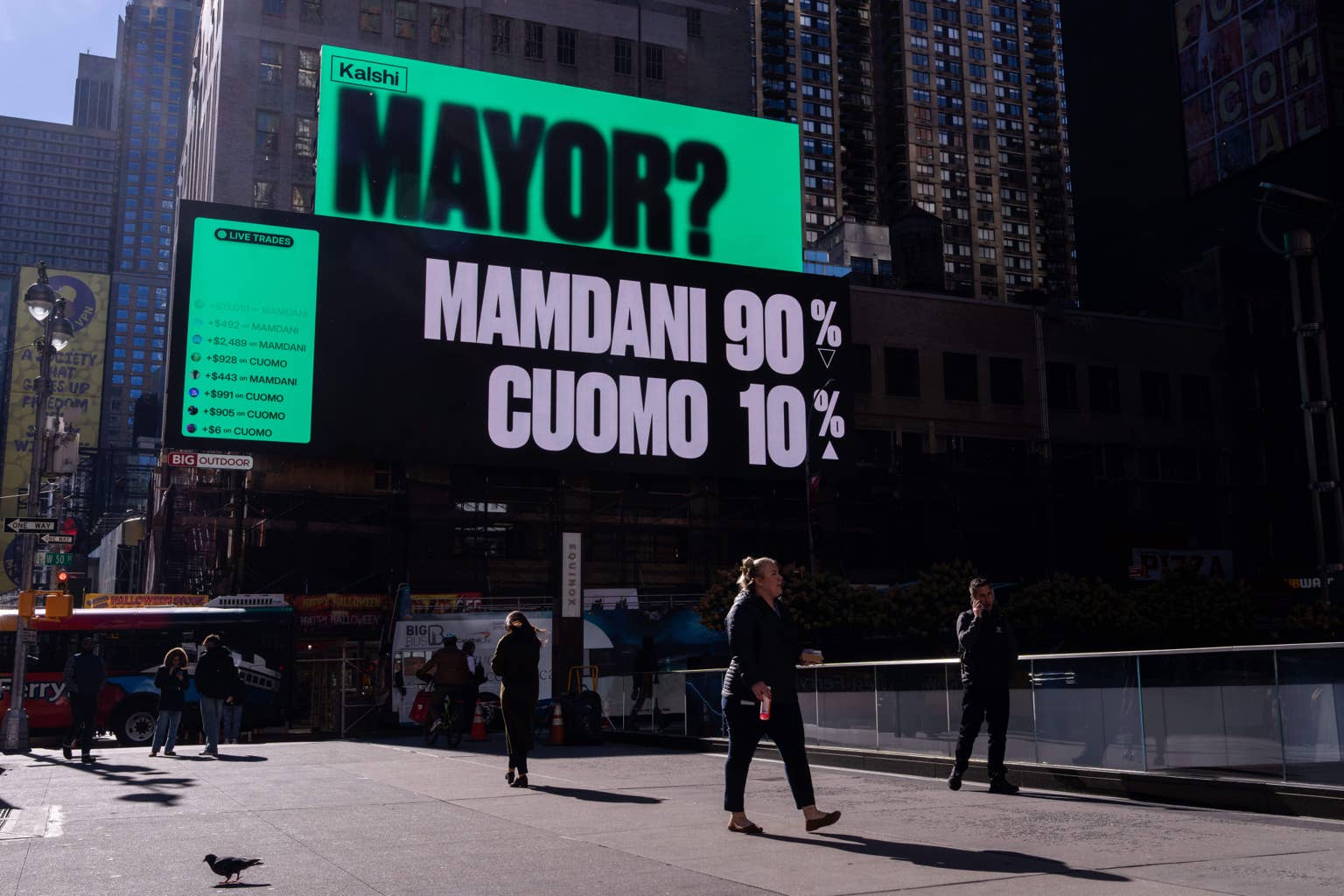
A Kalshi billboard displaying New York City mayoral election odds in Times Square in New York.
GettyImages/Bloomberg
In a Nov. 24 statement, the group flagged bets on both Polymarket and Kalshi. On Kalshi, users made 21 trades of $3,000 or more, spending $113,000 for a potential payouts of $828,000.
Public Citizen co-president Robert Weissman said there was “no way to know” whether traders had inside information, but the timing warranted an investigation.
Concerns about prediction market insider trading have already reached Washington.
In March, four senators introduced legislation to prohibit federal officials from betting using confidential information.
“The prediction markets industry can't be left alone to self-police,” Senator Adam Schiff said.
In March, Polymarket also tightened its rules against insider trading and market manipulation.
As of now, there is no evidence that the traders who profited from Huang's return had access to confidential information.
Related: Vertiv jumps 17 spots on the Roundtable 100