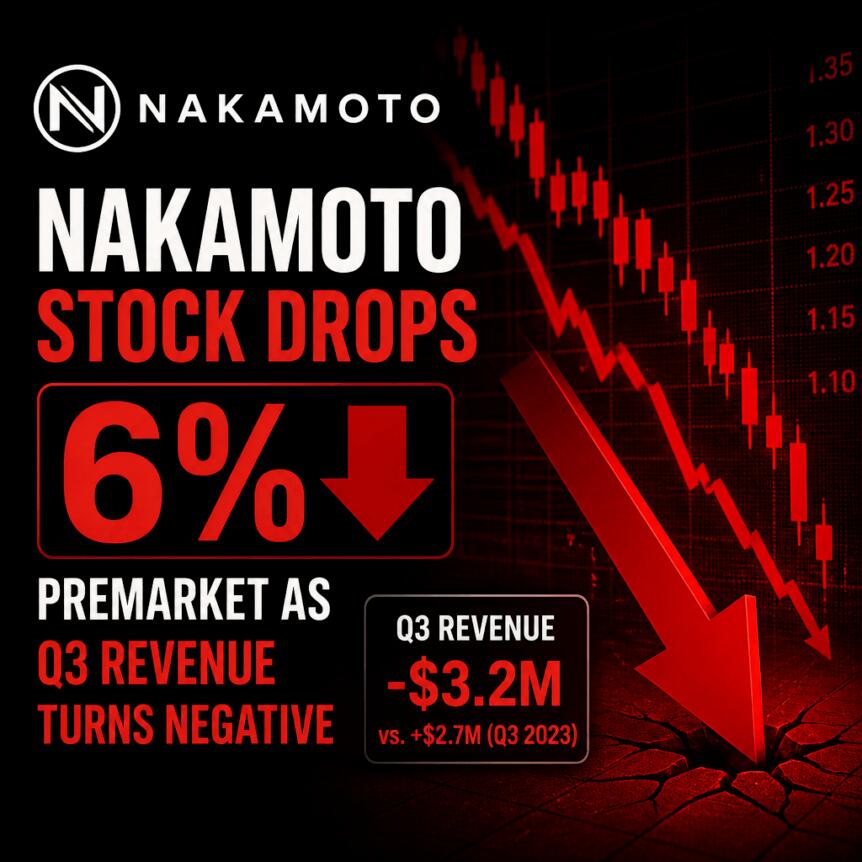
Nasdaq-listed Bitcoin treasury company Nakamoto Holdings (NAKA) saw its shares fall in premarket trading after it reported a third-quarter operating revenue loss tied to results from Bitcoin
Nasdaq-listed Bitcoin treasury company Nakamoto Holdings (NAKA) saw its shares fall in premarket trading after it reported a third-quarter operating revenue loss tied to results from Bitcoin options. The company also amended key terms of a $60 million loan backed by Bitcoin held with crypto exchange Kraken, pushing part of the repayment timeline into 2027.
Shares were quoted at $5.40 at 12:02 pm UTC on Friday, according to Yahoo Finance, representing a roughly 62% decline year to date. The move came after Nakamoto posted its quarterly results in an SEC filing following Thursday’s market close, a period in which option-related losses weighed heavily on operating figures.
Key takeaways
- Nakamoto reported third-quarter operating revenue of negative $1.9 million, driven by a $5.8 million net loss on Bitcoin options.
- The company’s adjusted operating loss for the quarter was $15.8 million, excluding a $110.4 million gain from revaluing digital assets.
- Nakamoto extended the repayment deadline for a $60 million USDT loan from Kraken by one year, moving it to Dec. 4, 2027.
- Under the amended loan terms, positive net value from certain Bitcoin derivative positions with Kraken can count toward collateral requirements.
Options losses push operating revenue into the red
Nakamoto’s third-quarter results, filed with the SEC, showed revenue of $3.9 million across its operating businesses. However, Bitcoin options losses of $5.8 million reduced total operating revenue to negative $1.9 million, according to the company’s quarterly filing on Form 10-Q (SEC). Nakamoto’s Q3 filing.
The disparity between headline profit and underlying operating performance is central to how the market appears to be reading the quarter. While Nakamoto reported net income of $85.5 million for the quarter, it also recorded a $15.8 million adjusted operating loss—an alternate metric that excludes the large revaluation gain from digital assets.
That gain—$110.4 million—came from revaluing its cryptocurrency holdings, “chiefly Bitcoin,” as described in the filing. In other words, the quarter’s profit was supported by changes in the value of assets held, while the options book weighed directly on operating revenue.
Analyst expectations compiled by Yahoo Finance had pointed to revenue of about $17.4 million, placing Nakamoto’s negative operating outcome further out of line with consensus for the quarter.
Digital asset revaluation masks operational pressure
Nakamoto reported holding 4,283 BTC as of Sept. 30, worth $357.9 million, down from 4,467 BTC at the end of June. The company’s filing indicates that asset revaluation contributed substantially to net income, which can make quarterly earnings less reflective of recurring operating performance—particularly for firms whose activity includes structured products such as options.
For investors focused on balance-sheet strength and downside protection rather than only accounting earnings, the combination of (1) shrinking BTC holdings and (2) option-related losses suggests the company may remain exposed to volatility even as it seeks to hedge. What matters going forward is whether the company’s derivative positioning can offset drawdowns without continuing to generate operating losses from options premiums, settlement outcomes, or mark-to-market effects.
Kraken loan amendment extends repayment to 2027
Alongside its earnings, Nakamoto disclosed an amendment to its debt arrangements with Kraken. In an SEC filing on Form 8-K, the company said it extended the repayment deadline for a $60 million loan denominated in Tether USD (USDT) by one year, shifting the due date from Dec. 4, 2026 to Dec. 4, 2027. The amendment is detailed in the company’s SEC filing.
Importantly, Nakamoto stated that total outstanding debt to Kraken remained unchanged at 165 million USDT. Of that amount, 105 million USDT is due June 30, 2027, while the revised terms specify that no principal repayments are scheduled for 2026.
The amendment also includes a mechanism that may help Nakamoto manage collateral requirements. Under the revised agreement, the positive net value of certain Bitcoin derivative positions held with Kraken can be used to satisfy collateral obligations. This could be particularly relevant if the company’s pledged Bitcoin declines in value—because it may allow gains from some derivatives to offset collateral shortfalls before additional collateral needs to be posted or repayment obligations kick in.
How collateral coverage may shift with derivative settlement
As of the end of September, Nakamoto had pledged 3,030 BTC as collateral to Kraken, representing about 71% of its total BTC holdings, according to its quarterly report. Nakamoto’s Q3 filing.
That collateral concentration makes the terms of the loan amendment more than a paperwork change. When pledged assets represent a large portion of total holdings, collateral calls and margin mechanics can accelerate liquidity pressure during periods of sustained market weakness. By allowing certain derivative outcomes to count toward collateral requirements, the company is effectively building flexibility into its risk management framework—although the effectiveness will depend on whether the derivative positions generate net positive value when Bitcoin moves.
Nakamoto’s quarterly filing already highlighted the role Bitcoin options played during the period, with a reported $5.8 million net loss on options. That makes the amended collateral treatment especially worth watching: it suggests the company is attempting to reduce the operational impact of volatility by linking parts of its derivatives book to collateral management with the lender.
Investors should monitor two things next: whether Nakamoto’s derivative strategy continues to produce net option losses similar to the quarter just reported, and how the amended Kraken collateral provisions perform in real time if Bitcoin underperforms. The answers will help determine whether the company can protect its pledged BTC base while keeping operating results from being dominated by options-driven outcomes.
This article was originally published as Nakamoto Stock Drops 6% Premarket as Q3 Revenue Turns Negative on Crypto Breaking News – your trusted source for crypto news, Bitcoin news, and blockchain updates.