The NanoBit fraud case ended with an SEC win after a New York court entered final judgment against four entities and two people tied to the crypto platform. The case involved claims that inve
The NanoBit fraud case ended with an SEC win after a New York court entered final judgment against four entities and two people tied to the crypto platform. The case involved claims that investors were pushed into a fake trading platform through social media and WhatsApp groups.
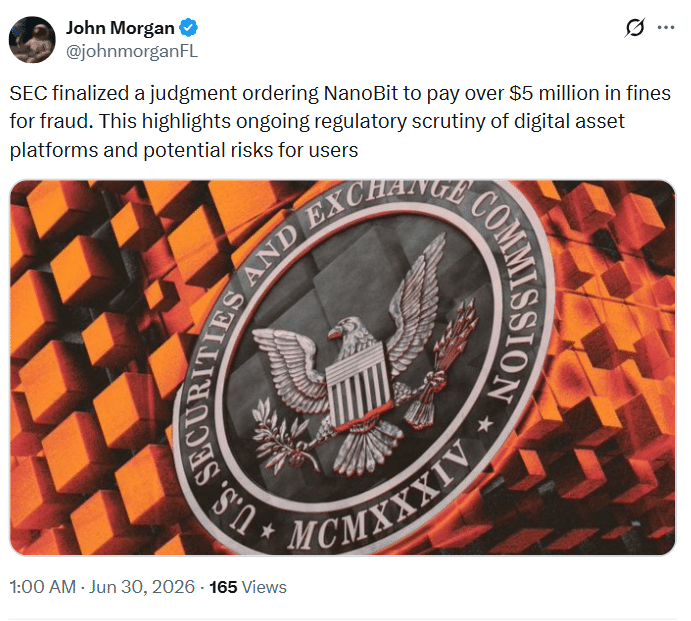
The US District Court for the Eastern District of New York entered the final judgment on June 16. The SEC announced the result on Monday. The ruling came nearly two years after the agency said NanoBit stole funds from investors between 2023 and 2024.
NanoBit Fraud Case Shows How Fake Professionals Targeted Investors
The court found that the defendants violated US securities laws. It also issued permanent injunctions against them. Those orders bar the defendants from engaging in the issuance, purchase, or sale of securities.
The SEC said NanoBit operators posed as financial professionals in WhatsApp groups. They allegedly used those groups to gain trust and persuade investors to deposit money. The funds were then diverted to scheme participants, according to the agency.
Source:
XAt least 18 investors were affected, the SEC said. The NanoBit fraud case shows how online investment scams can move from social media contact to private group chats. It also shows how fake platforms can use dashboards and registration claims to appear legitimate.
Court Orders $5.4 Million in Payments
The court ordered penalties, disgorgement, and interest across the defendants. NanoBit was ordered to pay a $1.18 million civil penalty. It was also ordered to return more than $532,000 in ill-gotten gains.
The company must also pay nearly $81,200 in prejudgment interest. Those amounts bring NanoBit’s total payment to nearly $1.8 million.
NanoBit affiliates Radiant Horizons, Sweet Karma, and Zhao Deli were each ordered to pay a $1.18 million fine. Jiajie Liu, described as one of the main orchestrators, was ordered to pay about $120,000 in penalties, disgorgement, and interest.
SEC Says Investors Were Recruited Online
The SEC’s September 2024 complaint said investors were first contacted on social media. Instagram was among the platforms named in the complaint. After that, investors were allegedly added to WhatsApp groups.
Inside those groups, the operators allegedly presented themselves as financial professionals. The SEC said the goal was to build trust before directing investors to NanoBit. The NanoBit fraud case focused heavily on those group-chat tactics.
Fake Dashboard Created Illusion of Returns
The SEC alleged that investors saw a dashboard showing rising returns. That dashboard allegedly gave the impression that their investments were growing. However, the agency said no real transactions happened on the NanoBit platform.
The complaint also said NanoBit promoted fake initial coin offerings. Those offers allegedly promised major returns. The SEC said the platform used those claims to draw in more investor funds.
False Broker Claim Added to the Scheme
NanoBit also allegedly claimed that NanobitUS Securities was an SEC-registered broker. The regulator said that claim was false. That detail was important because registration claims can make a platform look more credible to investors.
The SEC has often urged investors to verify firms and individuals before sending money. In this case, the agency said NanoBit used false information to support the scheme. The NanoBit fraud case now adds another court judgment tied to fake crypto investment activity.
Funds Allegedly Moved to Hong Kong Accounts
The SEC said investor funds did not stay on the platform for trading. Instead, they allegedly went to scheme participants. The agency said more than $2 million was wired to bank accounts in Hong Kong.
The regulator also alleged that hundreds of thousands of dollars in crypto assets were misappropriated. Investors who tried to withdraw funds were allegedly delayed. Some were asked to pay large fees.
Others were removed from WhatsApp groups after questioning NanoBit’s legitimacy. Those details show how pressure and isolation can be used in online investment scams.
Case Fits Wider SEC Fraud Actions
The NanoBit fraud case comes as the SEC continues to bring crypto fraud actions. The agency had already named NanoBit and CoinW6 among relationship investment scam cases in its 2024 enforcement review.
The SEC also charged Texas resident Nathan Fuller in May. That case involved an alleged $12.3 million AI crypto arbitrage scheme. The agency said investors were promised guaranteed returns from a trading robot.
In April, the SEC charged crypto executive Donald Basile and two companies he controlled. The agency said that case involved about $16 million raised through false claims linked to Bitcoin Latinum.
Investor Alerts Focus on Group Chats
The SEC has also warned investors about scams that begin in online groups. In a December 2025 investor alert, Investor.gov said people should not rely only on group-chat information when making investment decisions.
The agency also urged investors to check the background of anyone offering or selling investments. That warning matches the pattern described in the NanoBit complaint.
Conclusion
The NanoBit fraud case concluded in permanent injunctions and total payments of around $5.4 million. The SEC has scored another victory in a crypto fraud case, with the judgment.
For investors, the case signals to clear risks. Here the Fake dashboards, falsified claims of registration and pressure to join groups could all trigger alarm bells. The NanoBit fraud scheme also highlights why investors should validate platforms before sending money or crypto.
Appendix: Glossary of Key Terms
Prejudgment interest: Interest calculated on funds due prior to a definitive court ruling.
Permanent injunction: Court ruling prohibiting some actions the defendants may take in the future.
Fake trading platform: A platform that pretends to trade assets but does not carry out any real transactions.
WhatsApp investment scam: A fraudulent approach where criminals usually get the trust of it and later through these private chat groups, they urge for the investments from People or Participants.
Fake dashboard: As shown an example that is promising with a lot of profit generated, and will better persuade the investors they are growing what funds.
SEC registered broker: Broker legally registered with the SEC to offer or sell securities.
Frequently Asked Questions About NanoBit Fraud Case
1- What is NanoBit fraud?
An SEC action against NanoBit Limited, associated firms and persons claiming to run a bogus crypto investment site
2- The amount the defendants were ordered to pay?
The penalties include ones for disgorgement and pre-judgment interest, which total around $5.4 million ordered by the court.
3- What was the alleged scheme and how did it work?
The SEC claimed investors were solicited via social media, funneled into WhatsApp groups, presented with fictitious returns and pressured to fund at NanoBit.
4- Why is the case crucial for crypto investors?
It warns of dangers related to fake trading platforms, broker promise schemes, and investment offers in secret chat groups.
References
CoinTelegraph
Crypto/News
Read More:NanoBit Fraud Case Ends With SEC Win and $5.4M Court Payment Order">NanoBit Fraud Case Ends With SEC Win and $5.4M Court Payment Order