NEAR Protocol co-founder Illia Polosukhin has warned that widespread software vulnerabilities are creating a severe cybersecurity environment, calling for stronger AI-based defenses as NEAR t
NEAR Protocol co-founder Illia Polosukhin has warned that widespread software vulnerabilities are creating a severe cybersecurity environment, calling for stronger AI-based defenses as NEAR trades near $5 following a daily decline.
Summary
- NEAR co-founder Illia Polosukhin warned that software vulnerabilities are exposing internet services to growing security risks.
- Polosukhin identified PHP, TLS certificates, Node.js and LiteLLM while calling for improved AI-assisted defenses.
- Recent security advisories document vulnerabilities involving certificate handling, network requests and access to credentials.
- NEAR previously disclosed a $3.8 million Intents exploit in October, followed by service restoration and a compensation pledge.
- NEAR traded near $5.02 on October 22, while futures open interest declined 7.45% to $1.50 billion.
In an October 22 statement on X, Polosukhin described the situation as “Security Armageddon,” arguing that weaknesses in older software, authentication systems and widely used internet infrastructure are exposing applications to attacks.
NEAR Co-Founder Warns of Growing Software Security Risks
Polosukhin identified PHP-based systems, including WordPress websites, as areas of concern because of their widespread use and dependence on software components maintained over many years.
He pointed to malicious TLS certificates, Node.js and LiteLLM while warning that vulnerabilities affecting one software component can expose services that depend on it.
The concerns have documented technical examples. On September 24, PHP maintainers published a security advisory describing a memory-handling vulnerability involving specially constructed TLS certificate names.
The flaw affected specific versions of PHP’s OpenSSL integration and was addressed in subsequent maintenance releases. The advisory demonstrated a possible memory-access failure, without establishing widespread exploitation of WordPress websites.
Node.js networking software faced separate problems. On October 15, Undici maintainers disclosed vulnerabilities involving certificate validation, connection handling and denial-of-service conditions.
LiteLLM’s maintainers previously documented a vulnerability that could allow authenticated users to manipulate routing parameters and potentially expose provider credentials through server-side requests.
The advisories establish specific security weaknesses, although they do not independently confirm that the internet is experiencing a single coordinated attack.
Polosukhin Calls for AI Defenses and Cryptographic Authentication
Addressing potential responses, the co-founder argued that uncensored AI models could help security teams examine vulnerabilities and respond to threats more effectively.
He identified formal verification as another approach. The technique uses mathematical methods to test whether software satisfies precisely defined requirements, including conditions governing authorization and transaction handling.
However, Polosukhin said reliable AI systems remain necessary to translate software behavior into mathematical representations and check whether those representations accurately describe the original programs.
The comments follow NEAR’s October 19 formal verification research, which described an AI agent solving 672 mathematical proof problems at an estimated model cost of $111.85.
NEAR characterized the result as progress toward automated verification, while distinguishing mathematical benchmarks from proving the security of deployed applications.
Beyond software auditing, Polosukhin advocated replacing conventional API keys and access tokens with cryptographic authentication systems. He called for hosting arrangements capable of protecting software even from the infrastructure providers operating the underlying platforms.
His immediate recommendations focused on applying updates, patching vulnerable components and rotating credentials.
NEAR Security Push Follows October Intents Exploit
The warning follows a security incident involving NEAR Intents, the network’s cross-chain transaction infrastructure.
On October 1, NEAR Intents resumed operations following a $3.8 million exploit involving USDT on BNB Smart Chain.
Polosukhin said attackers exploited an interaction between Omni’s deposit and withdrawal infrastructure and an Intents smart contract.
The project’s SHIELD security system detected unusual activity, prompting operators to pause affected services. According to the co-founder, developers identified and corrected the vulnerability within an hour of detection.
He pledged full compensation for affected users and said the underlying NEAR blockchain and unrelated applications remained unaffected.
The incident provides a separate example of operational risks involving interconnected blockchain services. It does not establish a connection to the software vulnerabilities identified in his latest warning.
NEAR Price Holds Near $5 Despite Falling Futures Interest
NEAR traded around $5.02 at the time of writing, declining 3.61% over 24 hours despite gaining 8.21% during the preceding week.
As per crypto.news market data, the token retained a monthly gain of 13.21%, with its market capitalization near $6.57 billion and daily trading volume around $1.08 billion.
CoinGlass derivatives figures showed futures open interest falling 7.45% to $1.50 billion, while futures trading volume declined 6% to $2.56 billion.
The drop in outstanding contracts indicates reduced leveraged positioning, although open interest alone cannot determine whether traders closed long or short positions.
Spot exchange data recorded approximately $9.21 million in net outflows on October 22. Withdrawals can reduce tokens immediately available for exchange trading but do not independently establish investor accumulation.
Technical readings showed NEAR below its middle Bollinger Band at $5.066, with the Relative Strength Index at 52.88, compared with its moving average of 55.85.
Immediate support stood near $4.80, followed by $4.51. A recovery above $5.066 would bring resistance around $5.62 into focus.
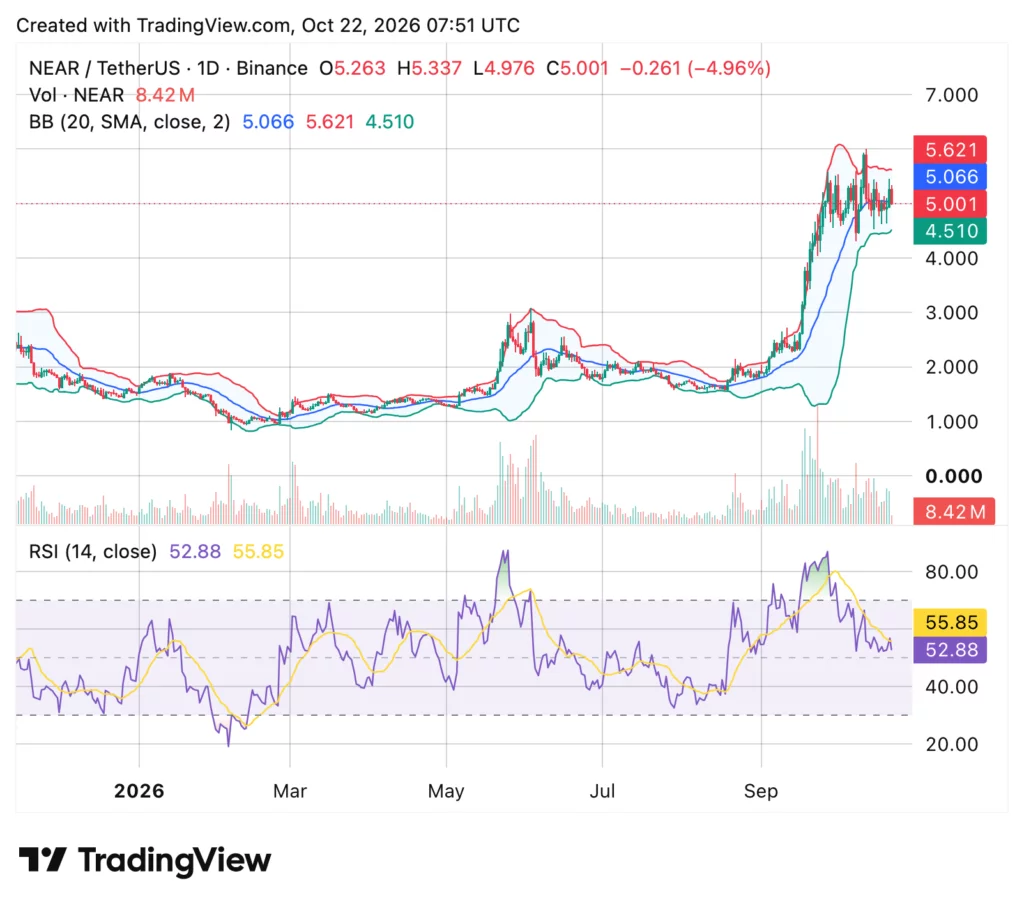
NEAR Protocol price chart, source: crypto.news
Analyst Rekt Capital identified a macro trading range between $3.79 and $5.97, while Michaël van de Poppe highlighted $4.30 as a support level he considered important for maintaining the token’s higher-low structure.
Disclosure: This article does not represent investment advice. The content and materials featured on this page are for educational purposes only.
Read more: China wants 61,800 Bitcoin seized in UK over $5.7B fraud
