The Nigerian telecoms industry, through the Nigerian Communications Commission (NCC), publishes monthly headline figures on phone line connections and national connectivity. In real terms, th
The Nigerian telecoms industry, through the Nigerian Communications Commission (NCC), publishes monthly headline figures on phone line connections and national connectivity. In real terms, these numbers, especially for telecom subscribers, reveal a difference between connected lines and active users.
Industry data as of August 2026 show that active mobile subscriptions now stand at 197.4 million, up from 195.1 million in July 2026 and 192.2 million in June 2026.
While the latest subscriber count puts Nigeria’s teledensity at 91.07%, industry data reveals a hidden reality: connected SIM cards do not equal connected individuals. Despite approaching 200 million subscriptions, tens of millions of unique Nigerians remain completely offline or digitally excluded.
Industry assessments from GSMA Intelligence show that Nigeria exhibits one of the highest levels of multiple SIM card ownership in Africa, with an average of 2.39 SIM cards per user (ranking second globally behind Indonesia). In reality, this means that 197.4 million active subscriptions are distributed across only roughly 68 million unique individuals.
To put it lucidly, the real figure shows that a large percentage of new gross subscriber additions are driven by existing users cycling through alternative or replacement SIMs rather than brand-new or first-time owners.
Also Read: Nigerians consume 1.76 million terabytes of data in August 2026, the highest yet.
What’s driving multiple SIM ownership?
Of a total of 220 million, the figure shows that about 160 million Nigerians (including minors) are without an active SIM card.
The SIM-NIN linkage directive by the NCC in 2024 revealed the reality of passive SIMs in the country. Under the policy, telecom operators were directed to disconnect unlinked SIMs in late 2024. Consequently, the number of active subscriptions dropped from 224.71 million in December 2023 to 154.9 million in September 2014.
That is a notable volume of inactive SIMs: 70 million.
A return to 197.4 million subscribers in August 2026 highlights a return to a system where one user holds and registers multiple lines.
Yet, here are the leading causes of the multi-SIM phenomenon across Nigeria.
The need to navigate network qualityissues: owing to frequent network outages, fibre cuts, power outages, and service blackouts, Nigerians rarely rely on a single operator. Carrying two or three SIMs, such as MTN for data and Airtel or Globacom for calls, is a typical survival strategy that the average Nigerian uses to ensure continuous connectivity for their lifestyle and business.
Navigating tariff adjustments: Nigerians actively manage telecom expenses by leveraging tariff and data plan differences across different networks. For instance, a subscriber might use one provider for cheap nighttime data bundles, another for low-cost intra-network voice calls, and a third for mobile money transactions.
As telecom companies regularly launch promotional tariffs, bonus data bundles, or welcome packages to attract new sign-ups, subscribers can cycle through temporary SIM cards to take advantage of these introductory rates.
Getting the best network signal strength in different locations: when MTN, Airtel or Globacom drops its signal in a rural area or at specific locations, the user can instantly switch to another to maintain a connection.
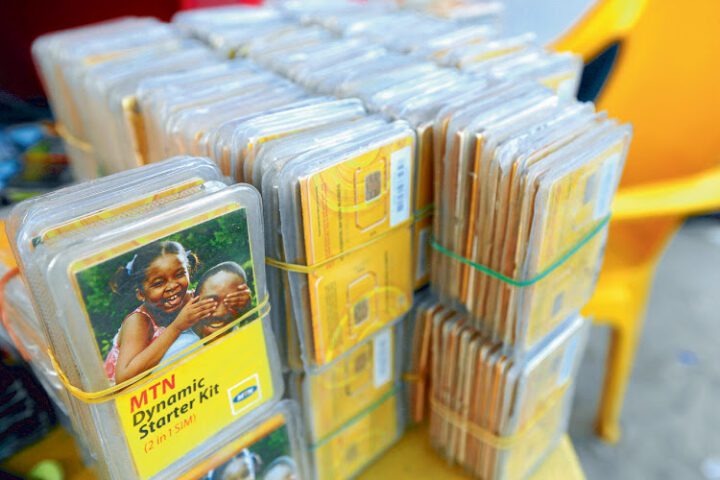 Packets of MTN Group Ltd. SIM cards sit for sale at a roadside kiosk in Lagos, Nigeria. Photographer: George Osodi/Bloomberg
The Dual-SIM smartphone dominance is a major contributor to multi-SIM usage. Unlike Western markets where single-SIM contract phones dominate, the sub-Saharan African phone market is flooded with affordable dual-SIM mobile devices. This smartphone model design directly encourages consumers to insert and maintain active lines from competing operators simultaneously.
For iPhones that don’t support dual SIMs, increased adoption of eSIM can fuel a surge in telephone lines.
However, multi-SIM usage is a double-edged sword for the Nigerian industry. While it provides consumers with flexibility, it serves as a major driver of inactive or ghost phone lines, creating significant challenges for network operators in trying to manage resources and maintain accurate subscriber metrics.
Recognising the implications, South Africa, under a proposed Government Gazette, has capped the number of mobile numbers an operator may assign to one subscriber at five. This forms a landmark measure to curb SIM swap fraud.
Nigeria faces a potential digital exclusion
Headline subscription numbers make Nigeria appear almost fully digitally connected, with various significant gaps.
Telecom infrastructure remains heavily concentrated in urban commercial centres like Lagos, FCT Abuja, and Port Harcourt, making rural communities frequently suffer from zero network coverage or limited 2G-only connections.
 Sim cards
While voice teledensity is high on paper, broadband penetration sits significantly lower at 58.22%. It becomes evident that millions of Nigerians cannot afford internet-enabled smartphones, leaving them cut off from the broader digital economy despite owning basic voice feature phones.
A recent GSMA report titled The State of Mobile Internet Connectivity 2026 revealed that 140 million Nigerians were in the mobile internet usage gap as of 2025, showing that these people lived under mobile broadband coverage but did not use mobile internet services.
Also Read: Nigeria is phasing out 3G, while 2G is yet alive, and 5G lags below 5%.