New Clarity Act Draft Tweaks DeFi Rules Ahead of Key Senate Vote
Key Facts A revised draft of the Digital Asset Market Clarity Act adjusts provisions covering decentralized finance and credit unions. The bill, formally H.R. 3633, has already cleared the Ho
A
AnonymousCryptoCompass newsroom
September 13, 2026
3 min read
NEWS
CryptoCompass editorial visual for policy coverage.
Key Facts
A revised draft of the Digital Asset Market Clarity Act adjusts provisions covering decentralized finance and credit unions.
The bill, formally H.R. 3633, has already cleared the House and awaits Senate Banking Committee action.
The Senate Banking Committee has previously advanced the bill in a bipartisan vote.
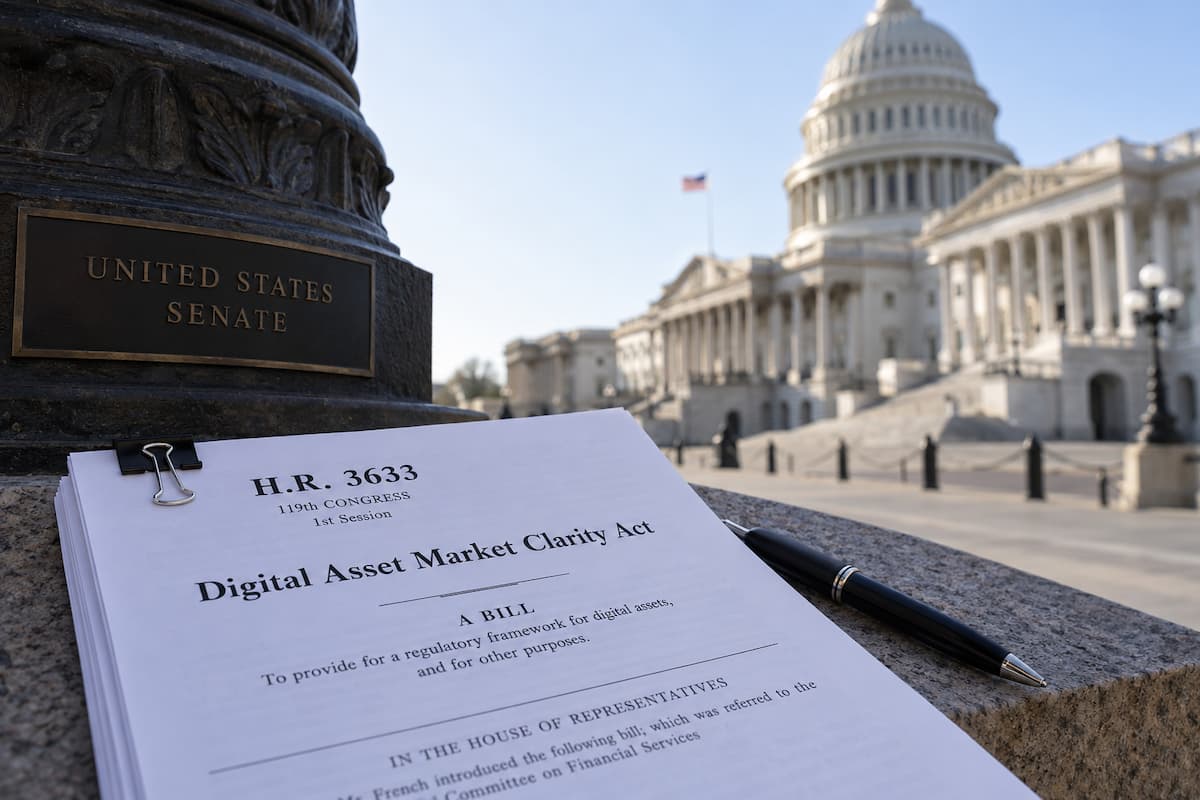
A new draft of the Digital Asset Market Clarity Act, the market-structure bill formally numbered H.R. 3633, has adjusted its treatment of decentralized finance protocols and credit unions ahead of a Senate Banking Committee vote. The bill’s core purpose has not changed since it passed the House: assign clear jurisdiction between the SEC and the CFTC over digital assets, something the two agencies have effectively litigated piecemeal, enforcement action by enforcement action, for most of the last decade.
Why DeFi Is the Hardest Part of This Bill to Write
Securities and commodities law was built around the assumption that a regulated entity, an exchange, a broker, a clearing firm, is a company with an address and an officer who can be held accountable. Decentralized finance protocols are often just code, deployed by a team that may have since dissolved its formal legal structure or handed governance to a decentralized organization. Writing a statute that decides when such a protocol counts as a regulated activity, and when it is simply open-source software nobody controls, is not a drafting detail; it is the single hardest conceptual problem the entire bill has to solve, and it is exactly the section getting revised again in this draft.
The committee’s own section-by-section summary and its published explainer on the bill’s intent both frame the legislation as protecting registered activity while leaving room for permissionless software, a distinction that sounds clean in a press release and is genuinely difficult to write into enforceable statutory text. Credit unions entered the draft for a narrower reason: as more of them explore offering crypto custody or related services to members, lawmakers have had to decide whether credit union regulators or the new digital-asset framework governs that activity.
What the Senate Vote Actually Decides
The Senate Banking Committee has already advanced an earlier version of the bill in a bipartisan committee vote, which means the coming vote is not the bill’s first test but a checkpoint on a text that has already been revised once to get this far. A committee vote on a further-amended draft does not send the bill to the president; it sends a specific version of the text to the full Senate floor, where further amendments are still possible. The detail worth tracking is not whether the bill advances, which committees with bipartisan sponsorship usually manage, but exactly how the DeFi and credit union language reads once it clears committee, since that text is what industry participants and regulators will actually have to operate under if it eventually becomes law.
BitMEX kurucusu Arthur Hayes, Ethereum (ETH), Ethena (ENA), Uniswap (UNI) ve diğer bazı altcoinlerde kar aldığını açıkladı. Makroekonomik gelişmeleri ve jeopolitik riskleri değerlendiren Haye
TLDR: The LIBRA scandal criminal case against Javier Milei, Karina Milei, Hayden Davis, and eight others was dismissed after the judge found no offense established. Judge Marcelo Martínez de
Is NEAR sliding toward a breakdown, or just shaking out weak hands before the next run? That's the real tension in this NEAR Protocol price prediction, written on Oct 24, 2026 at 11:30 UTC wi