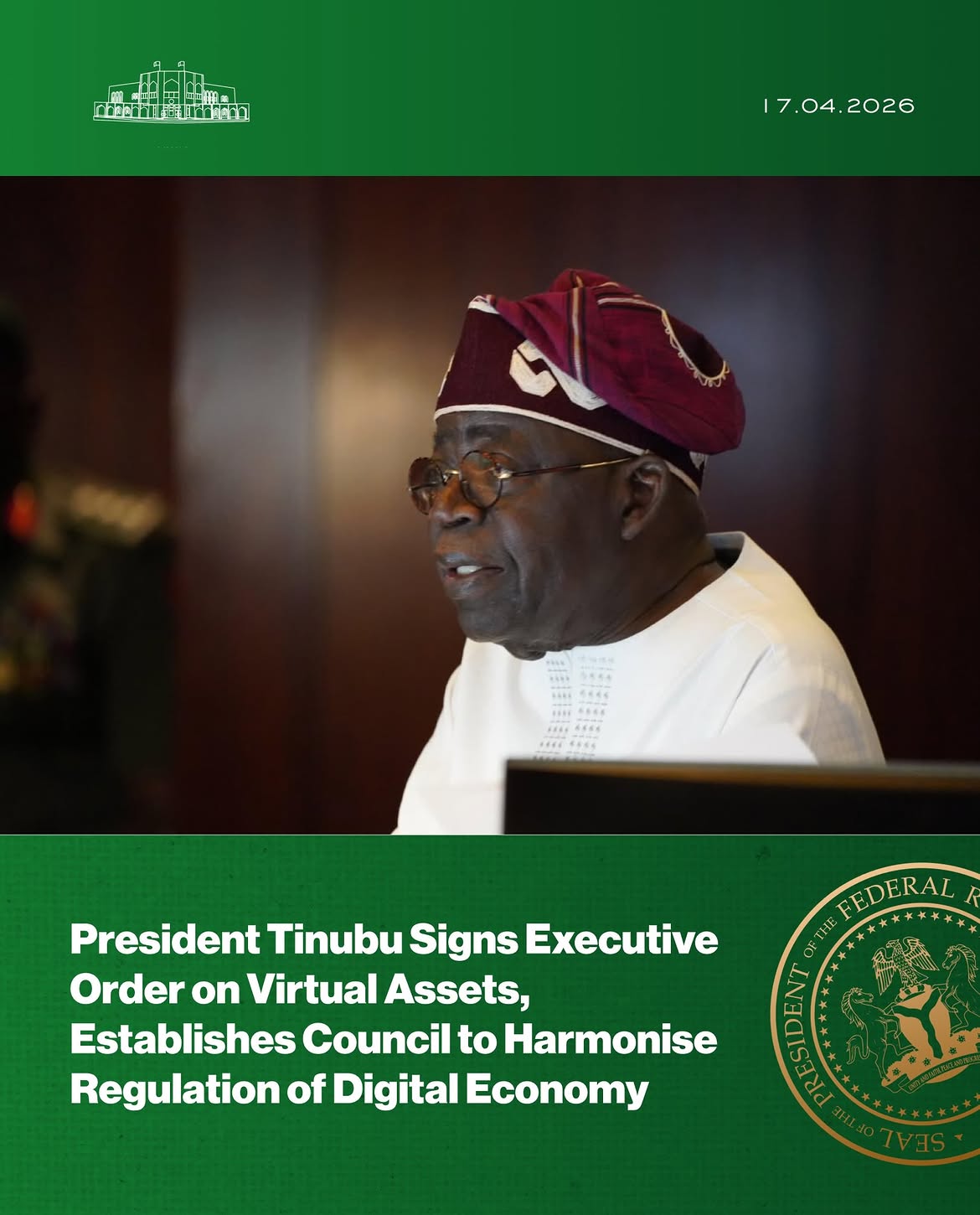
Nigeria Crypto Regulation Begins New Era With Tinubu's Order
Nigerian President Tinubu Signs Executive Order to Regulate For Crypt Nigerian President Bola Tinubu has signed the Presidential Executive Order on Virtual Assets Coordination, 2026, called N
A
AnonymousCryptoCompass newsroom
July 18, 2026
4 min read
NEWS
Hero article visual / chart / editorial image
CryptoCompass editorial visual for policy coverage.
Nigerian President Tinubu Signs Executive Order to Regulate For Crypt
Nigerian President Bola Tinubu has signed the Presidential Executive Order on Virtual Assets Coordination, 2026, called Nigeria Crypto Regulation, aimed at regulating virtual assets, taking effect immediately. Signed pursuant to Section 5 of the 1999 Constitution (as amended), the order builds a new oversight framework to fix a regulatory environment officials call fragmented while cracking down on operators who never registered with any agency.
Officials laid out a clear rationale for the order:
Goal: Protect citizens from fraud, curb money laundering, and prevent terrorism financing, without adding bureaucracy or removing existing agencies' independence.
The problem: Bayo Onanuga, special adviser to the president on information and strategy, said agencies had been operating in silos, overlapping in some areas and leaving gaps in others, exposing the country to risk.
The cost: Fraudulent operators, he added, had exploited those gaps, in some cases wiping out family savings.
How It Will Regulate Assets With New regulation
A new Virtual Asset Council becomes the chief policymaking and coordinating body for token oversight. The Central Bank of Nigeria (CBN) chairs it, with it's Revenue Service and Securities and Exchange Commission (SEC ) as vice chairs. The Nigerian Financial Intelligence Unit and the Office of the National Security Adviser also sit on the council. A new virtual asset office, housed inside the CBN, will handle day-to-day operations and share information across agencies on one integrated platform.
New Rules for Crypto Companies, Exchanges, and Digital Assets
Onanuga said the order creates no new agency and strips no existing agency of its duties. Here's how responsibilities split:
SEC Nigeria: Oversees securities-linked token activity and registration.
Central Bank of Nigeria (CBN): Manages payments, settlements, and custody for non-security virtual assets.
Unclear jurisdiction: Where regulatory responsibility is unclear or overlapping, the Virtual Asset Council will be determine which agency has authority.
Regulatory sandbox: The CBN plans to let token exchanges and the blockchain startups test products under supervision before public release.
Revenue Service: Preparing a dedicated tax policy to encourage voluntary compliance.
Nigeria isn't acting alone here. Other African nations are following a similar path, with Zimbabwe recently enacting its own token oversight law that shifts the region away from outright bans and toward formal registration.
Market Impact
It has one of Africa's largest token-using populations, so clearer CBN and SEC rules could steady an industry that has run on scattered, sometimes contradictory guidance. Formal Nigeria crypto regulation and a tax framework may draw more institutional participation, though compliance costs could squeeze smaller blockchain startups first. This mirrors a wider continental shift, where regulatory sandboxes are spreading across African crypto markets as governments move from restriction toward structured oversight.
What This Executive Order Means for Digital Assets Industry
Timeline: The Virtual Asset Council has 30 days to build a rollout framework for Nigeria crypto regulation.
Long-term strategy: The government is finalizing a broader virtual assets white paper covering its long-term approach to the sector.
For crypto investors: A coordinated council could mean stronger protection and fewer unregistered operators. Investors managing their own holdings may also want to review secure wallets in Nigeria as formal oversight takes shape.
For crypto businesses: Sandbox access and defined tax rules offer a path to operate with more certainty, provided they meet the new compliance bar.
Conclusion
The order does not overhaul Nigeria crypto regulation, but it forces them to coordinate instead of working in silos. Whether that builds real investor confidence depends on how fast the Virtual Asset Council turns its 30-day mandate into working rules.
Disclaimer
This article is for educational and informational purposes only and should not be considered financial or investment advice. Always conduct your own research before making investment decisions.
Bits of Gold, described as Israel's largest crypto broker, was hit by a data breach reportedly affecting 200,000 customers, raising fresh concerns about how digital-asset platforms safeguard
This Rollblock price prediction starts with a number that undermines any confident reading of RBLK's chart: just $5.06 in daily trading volume. At that level, a single small trade can swing t
ETH price has slipped in recent weeks. Meanwhile, activity on the Ethereum network just hit some of its strongest levels in months. Daily transactions and new wallet addresses are both climbi