At a time when the world is talking about the evolution of 6G and what it’s set to unfold, Nigeria’s 5G network and nationwide coverage are still considered to be below expected performance.
At a time when the world is talking about the evolution of 6G and what it’s set to unfold, Nigeria’s 5G network and nationwide coverage are still considered to be below expected performance. A scenario where demand for high-speed internet massively outweighs its supply, leaving serious gaps.
The latest Quality of Experience (QoE) joint report by the Nigerian Communications Commission (NCC) and Ookla, covering the second quarter of 2026, revealed the continued struggles with 5G connectivity in Nigeria. Specifically, the data tracked real-world mobile network experiences across Nigeria between June 2025 and May 2026.
At the centre of the findings is one disturbing theme: that millions of 5G-enabled smartphones are still unconnected to an available 5G network. In other cases, enabled devices fall back to 3G/4G networks when reaching a higher network becomes impossible in uncovered areas.

The findings are significant for two reasons.
One. The demand for a quality internet experience is attributed to the latest smartphone device interface, HD pictures and videos, large files that require fast upload and download speeds and lengthy time spent on the internet. The 5G network is still below par when Nigeria is experiencing the biggest advancement and revolution in telecoms history.
The advancement is further proven as industry data shows that Nigerian internet users used 1.5 million terabytes of data in May 2026, the highest yet. More than just a statistic, this reflects a testament to how users are turning the internet space into their home.
Two. Despite affordability challenges, smartphone adoption continues to grow. With the rise of mobile and digital banking, online skills acquisition, and the push for inclusivity, more Nigerians now own smartphones. The daily adoption of 5G-enabled devices, championed by new phone models, is also on the rise.

As of May 2026, 157.4 million Nigerians are connected to the internet, showing that 83% of phone users can access the internet. However, only 4.49% are connected to the 5G network, with others scattered around 2G, 3G and 4G, showing how the year-long analysis by NCC-Ookla corroborates with industry data.
While users’ digital experience is shaped by network access, millions of Nigerians remain underserved, leaving them to battle with throttling and delays when making fund transfers or streaming their favourite videos on Netflix and YouTube.
5G’s concentration on Lagos, FCT and Port Harcourt
Nigeria’s issue with the fifth-generation network is not only nationwide coverage but also a cohesive concentration in the top three cities of the country. It shows that the gap isn’t only rural-urban, but some urban areas experience mere basic connections.
Lagos, Abuja and Port Harcourt were identified as Nigerian cities with access to quality 5G services. The report noted that the network is 30% to 40% stronger than in other areas. In a situation where some urban areas are short of high-speed internet, what becomes the fate of rural settlements?
Meanwhile, the top three cities are not having it all. In fact, half of qualified devices for high-speed networks are left unconnected, showing a drastic gap and how Nigeria is far behind in terms of reliable internet connection at a time when it matters.
“In major urban centres, more than half of the time a 5G-ready phone is active, it falls back to 4G or legacy connections due to network density limitations,” part of the report reads.

Specifically, active 5G usage among capable devices is approximately 46.0% in Lagos, while Abuja has just passed the halfway mark at 53.1%.
Nigeria’s bulk of quality internet sits in 3 of 37 states (plus FCT), showing how it’s been difficult to spread the 5G network nationwide. For now, only MTN Nigeria and Airtel Nigeria are carriers of this network. Mafab, the third licensed entity for the high-speed network, is still unavailable, and no one knows when it will return.
Also Read: Nigeria’s rural network speed improved by 47.5% in 6 months.
Way forward
At a time when network outages and slow internet experience are part of Nigerian internet users’ complaints, 5G is expected to be a change-maker. Its availability gaps owing to network density limitations and infrastructure gaps still drag on.
A leading overemphasised solution is clearing the network spectrum for 5G to operate. The fact that devices are still connected to low-end 2G and 3G networks leaves emerging ones in a competitive phase. According to the report, Nigerians need to phase out small networks for bigger ones.
However, the phase-out should be gradual but intentional. NCC and other relevant regulators should set a date for the final phase-out of 2G and 3G networks.
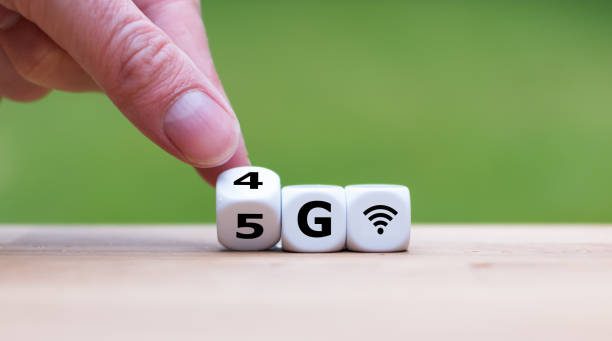
Symbol of the change from 4G to 5G
Also, infrastructure upgrades should be more intense. While telecom operators have reported building 5G network towers and upgrading others, the rate of these investments is below demand. Operators should know that increased revenue from data means a need for a high-speed network.
Network sharing is also encouraged. This is done through a share of baseline physical structures such as towers and fibre links to eliminate both urban and rural coverage gaps.
Nigeria’s digital economy and technological advancement are unavoidably dependent on internet speed and network reliability. This calls for a 5G network to meet these rising demands from various institutions and an increasing user base.
