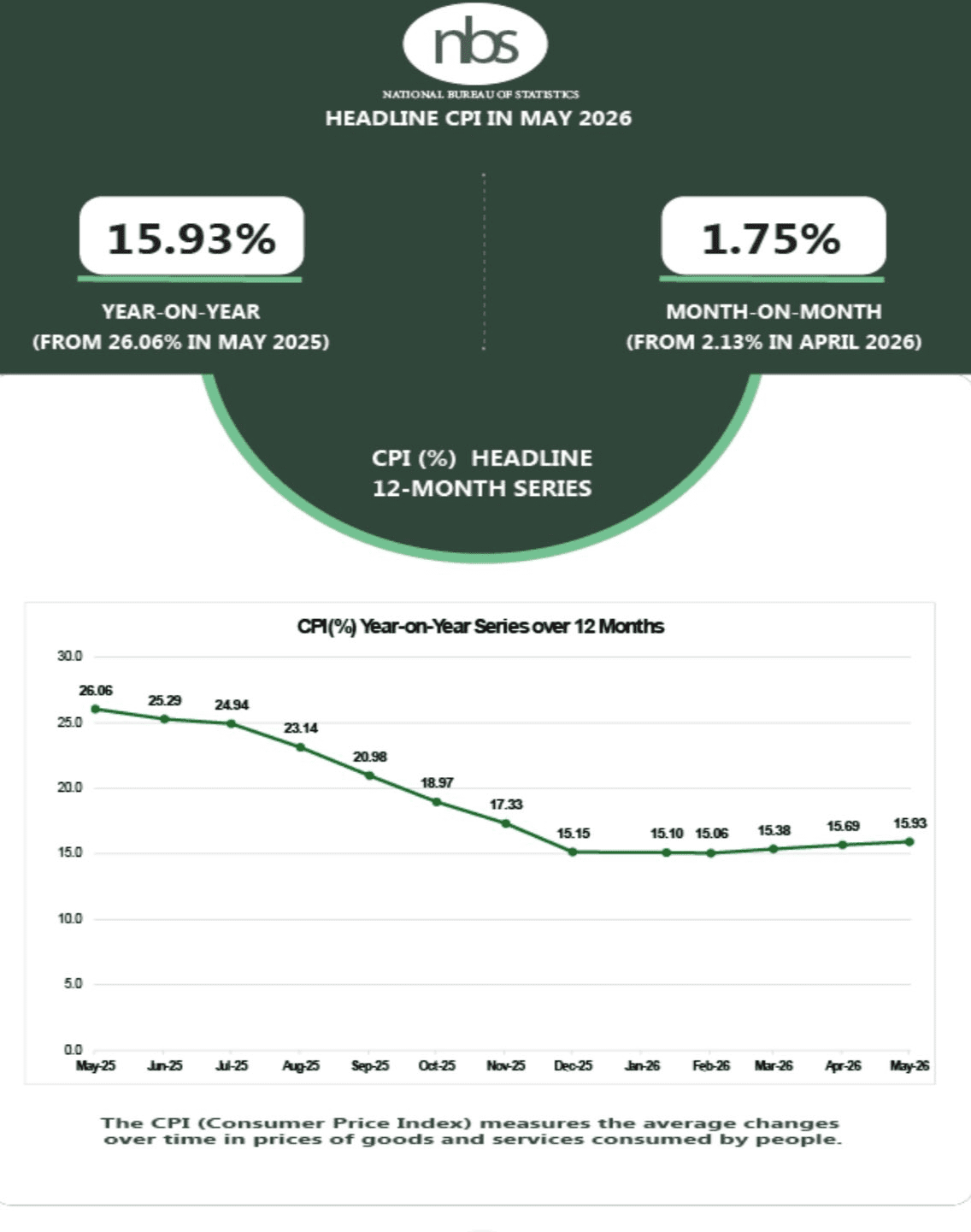
Nigeria’s headline inflation rate rose to 15.93% year-on-year in May 2026, an increase from 15.69% in April, according to the Consumer Price Index report released by the National Bureau of St
Nigeria’s headline inflation rate rose to 15.93% year-on-year in May 2026, an increase from 15.69% in April, according to the Consumer Price Index report released by the National Bureau of Statistics.
This has increased slightly by 0.24 percentage points, ending a decline that started in May 2025 when the rate was 26.06%. However, prices rose more slowly in May compared to April. The monthly rate dropped to 1.75% from 2.13% in April, indicating a slower pace of price increases.
To understand what this means, simply: year-on-year inflation tells you how much more expensive things are compared to the same time last year. Monthly inflation tells you how fast prices moved in the most recent month. Both numbers matter, and they are telling slightly different stories right now.
Food continues to be a significant concern for many. In May, the monthly food inflation rate decreased to 2.98%, down from 3.63% in April, which is a welcome change. However, on a year-on-year basis, food inflation remains high at 16.96%.
This rate is nearly double what it was two years ago and has decreased from 24.55% in May 2025. The increase in food prices is primarily driven by staples that are central to the daily diets of Nigerians, including onions, maize, egusi, yam, cassava flour, crayfish, peppers, tomatoes, plantains, and cowpeas.
Residents in urban areas are experiencing a rise in prices that is slightly faster than in rural communities. Year on year, urban inflation stands at 16.07%, while rural inflation is at 15.60%. Every month, urban prices have increased by 1.99%, compared to a 1.17% rise in rural areas. This suggests that living in the city is becoming increasingly more expensive at a quicker rate than in the countryside.

The states where inflation is hitting hardest
The national average inflation rate conceals considerable differences among states. Year-on-year, Yobe recorded the highest inflation at 24.94%, followed by Anambra at 23.29% and Sokoto at 22.60%. In contrast, Niger State had the lowest rate at 3.07%, with Plateau and Edo states at 7.10% and 7.73%, respectively.
Food increase tells an even starker story at the state level. Adamawa recorded the highest food inflation year on year at 29.62%, followed by Kwara at 28.47% and Rivers at 28.40%. Borno was the only state where food prices actually fell on a year-on-year basis, recording -6.53%.

Beyond food, the categories contributing most to the overall increase include restaurants and accommodation services, transport, housing costs, utilities, fuel, and rent, which together reflect the broader cost pressures squeezing Nigerian households every month.
The NBS data reveals that, excluding food and energy prices for a clearer view of price trends, the year-on-year increase was 16.82% in May, a decrease from 24.92% in May 2025. This notable drop indicates that the main factors driving increases have significantly eased over the past year, despite some monthly increases still occurring.
Also read: How to beat inflation in Nigeria (2026), the “New Maths” of savings by FairMoney