An Ookla and Nigerian Communications Commission (NCC) analytical report from March to August 2026 shows that in rural Nigerian communities where people have active connections and run speed t
An Ookla and Nigerian Communications Commission (NCC) analytical report from March to August 2026 shows that in rural Nigerian communities where people have active connections and run speed tests, download speeds are nearly identical to urban speeds. The findings contrast with most studies, which report that rural internet is slower than city internet.
According to the joint analytical report covering Q3 2026 quality of experience (QoE) studies, rural median download speed increased to 17.8 megabits per second (Mbps) in August 2026, up from 16.4 Mbps in March. At 19.7 Mbps in August, urban median download speed is now 11% ahead of rural, but the latter keeps improving.
For this report, Ookla used a different methodology where it classified urban and rural based on test density. This means the rural figures measure areas where users already have enough connectivity and smartphone penetration to run speed tests and not communities outside network coverage.

A subscriber in Rural Nigeria
The analysis presented the notion that the real digital divide in Nigeria is more than just about how fast rural networks run when connected. It is about which network active users in rural Nigeria rely on and the extent to which they have access to 4G and 5G networks.
Also Read: 48% of 5G-capable devices in Lagos and Abuja now connect to 5G – Ookla/NCC report says.
Urban vs Rural: How operators feared
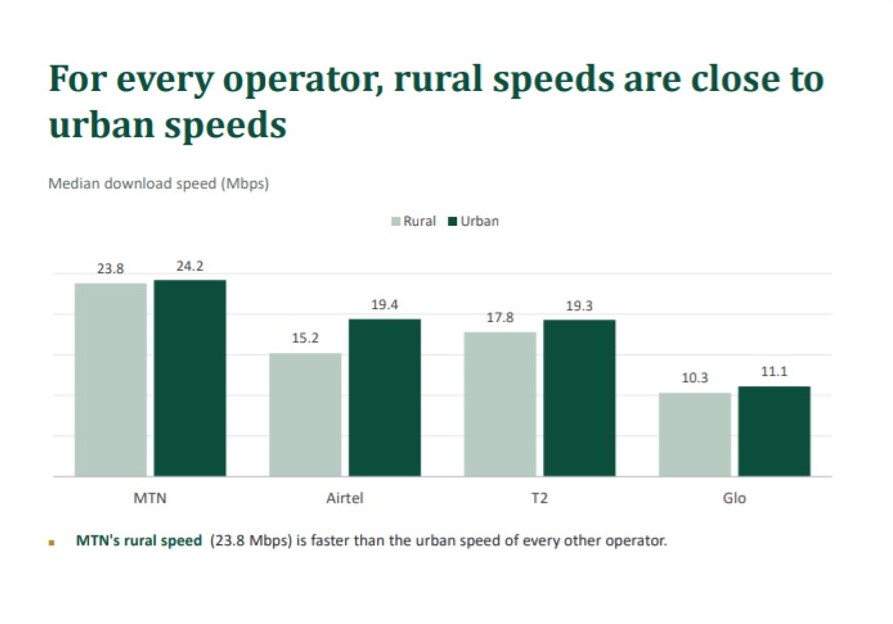
For the period, the report analysed 984,172 speed tests, split almost evenly between urban and rural areas, from which MTN led with 23.8 Mbps median download speed in rural areas compared to 24.2 Mbps in cities. In fact, MTN’s rural network speed outperformed the urban speeds of every rival operator.
Airtel is second, balancing 19.4 Mbps urban and 15.2 Mbps rural download speeds. T2 nearly matched Airtel, as its median download speed was 19.3 Mbps urban and 17.8 Mbps rural.
T2 median download speeds nearly match Airtel, making it also dependable for streaming and browsing. However, its high latency (59 / 69 ms in urban and rural) indicates possible network delays for remote workers, video callers, and small businesses sending large files.
IM: Ookla X NCC
Globacom sits at the end with a median download speed of 11.1 Mbps in urban areas and 10.3 Mbps in rural areas. However, it maintains competitive latency (32 / 34 ms) and moderate upload capacity (4.3 to 4.4 Mbps).
Nigerians depend largely on 4G LTE
The report reveals that 4G LTE continues to carry the nation as its primary network source, delivering 14 to 18 Mbps in cities and 10 to 17 Mbps in rural communities at roughly 30 ms latency.
On the other hand, 5G maintains its top spot after previously surging past 200 Mbps in several months of 2025 in both urban and rural test areas before moderating after March 2026. Recall that a similar report revealed that more 5G-capable devices are actively connecting to 5G networks in Nigeria’s top cities, as the share of 5G-capable devices running on 5G increased from 31.4% to 52.3% in Abuja (FCT) and from 27.5% to 43.6% in Lagos.
The data validates that despite financial constraints due to unfavourable economic conditions, Nigerians are not only penetrating the internet but also adopting 5G-enabled devices as they continue to demand high-speed internet.

Meanwhile, 3G continues to move nearer to the exit door from all angles, as the report stated that it keeps lingering at single-digit speeds that struggle with modern video and payment apps.
Overall, Nigeria’s networks have proven they can deliver near-urban speeds in connected rural towns. The report noted that the next step is accelerating 3G’s exit to free up space for 4G and 5G coverage into the unmeasured spaces left off the map.
Also Read: Nigeria’s smartphone sales fall by 44% in Q3 2026 over declining purchasing power – report.
