Israel’s prime minister Benjamin Netanyahu has floated cryptocurrency as part of a contingency plan for potential international banking sanctions, drawing criticism from Nobel Prize winners,
Israel’s prime minister Benjamin Netanyahu has floated cryptocurrency as part of a contingency plan for potential international banking sanctions, drawing criticism from Nobel Prize winners, economists, and one of his main election rivals.
Netanyahu last week issued a warning that the country should prepare for the possibility of wider economic and banking sanctions.
Related: Cathie Wood sells Bitcoin, buys $5.2 million of sinking stock
The warning comes weeks after the UK announced plans to ban imports from illegal Israeli settlements and introduce broader powers targeting businesses and services linked to settlement expansion. The measures were not a blanket banking embargo on Israel.
In an Oct. 23 interview, the prime mininster said that cryptocurrency could play a role in what he described as a “bypass economy” and added he had requested planning around blockchain technology. No official token or operating system has been announced as yet to support the plan.
Nobel winners reject Netanyahu’s crypto workaround
A group of 109 economists, executives, and former officials, including 2025 Nobel economics laureate Joel Mokyr and 2004 Nobel chemistry laureate Aaron Ciechanover, pushed back on the proposal.
The group warned in a letter that comprehensive banking sanctions, if imposed, could damage foreign investment, employment, and Israel’s ability to fund public services and security.
The letter was even blunter about the crypto proposal, saying what the prime minister is offering is "a bizarre solution commonly used by criminal organizations, which will accomplish absolutely nothing."
The country's central bank, meanwhile, has dismissed the notion that cryptocurrency could simply bypass international sanctions. The bank essentially argued that maintaining access to major trading partners and financial systems remains critical to advancing Israel's financial foundation.
Popular on TheStreet Roundtable:
Tomer Sharoni is the CEO at Addressable, an Israeli blockchain intelligence company, who warned that crypto is "not a sanctions-evasion mechanism."
Crypto will not solve the problem if Israel becomes a "financial pariah," he said. Crypto creates a parallel financial system that allows users to be identified, as was the case with Russia and Iran, he added.
"Crypto infrastructure is critical to Israel’s innovation and competitiveness, but it should be developed as a growth engine connecting us to the global economy, not as a planned escape route from sanctions," Sharoni remarked.
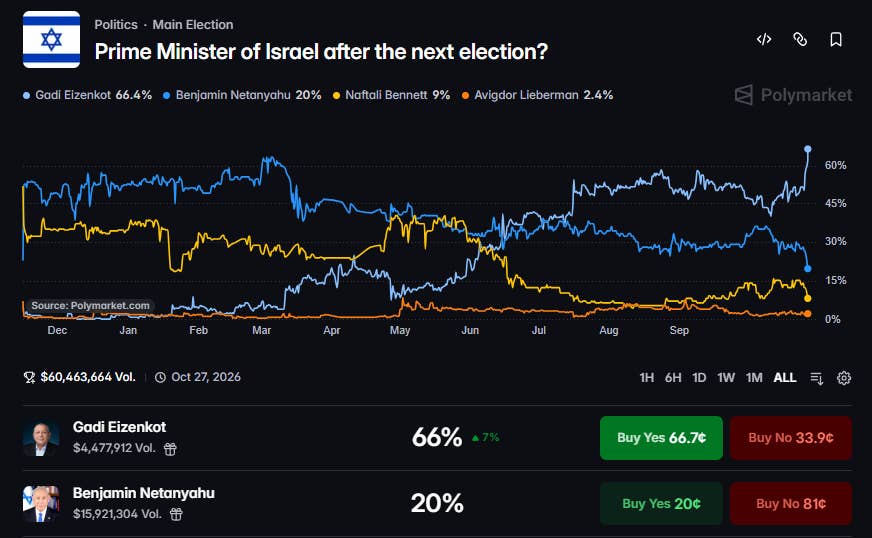
Polymarket gives Eisenkot the edge
The citizens of Israel are voting today for the national election.
Polls on prediction markets have favored former military chief Gadi Eisenkot to become Israel’s next prime minister amid the ongoing tensions with Iran under Netanyahu.
Eisenkot has also attacked Netanyahu’s crypto proposal.
“The BibiCoin vision is a threat to national security,” Eisenkot wrote in an X post Oct. 24.
He questioned how Israeli technology companies would receive international payments and investment, or how a foreign company such as Google could acquire an Israeli business if conventional banking relationships were disrupted.
His argument goes beyond whether crypto payments technically work. The bigger question is whether cryptocurrency could replace the banking, investment and commercial relationships that connect Israel’s economy to the rest of the world.
Users on Polymarket, the crypto-based prediction market platform, think there is a 66% chance of Eisenkot winning the election. In contract, only 20% think Netanyahu will win. The market had generated about $60.4 million in trading volume as of Oct. 27.
Source:
Polymarket
The prices represent traders’ expectations, not election results or seat projections. The contract resolves based on who is officially appointed and sworn in as prime minister after the election.
The voters' turnout has been unusually high in Israel. The Central Elections Committee said 44.9% of voters had cast ballots by 2 p.m., up from 38.9% at the same point in 2022 and the highest level at that hour since at least 1973.
Related: XRP rises as Ripple scores major U.S. win