Most people experience DeFi like it’s a website. A button. A swap. A chart. A vibe. And for a long time, that’s all it needs to be — until the day you realize something uncomfortable: Even th
Most people experience DeFi like it’s a website.
A button.A swap.A chart.A vibe.
And for a long time, that’s all it needs to be — until the day you realize something uncomfortable:
Even the strongest-looking DeFi product still depends on infrastructure you don’t control.
If the node is slow, you’re slow.If the provider rate-limits you, you become “down.”If the service changes behavior, your system becomes unpredictable overnight.If something breaks somewhere far away, your users blame you.
And that’s when you stop thinking like “we’re building an app.”
You start thinking like: we’re building a machine.
The problem we decided to solve
Crosswalk is not built for hype.
We’re building a real routing engine. Real scoring. Real automation. Real systems. The kind of thing you can’t fake by putting a nice UI on top.
And when you build systems like that, you eventually hit a wall:
You can’t scale trust on top of infrastructure you don’t own.
So we created NodeZero — our own Solana RPC node on our own workstation, behind our own gateway, with our own rules.
Not because it’s trendy.
Because it’s the only way to turn DeFi into something stable enough to build on.
What is NodeZero… in human words?
:)
Imagine Solana is a massive city.
A public RPC is like a public information desk.You walk up, ask questions, and get answers:
- “What’s the latest block?”
- “Did this transaction happen?”
- “What’s the balance of this wallet?”
Now imagine that desk is shared by thousands of people.
Sometimes it’s fast.
Sometimes it’s crowded.
Sometimes the clerk decides you’ve asked too many questions and sends you away.
That’s fine for casual browsing.
But when you’re building real infrastructure, you need your own desk.
Your own office.Your own rules.
That’s NodeZero.
The day it went live didn’t look like a “launch”
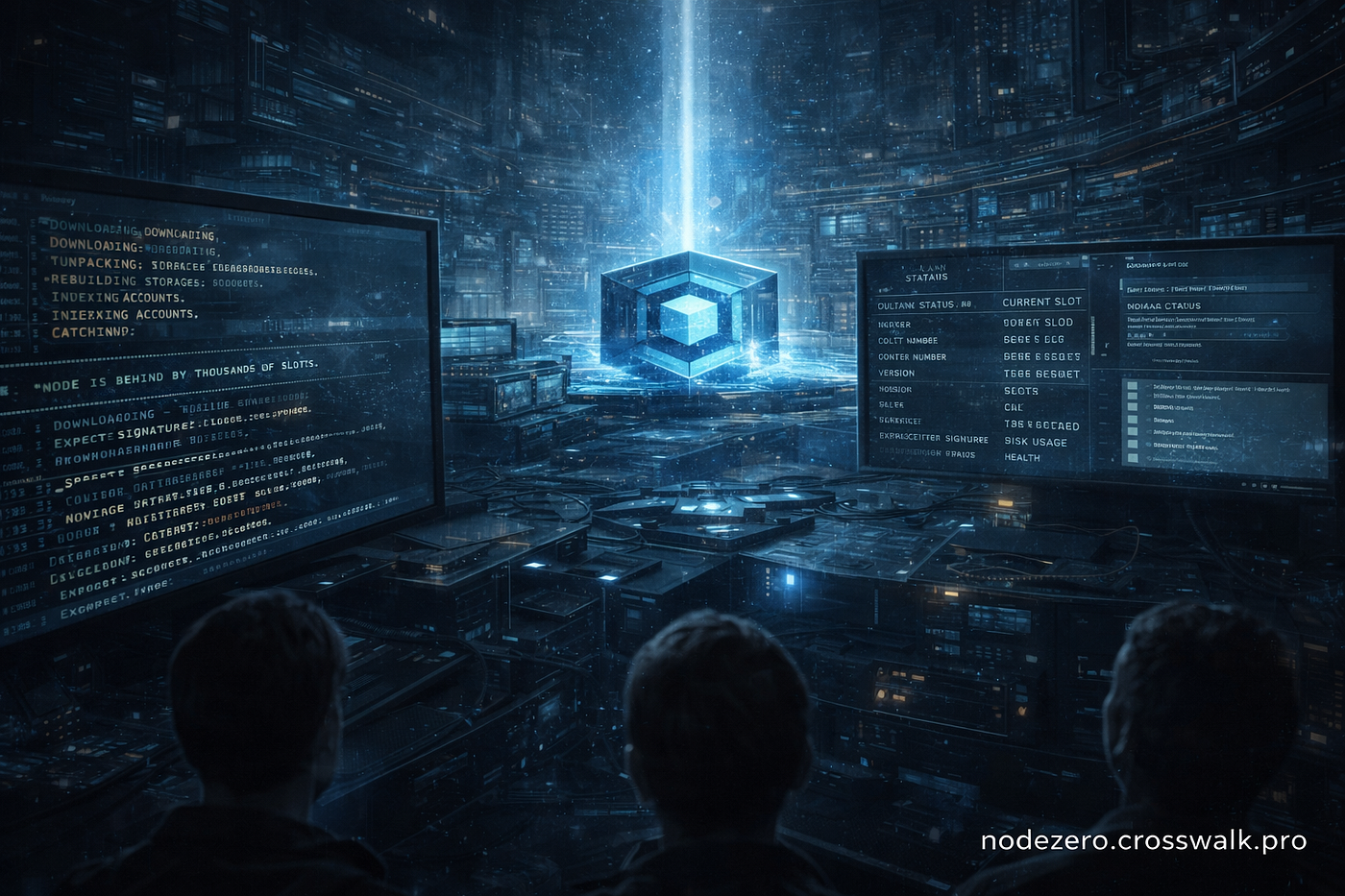
It looked like logs.
It looked like waiting.
It looked like the machine doing work that doesn’t care if you’re excited.
Downloading snapshots.Unpacking.Rebuilding storages.Indexing accounts.Catching up.
At one moment it tells you:
“Node is behind by thousands of slots.”
And if you don’t know what you’re looking at, it feels like failure.
But it’s not.
It’s the node waking up and sprinting to catch the network.
That moment is important because it teaches you the difference between:
“it runs” and “it runs under reality.”
The part nobody talks about: storage is a personality test
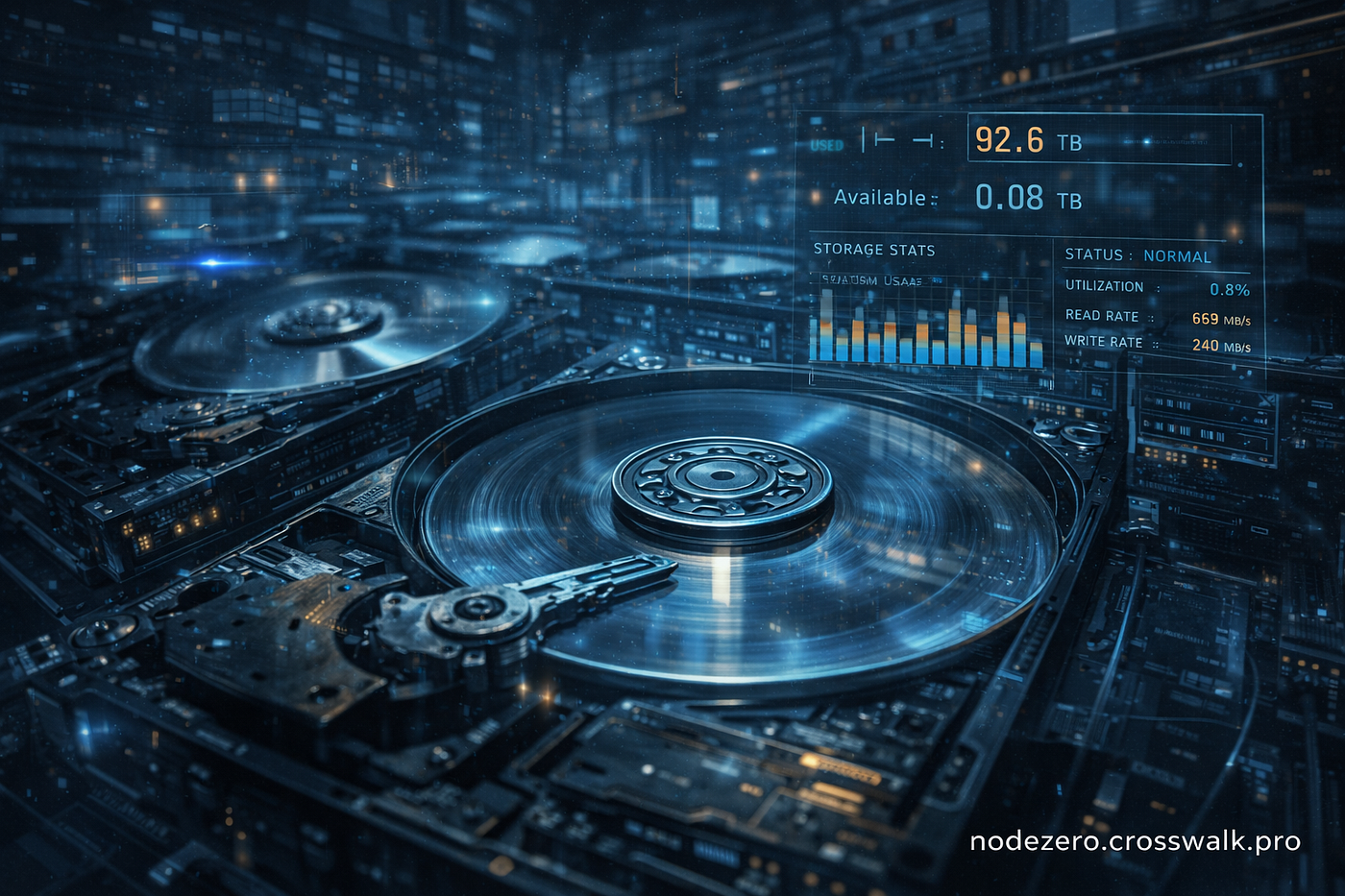
If you’ve never run a chain node before, here’s what surprises you:
It’s not “download a program and press start.”
It’s constant pressure:
- disks filling up
- data moving constantly
- bursts of heavy IO
- long rebuild phases
- heat and noise
- pruning and retention decisions
- mistakes that cost hours
We had to make the disk layout intentional, because on a node, disk isn’t just storage — it’s performance, stability, survival.
So we split responsibilities, cleaned leftovers from earlier attempts, and made the machine predictable again.
That cleanup moment — deleting what no longer belongs — was one of those “the fog lifts” moments.
Not dramatic.
Just real.
Public visibility without public access
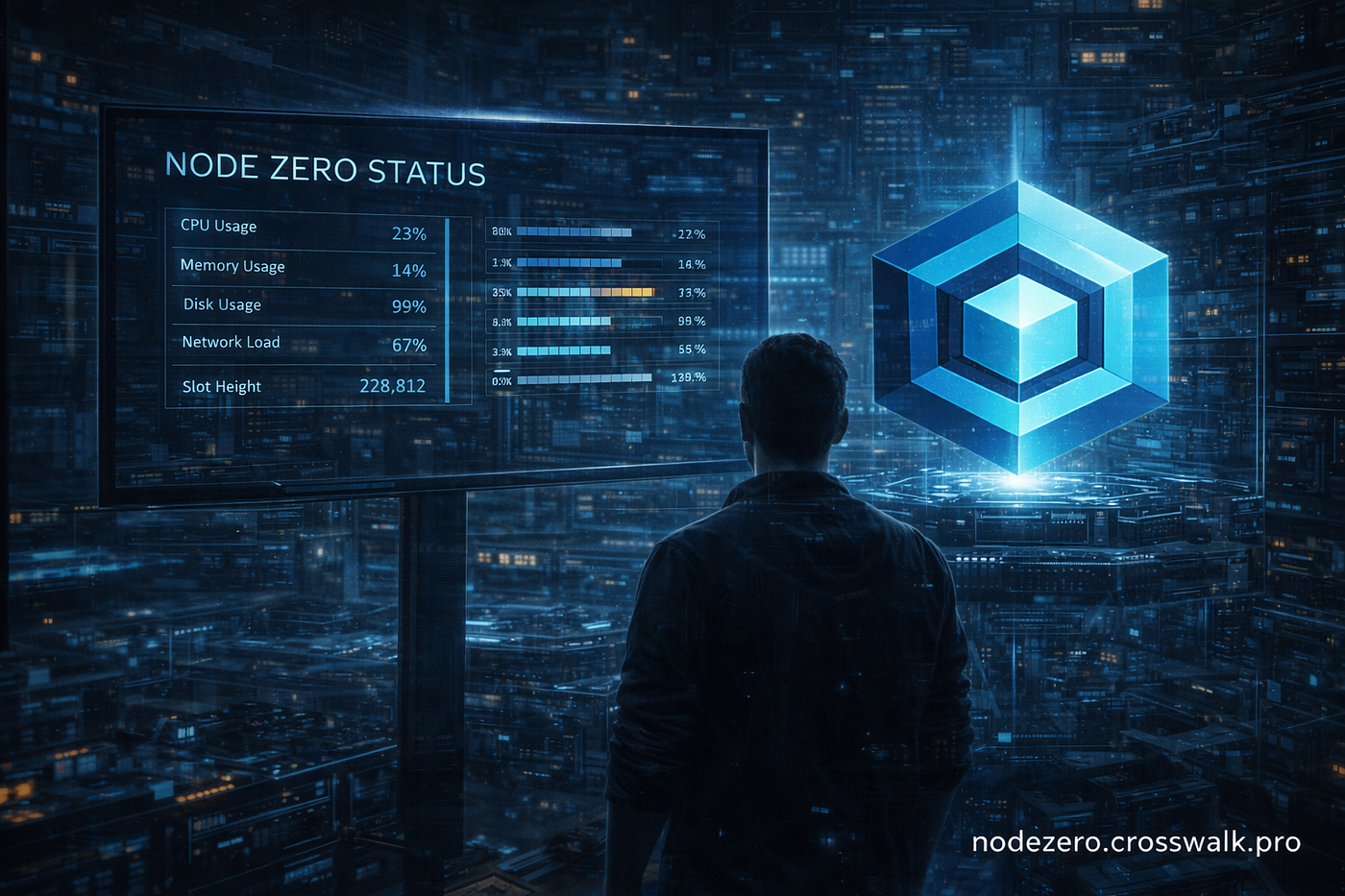
Here’s something I personally care about:
I hate “trust me bro infrastructure.”
So we built NodeZero to be visible without being usable by random strangers.
When someone opens nodezero.crosswalk.pro, they don’t hit the RPC.
They hit a status page.
It shows basic health and capacity — enough to verify:
- the node exists
- it is alive
- it is synced
- the system isn’t choking
- the machine is actually running
And it refreshes automatically.
So a non-tech person can open it and understand:
“Okay. This is a real thing. It’s working.”
But the actual RPC stays locked behind authorization.
That separation is the line between “community transparency” and “security.”
Why this milestone matters (the human truth)
This is huge for us, not because it’s flashy…
…but because it changes what Crosswalk can become.
There’s a type of DeFi that is mostly talk:
- endless roadmaps
- loud marketing
- polished graphics
- “soon”
- “trust us”
Then there’s another type:
The quiet kind that keeps shipping even when the market is ugly.
The kind that invests time and money into things most people never see — but everyone benefits from.
NodeZero is that.
It’s the moment where DeFi stops being “a product online” and becomes a structure in the real world.
A machine you can measure.
A system you can hold accountable.
A foundation you can build on without praying that someone else’s infrastructure behaves nicely today.
[xin_v2_LOG] (personal touch)
This one hits different.
Because it’s not a promise.It’s not a concept.It’s not a mockup.
It’s a real milestone you can literally open in a browser and verify.
This is what DeFi is supposed to be:not false hype — real structure.not dreams — systems.not noise — work.
NodeZero is a huge investment of time, resources, and knowledge.
And it’s one of those moments where I can say, with a straight face:
we’re building something real — despite the market, not because of it.
What happens next
Now that the foundation is alive, we can do the fun part:
- strengthen observability internally
- tune retention and performance
- gradually expand the capability surface
- later: build additional chain infrastructure in parallel
But most importantly:
Now Crosswalk has a core that doesn’t wobble.
Closing
Some people ship “features.”
We shipped a node.
And if you know what that means, you know why this matters.
NodeZero is live.
— xin_v2, CTOCrosswalk Ecosystemwww.crosswalk.pro