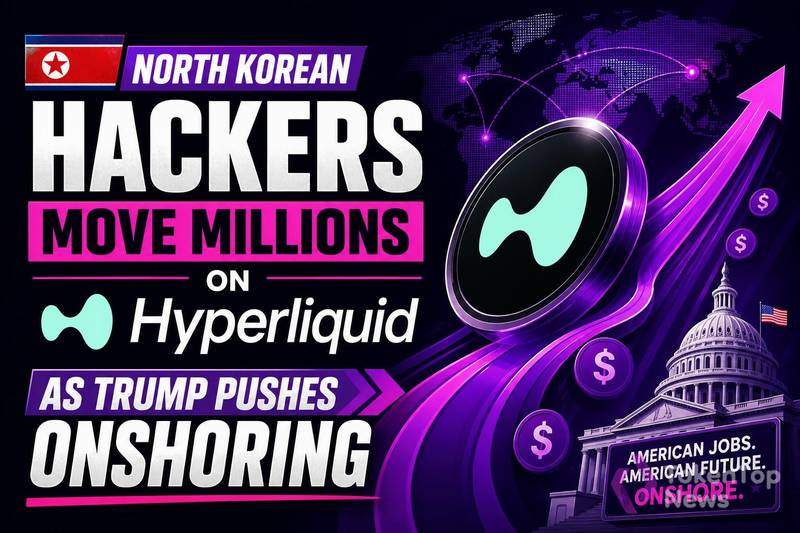
North Korean hackers are reportedly moving tens of millions of dollars through Hyperliquid, the on-chain derivatives platform, at the same moment President Donald Trump is pushing to onshore
North Korean hackers are reportedly moving tens of millions of dollars through Hyperliquid, the on-chain derivatives platform, at the same moment President Donald Trump is pushing to onshore the venue into the US regulatory sphere. The collision of alleged illicit flows and a political onshoring drive puts Hyperliquid at the center of both a security story and a policy fight.
The core claim, as first reported by CoinDesk, is that funds tied to North Korean actors are being routed through Hyperliquid at a scale large enough to make the platform itself part of the narrative. In practice, that means value linked to state-affiliated hacking operations is passing through a public venue where trading activity is visible on-chain. For related coverage, see Korean Regional Bank Adopts Ripple Payments as XRP Falls Below $1.
Why Hyperliquid is the venue that matters here
Hyperliquid is an on-chain perpetuals exchange, and its role in this story is as the movement channel rather than the target of a breach. The reporting frames the tens of millions in flows as significant precisely because they surface on a platform whose ledger activity is observable, drawing attention to how illicit value migrates through decentralized infrastructure. For related coverage, see Crypto Market Brief: Key Trends Connecting Today's News | September 1, 2026.
This is not the first time North Korean crypto activity has drawn scrutiny. Exchanges have previously pursued legal action against Pyongyang-linked groups, as seen when Bybit sued North Korea and the Lazarus Group over a $1.5 billion hack and secured an asset freeze. The infiltration risk also runs deeper than trading, extending to hiring, a pattern detailed in a North Korean IT worker interview that revealed crypto hiring risks.
How Trump's onshoring push raises the stakes
To onshore a crypto platform means pulling it under US-facing regulatory, legal, and jurisdictional oversight rather than leaving it offshore. The political dimension here is a direct consequence of the security story: bringing Hyperliquid into the American sphere would tie a US policy win to a venue simultaneously flagged for hacker-linked activity. For related coverage, see Crypto Market Brief: Key Trends Connecting Today's News Overnight, September 1, 2026.
That tension arrives as the administration presses Congress on crypto legislation. Trump has urged lawmakers to pass the CLARITY Act during a meeting with crypto executives, according to The Wall Street Journal. An onshoring effort layered on top of that agenda raises the compliance and reputational bar for any platform positioned as part of the US crypto build-out.
What to watch next
The immediate question is whether enforcement bodies or the platform itself confirm and act on the flagged flows, which would intensify scrutiny in the days ahead. For Hyperliquid users and counterparties, the concern is exposure to funds later tied to sanctioned actors and any freezing or compliance response that follows.
The broader signal is that illicit-flow allegations and an onshoring push are now overlapping on the same platform, a combination that keeps this above a single-transfer story. Read alongside prior North Korea-linked exchange litigation and the administration's legislative push, it points to a market where security exposure and US policy positioning are increasingly hard to separate.
Disclaimer: This article is for informational purposes only and does not constitute financial or investment advice. Cryptocurrency and digital asset markets carry significant risk. Always do your own research before making decisions.
Read original article on tokentopnews.com