Nvidia has instructed its manufacturing partners, Dell and Supermicro, to halt shipments of servers equipped with Nvidia AI chips to Malaysia, Singapore, Thailand and Indonesia, the Financial
Nvidia has instructed its manufacturing partners, Dell and Supermicro, to halt shipments of servers equipped with Nvidia AI chips to Malaysia, Singapore, Thailand and Indonesia, the Financial Times reported on November 26.
Citing three people familiar with the matter, the report said Nvidia and its partners were still determining how to comply with new US export controls. It is still unclear how long the shipment halt will last or which chip models it affects.
A halt with no clear end date
Nvidia declined to comment on the shipment halt. Dell, Supermicro, ByteDance and Singapore-based cloud provider Aolani did not respond to the Financial Times’ requests for comment.
In the meantime, those who are knowledgeable about the issue don’t expect Nvidia to ease its implementation of US export restrictions, despite Huang’s return to his role as CEO on November 23. Huang had previously resigned from the position after a controversy emerged relating to an affair he allegedly had with an employee at Megaspeed.
What the November 19 rules require
The Bureau of Industry and Security (BIS) issued an interim final rule on November 19 requiring licenses for advanced chip exports to Indonesia, Malaysia, Singapore, Thailand and Brazil.
An interim final rule is a regulation that takes effect before public consultation concludes.
Overseas data centers providing substantial computing power to companies headquartered in China, Macau and other restricted jurisdictions now face licensing requirements. Existing providers have 90 days to obtain licenses or face future export restrictions. Qualifying US-headquartered recipients are exempt from the five-country licensing requirement.
BIS also repealed the AI Diffusion Rule introduced under the Biden administration but never enforced.
The AI Diffusion Rule was a framework governing global access to advanced US AI chips and certain AI model weights.
Smuggling is not the only leak
Washington is trying to close two loopholes. The first relates to the physical diversion of chips towards the restricted markets. Cryptopolitan previously reported that former Super Micro contractor Ting-Wei Sun pleaded guilty in October over a scheme prosecutors estimated to be worth $2.5 billion.
The second involves to remote access. Instead of importing restricted AI chips, Chinese companies rent computing power from overseas data centers equipped with those chips. Before the new US export controls, the Institute for Progress estimated that Chinese companies could obtain roughly 32% of their available AI computing power through overseas data centers by the end of 2027.
Financing in the balance
The new export controls are already disrupting data center financing in Southeast Asia. Lenders have withdrawn roughly $500 million in credit for Aolani’s planned computing project with ByteDance. The TikTok owner may now abandon the deal, according to the Financial Times.
Malaysia has attracted nearly $100 billion in data center investments since 2021. Authorities have called on all 117 approved projects to comply with US restrictions and advised operators against serving seven blacklisted entities.
The risks extend beyond Malaysia. According to Cushman & Wakefield, Southeast Asia accounts for roughly half of Asia-Pacific’s data center capacity under construction.
Singapore Prime Minister Lawrence Wong said on November 24 that Singapore should not be “used and abused as a conduit” to circumvent US export controls.
However, data center operators still lack clear instructions on how to comply.
“There’s this new rule but no guidance on execution,” a cloud executive told the Financial Times.
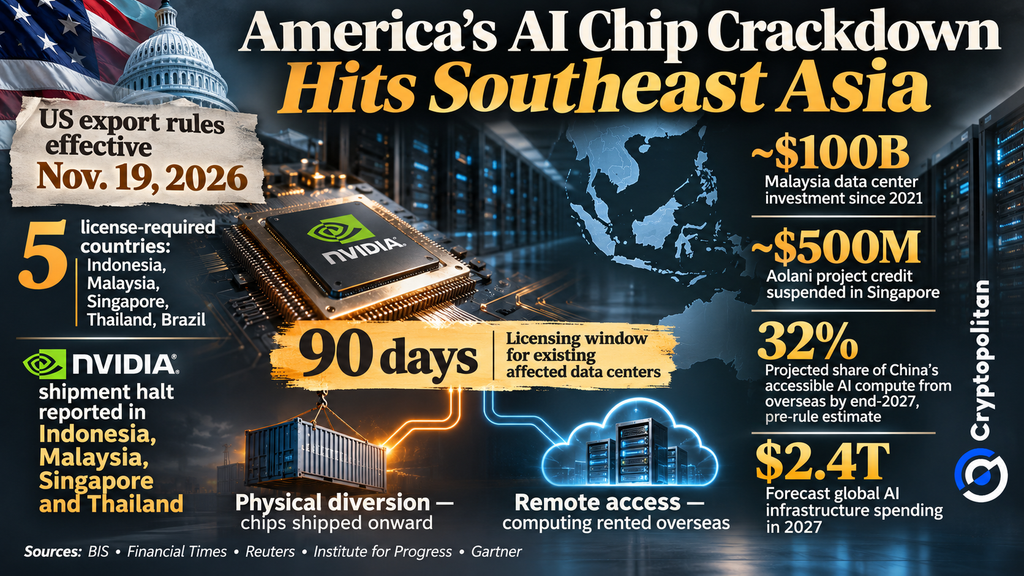 Nvidia AI chip export halt puts Southeast Asia’s data center investments at risk
Redirected, not erased
US export restrictions could change where companies build data centers rather than slow global investment. Gartner expects global AI infrastructure spending to rise 53% to $2.4 trillion in 2027.
With demand exceeding chip supplies, the Institute for Progress argues that other buyers will likely absorb chips that US companies cannot sell to restricted customers.
Vietnam, which is not subject to the new country-specific licensing requirements, is already attracting data center projects.
The longer bet on China
Beyond the immediate commercial fallout, questions remain about the long-term effectiveness of US export controls.
The US-China Economic and Security Review Commission argues that export restrictions remain essential to slowing China’s technological progress. One of China’s biggest challenges is overcoming Nvidia’s advantage through CUDA.
CUDAis Nvidia’s computing platform that allows developers to use graphics processors for complex tasks, including AI.
Defence24, however, argues that US restrictions have accelerated China’s efforts to develop its own technology. It cites DeepSeek-R1’s success and Beijing’s estimated $142 billion in semiconductor support between 2014 and 2023.
While export controls may help Nvidia retain its technological lead, they could also encourage Chinese companies to develop competing technologies faster.
Don’t just read crypto news. Understand it. Subscribe to our newsletter. It's free.