NVIDIA’s agreement to acquire Hugging Face for $12.93 billion puts one of the largest companies in AI behind one of its most open ecosystems. Hugging Face now serves more than 18 million deve
NVIDIA’s agreement to acquire Hugging Face for $12.93 billion puts one of the largest companies in AI behind one of its most open ecosystems. Hugging Face now serves more than 18 million developers, researchers, and creators, with more than 3 million models, 500,000 datasets, and 1 million applications on its platform.
NVIDIA says Hugging Face will remain open, with developers free to use different models, frameworks, cloud providers, inference services, and computing platforms. NVIDIA hardware won’t be required, either. Jensen Huang has argued that open models allow startups, universities, businesses, and public institutions to build on advanced AI without having to train everything themselves, while spreading access to capabilities that would otherwise remain concentrated among a much smaller number of companies.
XYO Co-Founder Markus Levin sees enormous potential in that expansion, but he has also warned about what becomes harder to control as increasingly capable models spread. In coverage of NVIDIA’s Hugging Face acquisition, his comments focused on the risks that accompany open AI, particularly when models can be copied, modified, and used in ways their original creators never intended.
It's important to put that warning in the context Markus intends. He is an AI booster. He wants the risks discussed alongside the possibilities, because open AI is also giving far more people the ability to study models, adapt them, build new applications, and experiment with technology that would have required enormous resources only a few years ago.
Robotics is one of the best places to see what that can produce. Models that once lived primarily on computers are being connected to cameras, sensors, motors, and machines capable of interacting with their surroundings, while open hardware is lowering the cost of joining in.
Some of those machines also happen to be ducks.

Read about our successful NVIDIA Orin Nano integration to learn more about how this kind of integration is designed to work!
In April 2025, Hugging Face acquired Pollen Robotics, a French company that had spent years building open-source robots and hardware. Hugging Face had already been developing its LeRobot open robotics tools, and the Pollen team brought hardware expertise into an ecosystem built around openly shared models, datasets, software, and research.
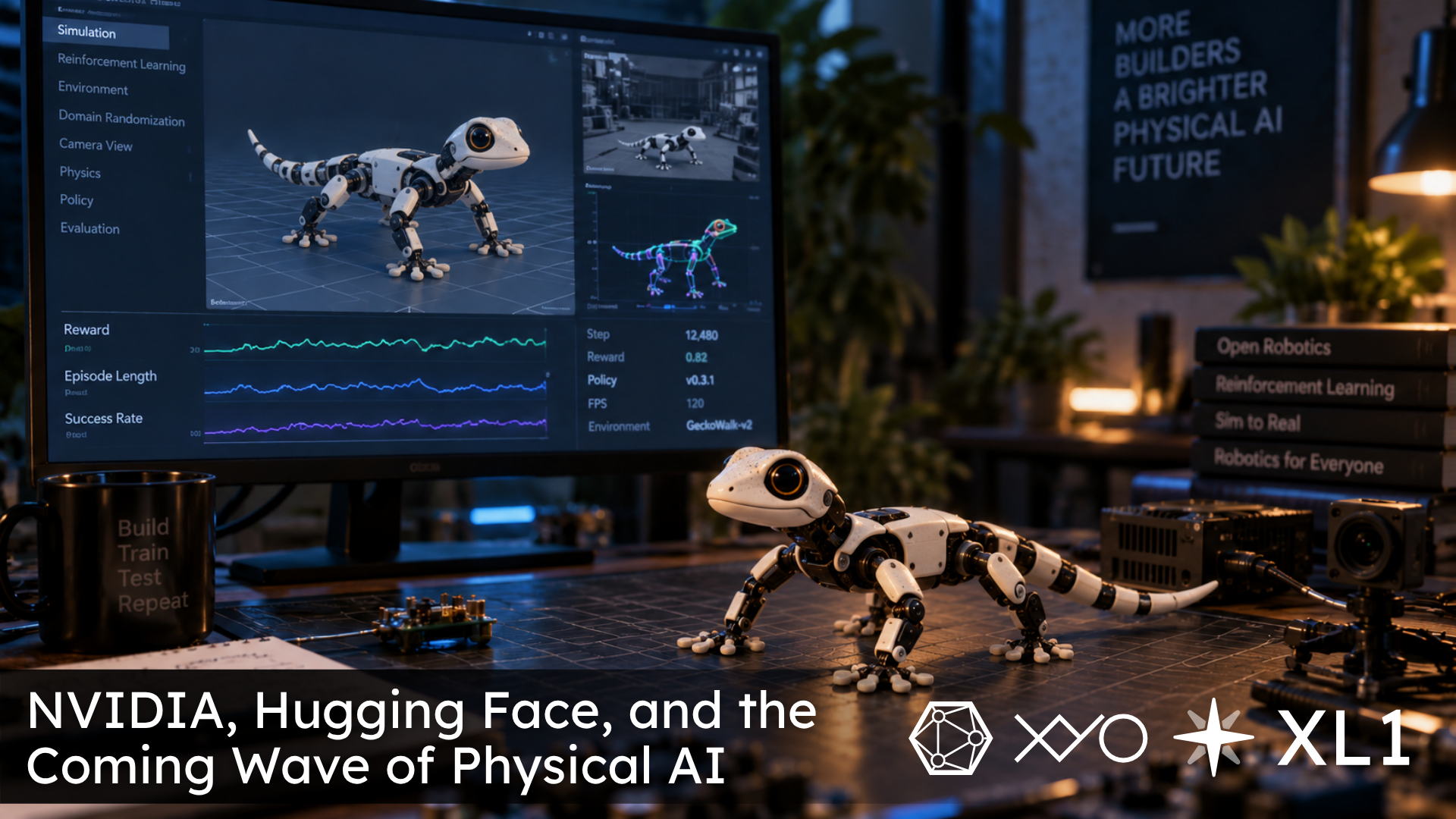
Pollen is also behind Microduck, the tiny robot that has gone viral online. At 25 centimeters tall, Microduck is an open-source biped designed to be trained with reinforcement learning. It can learn behaviors in simulation and perform them on the physical robot, while developers can work with an open software stack rather than treating the machine as a sealed consumer product.
It's also $399 during its introductory preorder period, which puts an unusually capable robotics platform within reach of individual developers, students, hobbyists, startups, and small research teams. A developer can buy the robot, work with its software, train new behaviors, and experiment with physical AI without first finding an industrial robotics lab willing to lend them a machine.
Microduck is charming enough to make all of this easy to overlook. People see a tiny robot learning to walk or roller-skate and share the video because, understandably, robot duck. Underneath the entertainment is a development model that could have much broader consequences. Open models and open hardware allow people to modify machines, teach them new skills, share those skills, and find uses their manufacturers never planned.
That freedom is part of the promise Markus wants included alongside the warnings.
XYO has been working on a similar set of questions from the data side. In XYO Brings NVIDIA Robotics Tech On-Chain, we connected a camera to an NVIDIA Jetson Orin Nano and used local computer vision to identify events taking place in a room. When our resident Shiba Inu wandered into view, the system classified her as a dog with 86.4 percent confidence, cryptographically signed the observation, and recorded it on XYO Layer One.
We deliberately chose a simple demonstration. Misidentifying a dog wandering through a living room is unlikely to cause much trouble, although the dog may disagree. What we wanted to test was the record surrounding the observation: what the machine detected, how confident it was, and evidence connecting that information to the device that produced it.
Put the same architecture into a warehouse robot confirming that it moved a pallet, an agricultural machine examining crops, a drone inspecting infrastructure, or a robot checking equipment in the field, and the usefulness becomes much easier to see. Those machines can produce huge amounts of information without a person standing beside them to verify every observation.
Another machine may eventually use that information to make its own decision. A business may need to prove that an automated task was completed. A developer investigating a failure may need to reconstruct what the system knew before it acted. In each case, the ability to trace machine-generated information back to its source becomes useful.
We don’t need to manufacture the robots for XYO to participate in that world. The XYO AI SDK was built to make it easier for developers to create applications around XYO Layer One without first having to master the chain’s underlying architecture. In robotics, the connection can happen around information the machine already produces.
The hardware could be an NVIDIA-based robotics system, a machine assembled from off-the-shelf parts, or an open platform from Pollen Robotics. Microduck is a particularly fun example because its open software and relatively low price invite exactly the kind of experimentation that can produce uses nobody anticipated.
We explored several of these possibilities recently in Building Verifiable Robots with XYO, looking at open and third-party hardware that could potentially work with the XYO AI SDK. The common thread is not a particular manufacturer or robot. It is the information those machines generate.
A robot collects information through cameras and sensors, while AI interprets those observations and decides what to do next. XYO can give developers ways to establish provenance around selected data produced during that process, allowing another application, machine, business, or researcher to check where the information originated and whether it has changed.
Model safeguards are one part of the discussion around AI risk, but increasingly autonomous machines also create a different problem. When software is making decisions about the physical world, people need ways to examine the information behind those decisions. Building better verification around machine-generated data can add accountability without dictating which models developers are allowed to use or which machines they are allowed to build.
Warnings about AI can easily dominate the conversation until progress starts sounding like something society has to brace itself for. That misses a large part of what is happening.
Open models are giving more people access to advanced AI. Open hardware is doing something similar for robotics. Developers who would once have needed access to a well-funded laboratory can increasingly buy, modify, train, and program machines themselves. Companies such as Hugging Face and Pollen Robotics are building ecosystems where the software, hardware, models, datasets, and learned behaviors can circulate among the people using them.
NVIDIA putting nearly $13 billion behind Hugging Face gives that ecosystem considerably more resources and visibility. It also makes the tension Markus described harder to ignore. Wider access means less centralized control, and less centralized control creates problems that need serious thought. Wider access can also produce a staggering amount of experimentation, competition, research, and invention.
Microduck gives us a small and unusually adorable glimpse of what that looks like. Thousands of other robots, sensors, agents, and autonomous systems will follow, many of them built by people and companies we have never heard of yet.
For XYO, that expanding variety is part of the opportunity. We don’t have to know which model will dominate or which robot will sell the most units. As more machines observe their surroundings and make decisions based on what they see, there will be growing demand for ways to establish where their information came from, preserve its provenance, and allow other systems to verify it.
The risks deserve attention, but they shouldn’t swallow the conversation. There is far too much worth building.