NVIDIA’s Computex 2026 presence is drawing fresh attention after NVIDIA, Microsoft and Arm coordinated around the phrase “A new era of PC” with Taipei coordinates, raising expectations for a
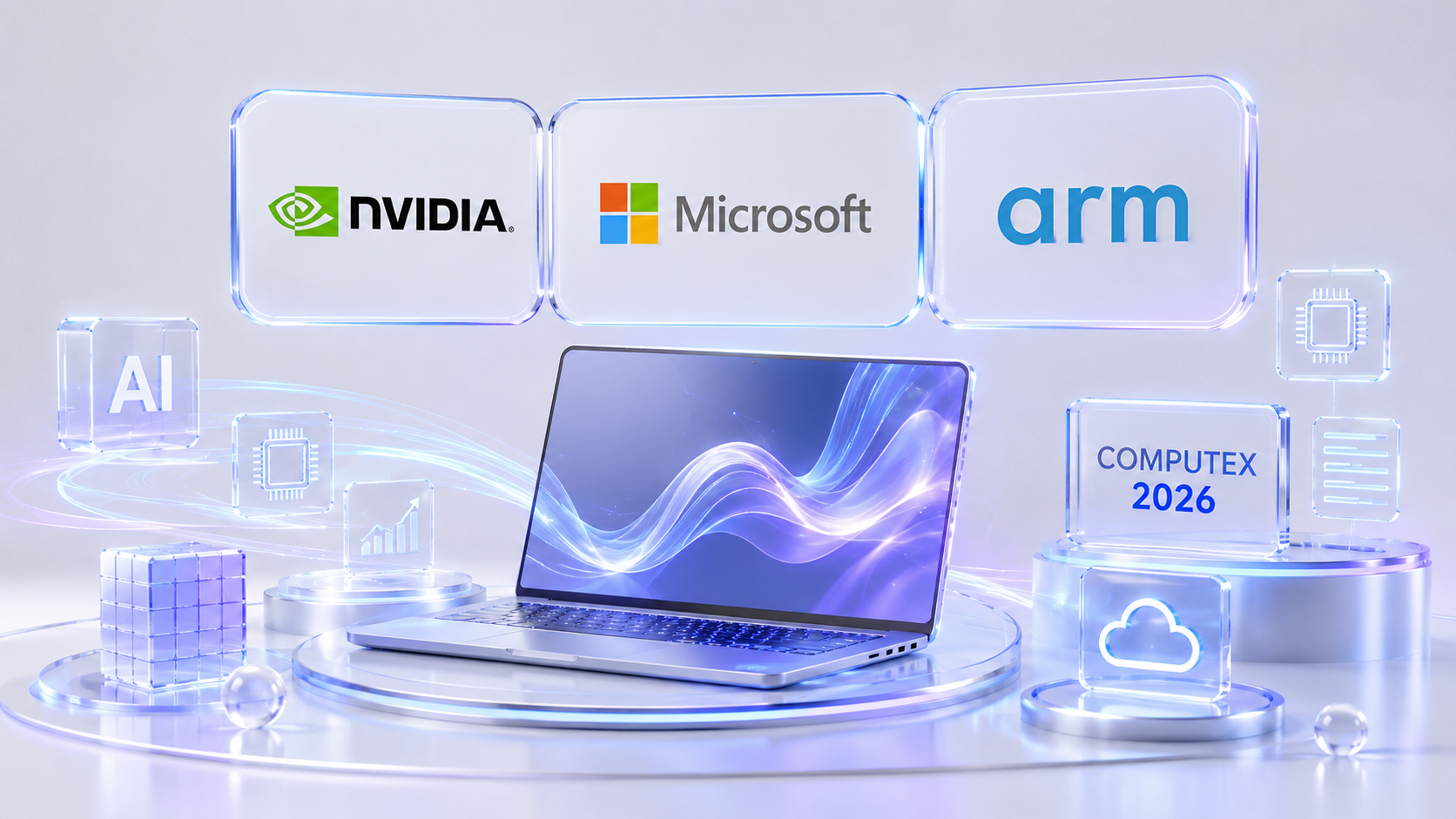
NVIDIA’s Computex 2026 presence is drawing fresh attention after NVIDIA, Microsoft and Arm coordinated around the phrase “A new era of PC” with Taipei coordinates, raising expectations for a major Windows-on-Arm hardware announcement at the trade show.
The teaser has fueled speculation that NVIDIA is preparing to unveil its long-rumored N1 or N1X processors for Windows laptops. The chips have not been formally announced, so the exact names, performance targets and launch partners remain unconfirmed. The expected direction is clear enough: an Arm-based system-on-chip built for thinner laptops, stronger battery life, NVIDIA graphics, and on-device AI workloads.
If the announcement lands as expected, it would push NVIDIA deeper into the client PC market rather than keeping its consumer presence focused mainly on discrete GPUs. Microsoft would gain another major Arm silicon partner for Windows, while Arm would strengthen its role in high-performance laptops beyond smartphones, tablets and Apple’s Mac lineup.
Windows AI PCs Could Get A New Chip Challenger
The rumored NVIDIA chip would enter a market already reshaped by Apple’s M-series processors and Qualcomm’s Snapdragon X Elite platform. Apple proved that Arm-based laptops can deliver strong performance per watt, long battery life and tight hardware-software integration. Qualcomm then pushed Windows laptops further into the same lane with Copilot+ PCs and Snapdragon X systems.
NVIDIA’s entry would add a different kind of pressure. A chip that combines Arm CPU cores, NVIDIA graphics and AI acceleration could give Windows laptop makers a stronger option for local AI processing, creative workloads, gaming, developer tools and agent-style software that runs partly on-device.
That local AI angle is becoming more important as the industry moves beyond cloud-only models. Frontier AI companies are still spending heavily on data-center infrastructure, with Anthropic’s latest near-trillion-dollar funding round showing how large the cloud compute race has become. At the same time, PC makers want more AI tasks to run directly on laptops for speed, privacy, cost control and offline use.
Computex Puts Taiwan At The Center
Computex 2026 runs from June 2 to June 5 in Taipei, with AI and computing among the show’s main themes. NVIDIA CEO Jensen Huang is scheduled to headline the event, and his early arrival in Taiwan has already brought meetings with key supply-chain executives, including TSMC, Foxconn and Quanta leaders.
Those meetings reflect the hardware reality behind the AI PC race. A new laptop platform does not depend only on chip design. It needs advanced manufacturing, packaging, memory, thermal design, motherboard engineering, OEM support, software optimization and enough capacity to reach major laptop brands.
Taiwan sits across nearly every layer of that stack. TSMC provides advanced foundry capacity, Quanta is one of the world’s largest notebook manufacturers, and the island’s broader supplier base now stretches across AI servers, components, cooling systems and advanced computing infrastructure.
Intel And AMD Face A Wider Fight
A serious NVIDIA Windows-on-Arm platform would widen the pressure on Intel and AMD, which have dominated PC processors for decades. Both companies are already moving faster on neural processing units, integrated graphics, battery efficiency and AI laptop branding, but NVIDIA brings a different threat because of its GPU ecosystem, developer tools and AI software reach.
The disruption would not happen overnight. Windows-on-Arm still has to prove software compatibility, gaming performance, driver maturity, app support and OEM pricing at scale. NVIDIA would also need strong partner devices from major brands before the platform could challenge Intel and AMD beyond early adopters.
The timing still gives the potential launch weight. AI laptops are becoming a strategic battleground for Microsoft, chipmakers and PC brands. Developers want machines that can run coding assistants, small models, local inference, creative tools and productivity agents with less cloud dependence. Consumers want battery life and performance without paying workstation prices.
Crypto markets are watching the same hardware trend from another angle. AI agents, wallets and onchain automation are becoming a live product category, with recent launches such as Binance’s Agentic Wallet and Base’s AI agent payment rails showing how software automation is moving toward real transactions. More powerful local AI hardware could push that shift further by making agent workflows faster and cheaper to run.
Computex Could Reset The AI Laptop Race
NVIDIA, Microsoft and Arm have not confirmed the final product details, but the coordinated teaser has already shifted attention toward a possible new Windows PC platform. A launch built around Arm efficiency, NVIDIA graphics and local AI acceleration would give laptop makers a new alternative to Apple, Qualcomm, Intel and AMD.
The strongest impact would come from real devices, clear specs and OEM commitments rather than teaser language alone. If NVIDIA shows working laptop silicon at Computex, the AI PC race will move from branding to platform competition, with Windows vendors fighting over battery life, graphics, local inference and developer support in the same machines.
The post NVIDIA, Microsoft And Arm Tease New AI PC Era Ahead Of Computex 2026 appeared first on Crypto Adventure.