Key Takeaways NVDA shares have declined 14% from their May peak even as broader indexes reach new records The chip giant now trades at just 16x forward earnings for next fiscal year — a disco
Key Takeaways
- NVDA shares have declined 14% from their May peak even as broader indexes reach new records
- The chip giant now trades at just 16x forward earnings for next fiscal year — a discount to the S&P 500 average
- First quarter fiscal results showed 85% year-over-year revenue expansion, marking the strongest growth in a year and a half
- Recent analyst reports from Citi and Wedbush highlight expansion opportunities in CPU technology, networking infrastructure, and enterprise artificial intelligence
- Wall Street’s consensus price objective of $309.33 represents approximately 54% potential appreciation from today’s trading price
Shares of Nvidia currently sit at $201.95, representing a roughly 14% retreat from the record peak reached during May. This correction has compressed valuation multiples to attractive territory not witnessed in several years.
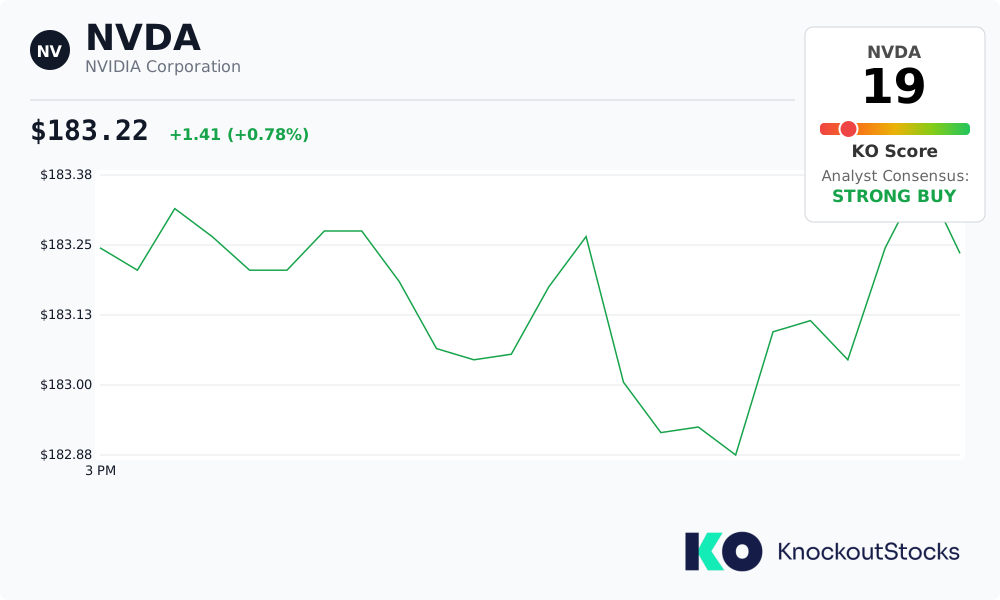 NVIDIA Corporation, NVDA
The shares are valued at 23x current fiscal year earnings projections. What stands out more dramatically is the multiple based on next fiscal year’s estimates — merely 16x anticipated profits. This represents a lower valuation than the broader S&P 500 index, an uncommon situation for a business delivering this level of expansion.
Wall Street’s earnings forecasts have steadily climbed upward even while the share price has declined. This divergence between strengthening profit expectations and weakening stock performance explains the compressed valuation multiples investors now see.
Top-Line Expansion Continues at Robust Pace
Nvidia delivered 85% year-over-year revenue expansion in its most recent fiscal quarter — representing the strongest growth rate achieved over the past 18 months. This performance followed three straight quarters of accelerating top-line momentum.
The data indicates that early market concerns about China’s DeepSeek platform haven’t materially impacted Nvidia’s commercial performance. Enterprise clients appear to be prioritizing proven performance and dependability over lower-cost alternatives.
DeepSeek has resurfaced in recent discussions. The company’s latest DSpark inference technology reportedly accelerates AI processing speeds by as much as 85% without requiring hardware upgrades. This development raises questions about future demand for Nvidia’s next-generation processors, though comparable concerns emerged in early 2025 without significantly affecting actual business outcomes.
The semiconductor leader also recently executed its first substantial debt issuance in five years. Intensifying competition in the AI chip sector and ongoing Chinese export limitations present continuing challenges. However, neither represents a new development in the investment narrative.
Major Firms Highlight Expanded Opportunity Set
This past Thursday, both Citi and Wedbush released optimistic research reports on Nvidia, emphasizing growth vectors that extend far beyond its dominant GPU franchise.
Wedbush’s Matt Bryson drew attention to Nvidia’s forthcoming Vera CPU architecture. His analysis suggests its elevated core configuration could deliver superior performance versus conventional x86 processors, opening pathways into segments currently dominated by AMD and Intel.
Wedbush’s research also emphasized that Nvidia’s expansion into networking solutions and general-purpose computing platforms could significantly enlarge its total addressable opportunity beyond AI acceleration hardware.
Citi analysts engaged directly with Nvidia’s investor relations leadership and emerged with an optimistic assessment. The firm characterizes current demand conditions as “very strong” and notes that AI infrastructure spending has diversified beyond hyperscale cloud providers.
AI research laboratories, enterprise customers, sovereign AI initiatives, and emerging cloud service providers are all increasing capital deployment. Citi identified this broadening customer base as a significant structural change in the demand landscape.
Citi’s report also confirmed that Nvidia’s product development timeline remains “fully intact,” countering recent speculation about potential delays to its Kyber platform. The firm stated that NVLink development schedules are proceeding as planned.
Nvidia has reconfirmed its mid-70% gross margin objective, partially underpinned by long-duration memory component supply agreements. Management also restated its commitment to distributing 50% of annual free cash flow to equity holders.
Citi noted that share repurchase programs could expand in coming years as cash generation scales higher.
With 36 Buy recommendations and a single Hold rating tracked by TipRanks, Nvidia maintains a Strong Buy consensus rating. The mean analyst price objective of $309.33 suggests roughly 54% appreciation potential from present trading levels.
The post Nvidia (NVDA) Stock Down 14% — Analysts Project 54% Rally Ahead appeared first on Blockonomi.