TLDR NVIDIA Vera CPUs will support SpaceXAI’s Grok infrastructure and agentic workloads. SpaceXAI plans to scale Grok using NVIDIA Vera Rubin across major AI systems. The Starmind satellite w
TLDR
- NVIDIA Vera CPUs will support SpaceXAI’s Grok infrastructure and agentic workloads.
- SpaceXAI plans to scale Grok using NVIDIA Vera Rubin across major AI systems.
- The Starmind satellite will extend NVIDIA accelerated computing into orbit.
- Vera CPUs handle code, data processing, and orchestration around AI workloads.
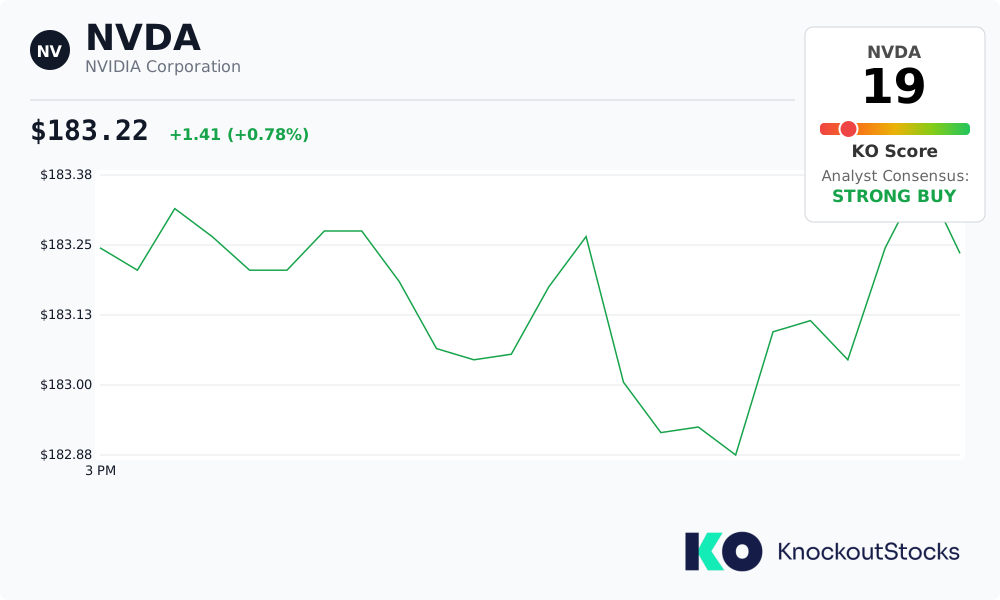
- NVIDIA shares fell 2.13% to $210.15 despite the new SpaceXAI deployment deal.
NVIDIA (NVDA) shares fell 2.13% to $210.15 as the company announced a major infrastructure agreement with SpaceXAI. The partnership will bring NVIDIA Vera CPUs into systems supporting Grok and large-scale agentic computing workloads. SpaceXAI also plans to extend Vera Rubin into orbital computing through its first Starmind satellite.
NVIDIA Corporation, NVDA
SpaceXAI Adds NVIDIA Vera CPUs to Grok Infrastructure
SpaceXAI will deploy NVIDIA Vera CPUs across its expanding infrastructure for agentic applications. The processors will handle code execution, data processing, tool coordination, and simulations between model requests. This setup should keep GPUs focused on model training, reasoning, and inference workloads.
NVIDIA designed Vera for computing tasks that rely heavily on CPU performance around model execution. The processor uses 88 Olympus cores, Spatial Multithreading, and high-bandwidth LPDDR5X memory. NVIDIA says the platform can provide memory bandwidth reaching 1.2 terabytes per second.
The company says Vera can complete selected workloads up to 1.8 times faster than x86 processors. Those workloads include data processing, reinforcement learning, and other demanding agent-driven tasks. SpaceXAI expects the architecture to support more orchestration while improving overall computing efficiency.
Vera Rubin Supports SpaceXAI’s Expanding Systems
SpaceXAI also plans to expand the infrastructure behind Grok using NVIDIA’s Vera Rubin platform. The system combines accelerated computing, networking, data processing, and software within one architecture. NVIDIA designed the platform to improve performance, utilization and energy efficiency across large computing environments.
Vera Rubin includes NVLink interconnect technology, Spectrum-X Ethernet networking, and BlueField data processing capabilities. Together, these components support faster data movement across large clusters and demanding workloads. SpaceXAI plans to use the platform as it develops computing capacity measured at gigawatt scale.
The agreement gives SpaceXAI one computing architecture across terrestrial facilities and future orbital systems. That consistency can simplify software deployment, system management, and workload scaling across different environments. NVIDIA also gains another large deployment for its next-generation data center hardware.
Starmind Satellite Extends NVIDIA Computing Into Orbit
SpaceXAI plans to base its first Starmind satellite on an optimized Vera Rubin NVL72 system. The project will extend NVIDIA’s accelerated computing architecture beyond data centers and into orbital infrastructure. SpaceXAI is developing the satellite for environments with strict power, thermal, bandwidth, and reliability limits.
Orbital computing creates different operating demands from conventional data centers because hardware faces tighter physical constraints. SpaceXAI and NVIDIA will adapt the platform while maintaining a common software foundation. The companies plan to preserve compatibility between ground-based systems and future orbital infrastructure.
The project expands NVIDIA’s role beyond traditional data centers, cloud systems, and enterprise computing deployments. SpaceXAI plans to use Vera CPUs, Vera Rubin systems, and orbital infrastructure within one broader computing strategy. Meanwhile, NVIDIA shares remained lower as the market absorbed the announcement and its infrastructure implications.
The post NVIDIA (NVDA) Stock: SpaceXAI Taps Vera CPUs to Power Grok and Orbital AI appeared first on Blockonomi.