Key Takeaways Nvidia shares advanced over 2% Thursday, reaching approximately $218 per share CEO Jensen Huang projects the company will double its chip shipments in the coming year The chipma
Key Takeaways
- Nvidia shares advanced over 2% Thursday, reaching approximately $218 per share
- CEO Jensen Huang projects the company will double its chip shipments in the coming year
- The chipmaker forecasts 70% revenue expansion for its upcoming fiscal year, with potential to double given adequate supply
- Huawei unveiled plans for two new AI processors as China pursues technological independence from Nvidia
- Huang anticipated to join the Trump-Xi state dinner scheduled for September 24
Nvidia stock advanced more than 2% during Thursday’s trading session, hovering near $218, following CEO Jensen Huang’s optimistic demand projections and a broader technology sector rally that lifted major indices.
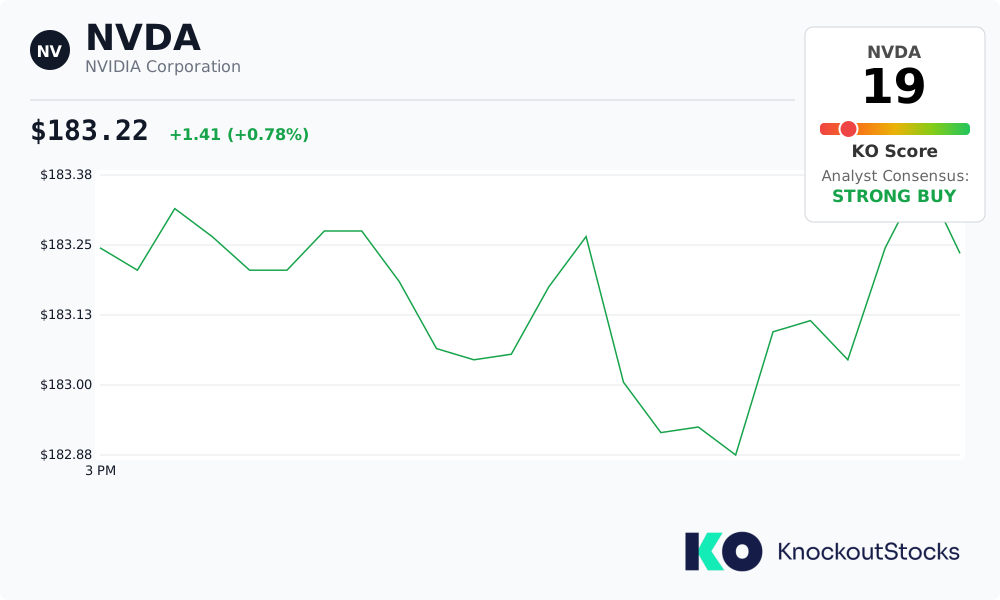 NVIDIA Corporation, NVDA
Speaking at a summit in Scotland organized by King Charles III, Huang shared with journalists his expectation that Nvidia will ship double the number of chips in the next year compared to current volumes. “This is driven by AI’s significant value creation across various industries and global economies,” he explained.
The chipmaker’s shares are posting consecutive daily gains. Thursday saw the S&P 500 climb 1.1% while the Nasdaq Composite jumped 1.6%, with technology stocks driving the upward momentum.
Semiconductor peers experienced similar upward movement. Qualcomm shares increased 2% while Intel posted impressive gains of 9% for the session.
Financial Projections
Nvidia previously announced expectations for 70% revenue expansion through its fiscal year concluding in January 2028, targeting approximately $673 billion in sales. Huang suggested revenues might actually double should production capacity align with market demand.
The company doesn’t release specific figures for total chip unit shipments. Its flagship offerings include data center GPUs, featuring the Blackwell and Rubin processor lines. During the fall, Huang disclosed that Nvidia delivered 6 million Blackwell GPUs across four quarters.
The company’s portfolio extends beyond GPUs to encompass central processing units, switching chips, optical networking solutions, laptop processors, Jetson chips designed for robotics and automotive applications, and the processor powering Nintendo’s Switch 2 console.
During the Scotland gathering, Huang emphasized AI safety concerns, stressing corporate accountability prior to product launches. “If a product lacks proper safety measures, we must delay its release and continue development,” he stated. The event included participation from Google DeepMind, OpenAI, and Anthropic representatives.
Chinese Competition Intensifies
Concurrent with Huang’s Scotland appearance, Huawei made significant announcements. The Chinese technology powerhouse revealed intentions to introduce two new AI processors in the coming year, noting it has already delivered over 1,000 AI computing platforms to more than 370 clients.
This initiative reflects China’s broader strategy to reduce dependence on American technology, responding to Washington’s limitations on Chinese access to Nvidia’s cutting-edge chips. Huawei has operated under US sanctions since 2019.
Morgan Stanley projects China’s AI chip sector could reach $67 billion by 2030, with domestic manufacturers capturing 86% of the market, a substantial increase from under 50% in 2025.
Regarding diplomatic developments, Huang is slated to attend a state dinner organized by President Trump for Chinese President Xi Jinping on September 24. Artificial intelligence is anticipated to be a central discussion point during Trump-Xi negotiations.
Huang has cultivated strong connections with the Trump administration and accompanied the president on a China visit earlier this year. He also participated in a state dinner hosted by Xi in May, joined by Elon Musk and former Apple CEO Tim Cook.
The post Nvidia (NVDA) Stock Surges as CEO Projects Chip Demand to Double in 2026 appeared first on Blockonomi.