Nvidia shares fell approximately 7% in US premarket trading on November 12 as investors reacted to reports that its board was considering removing chief executive Jensen Huang following alleg
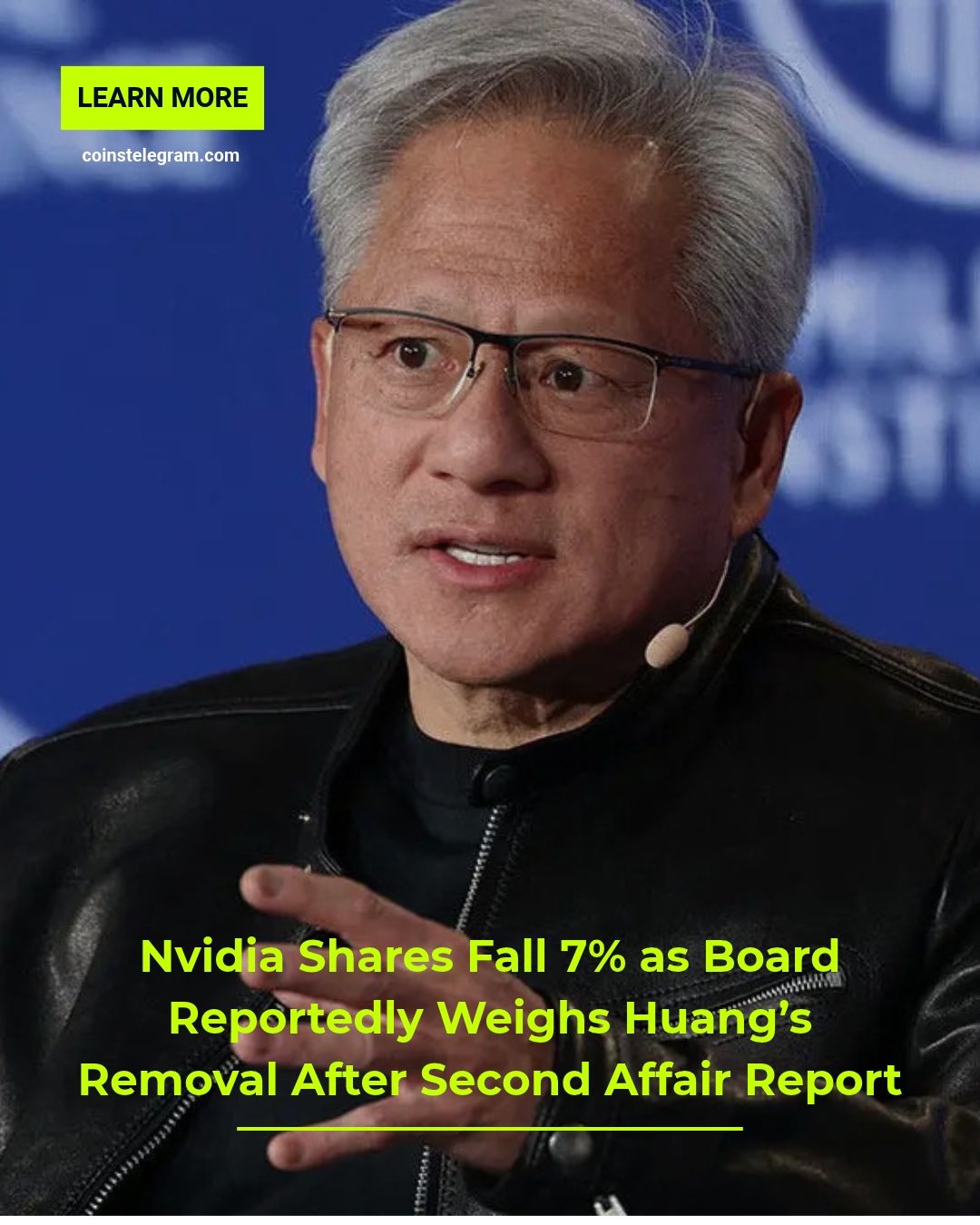
Nvidia shares fell approximately 7% in US premarket trading on November 12 as investors reacted to reports that its board was considering removing chief executive Jensen Huang following allegations of a second extramarital relationship.
The decline followed a selloff of more than 8% in extended trading on Wednesday. The Wall Street Journal initially reported that directors were preparing to oust Huang; Reuters subsequently reported, citing a person familiar with the matter, that the board was meeting late Wednesday to decide his future.
The reports reviewed for this article did not include an official announcement that Huang had resigned or been dismissed. Nvidia had not named an interim successor.
The distinction matters: a reported board discussion is not confirmation of a completed leadership change.
Nvidia Stock Reverses Its Rebound as Leadership Concerns Intensify
The latest allegations abruptly interrupted a recovery in Nvidia’s share price. The stock gained approximately 2.9% during Wednesday’s regular session before falling sharply after the closing bell.
Extended-hours reports showed losses of more than 8%, with some snapshots approaching 9%. These figures reflect different observation times rather than necessarily conflicting accounts.
By early Thursday, Nvidia remained under pressure, trading about 7% lower in the US premarket. These were preliminary prices before the regular session, not a confirmed November 12 closing result.
The market response reflects uncertainty over leadership continuity at a company whose technology and commercial relationships are closely associated with its founder.
A falling share price does not establish the truth of the underlying allegations. It shows investors adjusting their exposure while important questions remain unresolved.
For shareholders, the immediate concern is whether a board decision could change Nvidia’s management, customer relationships or ability to execute its strategy.
Second Alleged Relationship Involves Healthcare Executive Kimberly Powell
The New York Times reported Wednesday that Huang had also had a relationship with Kimberly Powell, Nvidia’s vice president of healthcare, citing five people who had worked at the company.
Reuters relayed that report but said it could not immediately verify it independently. Nvidia did not immediately respond to its request for comment.
According to the account supplied for this article, the Times described an alleged incident at a San Jose hotel during Nvidia’s GTC conference in March. The newspaper said it had not viewed the purported video itself.
That limitation is important. The reported existence of a recording should not be presented as publicly available video evidence establishing the allegation.
Neither Huang nor Powell had publicly addressed the reported relationship in the material reviewed. Nvidia had not announced a finding that either executive violated company policy.
The allegation nevertheless introduces a corporate governance issue because Powell reportedly reported to Huang. A relationship involving a chief executive and a subordinate can raise questions about disclosure, conflicts of interest and the handling of personnel decisions.
Those questions require investigation; they are not, by themselves, proof of misconduct.
Board Review Follows Earlier Foreign Intelligence Concerns
The controversy began before Wednesday’s report.
On November 8, Nvidia announced an independent investigation following reporting that Huang had been targeted by a foreign intelligence operation. A committee of independent directors, assisted by outside legal counsel, was assigned to oversee the review.
At that time, the board expressed confidence in Huang and his leadership team. It also said it had no reason to believe national security or Nvidia’s confidential information had been compromised.
The earlier reporting concerned Alice Huang, a businesswoman associated with Nvidia customer Megaspeed. She is not related to Jensen Huang. US intelligence officials reportedly considered her a Chinese intelligence asset; China has rejected the espionage allegations.
Huang acknowledged being unfaithful in his November 8 employee message, but that admission did not establish that confidential information was disclosed or that he knowingly assisted an intelligence operation.
The reported move toward considering his removal therefore represents a significant development from the board’s earlier public position. It does not reveal the investigation’s final conclusions.
Succession Questions Grow as Musk Signals Interest
Huang’s potential departure raises an unusually consequential succession question. He co-founded Nvidia in 1993 and has led it for more than three decades.
Elon Musk added to the discussion by responding to a suggestion that he hire Huang, saying it would be an honor. The comment was an expression of interest, not a formal job offer or evidence that Huang had agreed to leave Nvidia. businessinsider.com
For Nvidia, choosing a temporary replacement and appointing a permanent chief executive would be separate decisions.
Investors would need clarity about responsibility for product development, customer commitments and the company’s long-term technology direction. A transition plan could help reduce uncertainty even while the investigation continues.
The scrutiny also extends beyond the boardroom. Senators Elizabeth Warren and Chris Coons requested that government agencies preserve records concerning Nvidia chip exports and the reported intelligence operation. Their letter sought documents and briefings; it did not establish wrongdoing.
November 12 Selloff Reaches Other AI Stocks
The pressure spread beyond Nvidia during Thursday’s early trading.
At 4:11 a.m. ET, Nasdaq 100 futures were down approximately 0.79%, while S&P 500 futures slipped 0.38%. Dow futures were slightly higher, showing that the market was not moving uniformly lower.
Intel, Marvell and Micron declined between approximately 2.6% and 3.4%, while AI infrastructure companies CoreWeave and Nebius also fell. reuters.com
These movements show broader investor sensitivity around the AI trade, but do not demonstrate that every decline resulted solely from Huang’s situation.
The next decisive development will be an official statement on the board’s decision. Until then, Huang’s removal, the choice of a successor and the outcome of the misconduct and security inquiries remain unconfirmed.