The consensus reading of Nvidia stock — that the dip below $5 trillion is just rate jitters ahead of the Fed — misses the strangest configuration on the board: NVDA trades at $201.68 while th
The consensus reading of Nvidia stock — that the dip below $5 trillion is just rate jitters ahead of the Fed — misses the strangest configuration on the board: NVDA trades at $201.68 while the
lowest price target among dozens of covering analysts is $250, a full 24% above the market price (
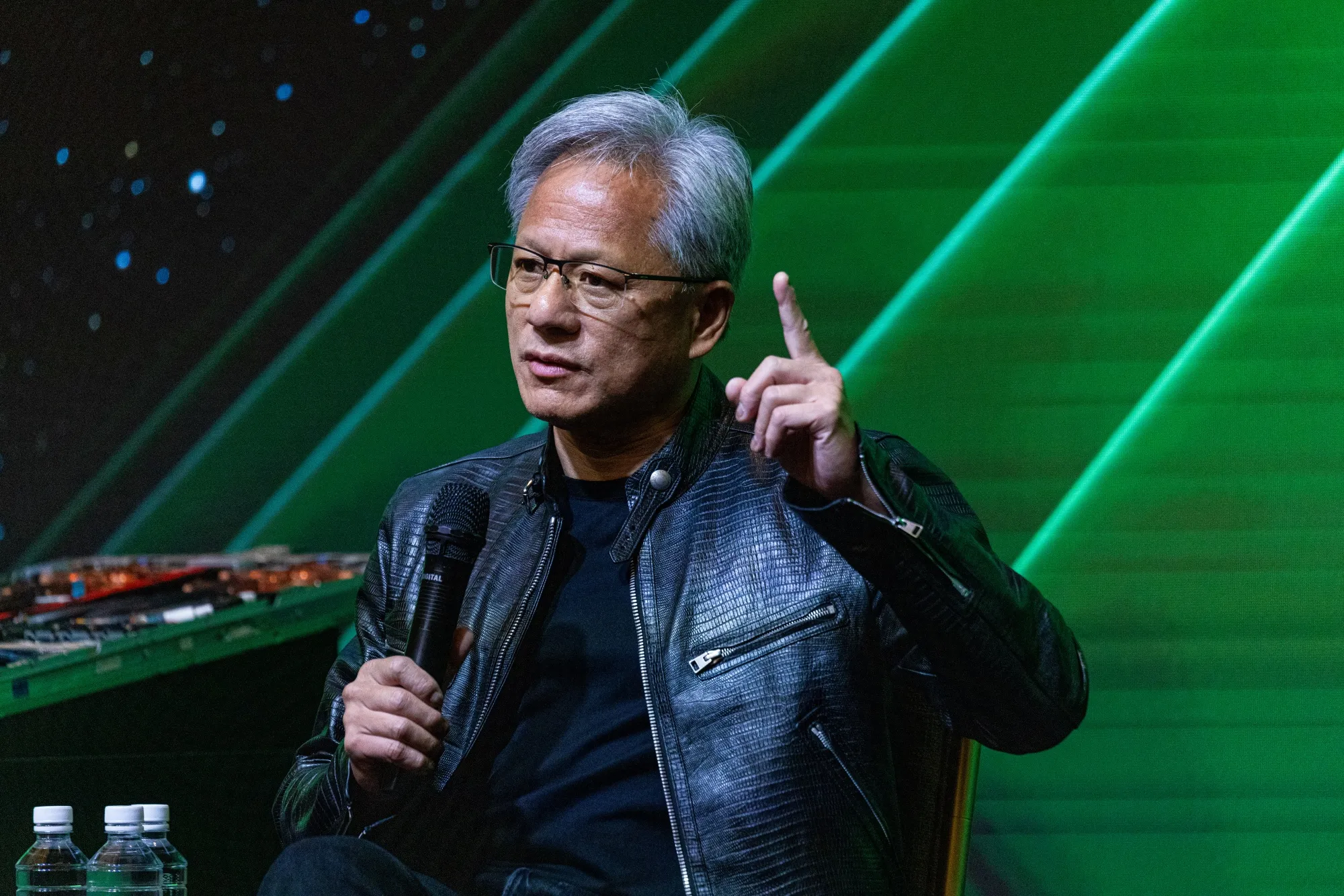
StockAnalysis, June 12, 2026). When an entire analyst distribution sits above spot — the mean clusters at $298–$311, the high at $500 — one of two things is true: the street is stale, or the market is pricing a risk that no sell-side model carries. Our read is the second, and the risk has a name: Washington. Any nvidia stock price prediction that ignores the gap between the China-policy discount and the Vera Rubin supply ramp is describing a different stock. That tension is the information gain this piece runs on, because the two forces have date stamps four days apart. On June 1, 2026, Jensen Huang confirmed at GTC Taipei that Vera Rubin — Blackwell's successor — is in full production with Q3 deliveries and all three HBM4 memory suppliers qualified, removing the supply bottleneck that capped the last two product cycles. On June 11, the Senate Banking Committee held its AI hearing with an empty chair where Senator Elizabeth Warren wanted Huang to sit — he declined, by letter — escalating a China export-controls fight that Warren's office says touches more than 20% of Nvidia's fiscal-2026 compute revenue via alleged diversion. The bull catalyst and the bear catalyst are both live, both dated, and the $100-plus spread between spot and consensus is the market refusing to choose. The June 16–17 Federal Open Market Committee meeting — the new Fed chair's first — will force the first move.
Key Facts: • NVDA trades at $201.68 (June 12, 2026), below a $5 trillion valuation after a ~6% single-session drop on hot jobs data — StockAnalysis; Yahoo Finance • Analyst consensus: $298–$311 average target across major trackers, high $500, low $250 — all above spot; 62 analysts rate it Strong Buy — TipRanks; Public.com • Vera Rubin entered full production June 1, 2026, with Q3 2026 deliveries confirmed — TechTimes • All three HBM4 suppliers qualified: SK Hynix (est. 60–70% of volume), Samsung (25–30%), Micron (remainder) — TechTimes, June 5, 2026 • HBM4 doubles memory bandwidth: up to 2 TB/s per stack on a 2,048-bit bus versus ~1 TB/s for HBM3E — JEDEC via TechTimes • Senator Warren's office cites $160 million in diverted H100/H200 chips and $510 million in diverted servers, alleging over 20% of FY2026 compute revenue was China-diversion-driven — Yahoo Finance • Huang declined to testify at the June 11 Senate Banking hearing, offering instead to host members at Nvidia HQ — CNBC
What's actually happening: three catalysts, four days apart
Start with the selloff mechanics, because they explain why the dip is macro rather than fundamental. NVDA fell roughly 6% in the June 5 session — part of a broad chip rout — after May payrolls came in well above forecasts and unemployment eased to 3.4%, repricing the Federal Reserve toward higher-for-longer exactly when long-duration growth stocks can least afford it. Nothing in that move involved Nvidia's order book. The same pre-FOMC de-risking took the Nasdaq 100 down 4.77% on June 8 and pulled Microsoft 27% off its highs — the setup we mapped in our
Microsoft stock prediction — and it resolves the same way: at the new Fed chair's first press conference on June 17. The fundamental news running underneath the macro noise points the other way. Vera Rubin's June 1 full-production confirmation matters less for the product than for the supply chain: in the Hopper and Blackwell cycles, high-bandwidth memory was the binding constraint, with SK Hynix effectively a single point of failure. This time Huang certified all three memory majors before first shipment — SK Hynix at an estimated 60–70% of allocation, Samsung (mass-producing HBM4 since February) at 25–30%, Micron the balance — on a memory standard that doubles per-stack bandwidth to 2 TB/s. A de-bottlenecked supply chain converts demand into revenue faster and removes the shortage-premium volatility that defined 2024–25. The selloff narrative has not priced this; the analyst distribution, sitting entirely above spot, arguably has. "American leadership in AI technologies cannot be taken for granted, but we are confident in the future and believe in the American system," Jensen Huang, President and Chief Executive Officer of Nvidia, wrote in his letter declining the Senate invitation. (
CNBC)
Quick Take: The dip is macro; the fundamentals improved during it. Vera Rubin in full production with three qualified HBM4 vendors is the opposite of the supply story that capped the last two cycles.
The industry response: who moved on the Vera Rubin news
The supply chain reaction is the cleanest tell that the Q3 ramp is real. SK Hynix locked in a multi-year HBM4 agreement with Nvidia — the first such structure in the AI-memory race — while Samsung's February head-start on HBM4 mass production positioned it to claw back share it lost across the HBM3E generation. For Micron, qualification reversed a narrative that had pressured the stock since March, per TechTimes' supplier breakdown. Downstream, the neocloud builders are committing capital against the new platform: CoreWeave's $31–35 billion 2026 capex programme — the leveraged AI-infrastructure bet we deconstructed in our
CoreWeave stock forecast — is, at bottom, a forward purchase of exactly these GPUs, and Nvidia holds a $2 billion equity stake in that buyer. The vendor-financing loop cuts both ways: it guarantees Vera Rubin demand, and it ties Nvidia's revenue quality to the funding health of customers that the OpenAI scare just stress-tested. On the Washington flank, the response was an escalation by absence. Warren invited Huang on June 1 to testify at the June 11 "AI and the American Dream" hearing; Huang declined by letter, offering a Santa Clara visit instead; Warren's staff confirmed they are still seeking his appearance "in an open setting". The committee aired its case without him — including enforcement figures of $160 million in diverted H100 and H200 chips and $510 million in diverted servers — and Warren directly challenged Huang's public claims that there is "no evidence of any AI chip diversion" and that Nvidia's China market share has "dropped to zero", calling them contradicted by enforcement actions. An empty chair in front of a Senate committee is rarely the end of a story; it is usually the part where subpoena chatter starts.
The numbers: bull, base and bear for NVDA
What is a defensible nvidia stock price prediction from $201.68? The honest scaffolding uses three anchors: the analyst distribution ($250 low / ~$306 mean / $500 high), the Vera Rubin revenue timing (Q3 2026 first deliveries), and the China policy variable that no target on the street currently models below $250. Note the asymmetry that creates: every published target implies upside, so the bear case below $200 is a policy-shock scenario, not a consensus view — which is precisely why it is worth writing down before the FOMC and any export-control action, not after. ScenarioRangeAnchorWhat has to be true
Bull$380–500Street high $500 (TipRanks)Vera Rubin Q3 ramp ships on schedule into de-bottlenecked HBM4 supply; Warsh FOMC keeps a 2026 cut pathway alive; China stays a headline, not a statute
Base$250–310Consensus mean ~$306; street low $250Macro chop into the June 16–17 FOMC; Vera Rubin executes but China scrutiny caps the multiple; stock converges toward the bottom of the analyst range first
Bear$160–185No analyst anchor — a ~20% policy-shock derating from spotExport-control escalation (new statutory restrictions or enforcement against diversion channels) plus a hawkish first Warsh FOMC; the scenario the spot-versus-target gap is already sniffing
Sources: TipRanks, StockAnalysis, Public.com analyst data (June 12, 2026); scenario ranges are analytical constructs, not probability-weighted forecasts. The bear range sits below every published street target by design — it prices policy risk the consensus does not. The synthesis worth carrying out of this section: the spot-to-lowest-target gap of 24% is the market's implied price for Washington risk, and it is currently larger than the upside the street assigns to Vera Rubin's entire first quarter of shipments. That is either the most attractive entry configuration in megacap tech or evidence that 62 Strong-Buy analysts are anchored to a world where export policy stays frozen — and the June 11 empty-chair hearing suggests it will not. For the crypto-crossover audience: this is the same "policy discount versus protocol fundamentals" trade that defined Ripple's XRP through its SEC years, transplanted into the largest company-adjacent valuation in equities — and that precedent cuts both ways, since XRP's discount persisted for years before resolving in a single court-driven session. Policy discounts do not decay on fundamentals' schedule; they decay on Washington's.
The regulatory tension: an empty chair is not a verdict
The regulatory landscape now has two tracks. Track one is enforcement: the diversion figures Warren's office cites — $160 million in chips, $510 million in servers, and the allegation that over 20% of FY2026 compute revenue traces to China-linked diversion — describe conduct by intermediaries, not necessarily by Nvidia, but they hand restrictionists their evidentiary base. Track two is legislative: a Banking Committee building a public record, with Huang sizing the Chinese AI market he is barred from serving at roughly $50 billion (
StartupHub) — a number that explains both why Nvidia lobbies against broader bans and why Congress doubts the bans bind. The push-pull is structural: every Vera Rubin performance leap widens the gap between what US firms can buy and what export rules let China buy, which raises both the commercial stakes and the diversion incentive simultaneously. "The Chinese, in effect, buy our stuff, and American companies make a profit doing that. But it certainly undermines our long-term security," said Elizabeth Warren, US Senator and ranking member of the Senate Banking Committee. (
Yahoo Finance)
What happens next: three predictions
First, the June 16–17 FOMC decides which end of the base-case range NVDA tests within a week. A statement that preserves a 2026 easing pathway re-rates every long-duration AI name and likely closes part of the spot-to-$250 gap immediately; a hawkish surprise extends the macro discount and hands momentum to the bear scenario regardless of Vera Rubin. Second, expect Huang in front of the committee — or a subpoena fight — before the August earnings print. The empty-chair strategy works for one news cycle; with enforcement figures already in the record, the political cost of continued absence compounds, and a negotiated appearance (likely paired with new compliance commitments) is the modal outcome. Third, the first Vera Rubin delivery confirmations in Q3 become the cleanest fundamental catalyst of the year: with three HBM4 vendors qualified, any upside surprise comes from volume, not scarcity — a healthier, less volatile earnings mix that the option market, still pricing shortage-era swings, has not adjusted to. Position-wise the takeaway is the same one we drew on
SPCX's listing day: when a stock's pricing question is "which dated catalyst fires first", the calendar is the analysis.
FAQ
Q: What is the Nvidia stock price prediction for 2026? A: From $201.68 (June 12, 2026), the analyst consensus targets $298–$311 with a $250 low and $500 high. Our scenario map: bull $380–500 on the Vera Rubin ramp, base $250–310, bear $160–185 on export-control escalation — the one outcome no street target currently models.
Q: Why is Nvidia stock dropping? A: The ~6% June 5 drop was macro: hot May payrolls (unemployment 3.4%) repriced the Fed toward higher-for-longer ahead of the June 16–17 FOMC, hitting all long-duration growth names. China export-control scrutiny — including the June 11 Senate hearing Jensen Huang declined to attend — adds a stock-specific policy discount.
Q: What is Nvidia Vera Rubin and why does it matter? A: Vera Rubin is Blackwell's successor platform, confirmed in full production on June 1, 2026 with Q3 deliveries. Critically, all three HBM4 memory suppliers — SK Hynix, Samsung and Micron — are qualified, removing the memory bottleneck that constrained the previous two product cycles.
Q: Did Jensen Huang testify before the Senate? A: No. Huang declined Senator Elizabeth Warren's invitation to the June 11, 2026 Senate Banking Committee hearing on AI and China chip sales, offering instead to host members at Nvidia's headquarters. Warren's staff say they are still seeking his testimony in an open setting.
Q: Is the NVDA stock forecast for 2026 still bullish? A: The street is uniformly bullish — 62 analysts at Strong Buy with every published target above the current price. The honest caveat: that unanimity itself is the risk, because it means consensus models assign near-zero probability to the export-policy shock the spot price is partially discounting.
Q: What should investors watch next for NVDA? A: Three dated catalysts: the June 16–17 FOMC (the new Fed chair's first meeting), any scheduling of Huang's Senate appearance or escalation to subpoena, and Q3 Vera Rubin delivery confirmations alongside the August earnings report.
This article is informational analysis only and is not financial, investment, or trading advice. Equities — particularly AI-sector names — are volatile, and scenario ranges are analytical constructs anchored to cited third-party estimates; they can be invalidated quickly by policy, earnings or macro news. All figures are sourced as cited and reflect June 12, 2026. Do your own research and consult a regulated financial adviser before making any investment decision.