NYSE Tokenized Stock Trading: Is Wall Street Going Onchain? Stock exchanges close for the night, yet blockchains never stop. That is why NYSE tokenized stock trading is getting so much attent
NYSE Tokenized Stock Trading: Is Wall Street Going Onchain?
Stock exchanges close for the night, yet blockchains never stop. That is why NYSE tokenized stock trading is getting so much attention right now.
Two separate projects cause most of the confusion. OKXICE, a venture between OKX and NYSE's parent company ICE, started offering tokenized stocks to eligible US customers on November 23, 2026.
NYSE's own venue is another matter, since it still needs regulatory approval. Here is where each one stands.
Which Tokenized Stock Projects Are Live Today, and Which Are Not?
NYSE tokenized stock trading is still only a plan. The exchange announced a standalone blockchain venue in January 2026, but no launch date has been set.
OKXICE did go live on November 23, and DTCC switched on its tokenization service on October 28.
Both moves belong to the wider trend of real-world asset tokenization, where traditional assets are recorded as tokens on a blockchain.
What Is NYSE Tokenized Stock Trading, and How Would It Work?
NYSE tokenized stock trading would let investors buy and sell US-listed shares and ETFs in tokenized form.
A tokenized stock is a digital record tied to a share, and the trade settles on a blockchain rather than through the usual post-trade systems. NYSE's design has three parts.
Its pillar matching engine pairs orders, a blockchain handles clearing and settlement, and transfer agents keep the official shareholder records in step with the tokens.
The stated goals include trading outside normal hours, fractional shares, and orders sized in dollars. None of this is open to the public yet.
Where Does Each Tokenization Effort Stand on November 24, 2026?
NYSE standalone venue
OKXICE
DTCC service
Status
Planned; approval pending
Live since November 23
Live since October 28
Access
Not open yet
Eligible US customers via the OKX app
Eligible DTC participants
Trading model
Proposed 24/7, immediate settlement
Automated market maker pools
Not a trading venue
Regulatory basis
Needs approval
SEC Innovation Exemption
SEC no-action letter, December 2025
OKXICE is a joint venture between crypto exchange OKX and Intercontinental Exchange (ICE), and it runs inside the OKX app.
Customers must be eligible US residents, pass identity verification, and activate a wallet before they can trade.
The launch announcement confirmed 113 stocks, ETFs, and other products, but that figure describes the planned rollout rather than what was available on day one.
Only six securities were named for the first trading day: Coinbase, Securitize, Strategy, BitGo, Robinhood, and Circle. Theofficial OKXICE public notice lists them.
Each digital asset is a security entitlement backed 1:1 by an underlying share, so holders may receive the shareholder rights and economic benefits tied to that share, depending on the product's terms.
Prices come from permissioned automated market maker pools, where a smart contract sets the price from a pool of assets instead of matching individual orders. The pools run on Uniswap v4 on X Layer, OKX's Layer 2 network.
The venue operates under the SEC's temporary innovation exemption. It is not a registered exchange or broker-dealer, and the SEC has not approved it.
A public notice dated November 5 listed 67 companies that had objected to tokenized versions of their shares being offered there, and that notice is separate from the later one naming the six launch securities.
What Did NYSE and ICE Announce About Tokenized Stocks?
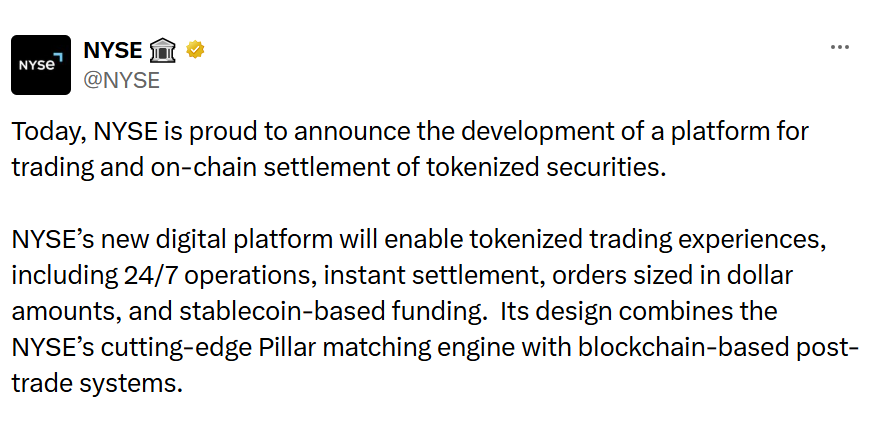
NYSE and ICE announced the project on January 19, 2026. The headline features were 24/7 trading, fractional shares, dollar-sized orders, and immediate settlement, all of which are design goals rather than working features. The original ICE platform announcement lays out the scope.
NYSE also shared the announcement through its official X account.
How Would NYSE Connect Trading, Stablecoins, and Settlement Work?
Post-trade covers clearing, settlement, and ownership records, and the approach resembles tokenized real-world assets, where a claim is recorded as a token.
A transfer agent keeps an issuer's official list of registered shareholders. On November 2, NYSE named six: Securitize, tZERO, Broadridge, Computershare, Equiniti, and Superstate.
According to the NYSE transfer agent update, the three long-established firms serve nearly 5,000 listed companies.
Stablecoins also have a role. A stablecoin is a crypto token meant to hold a steady value, usually one US dollar, and it could let traders fund orders outside banking hours, depending on the final rules. A separate explainer covers how stablecoins work.
What SEC Rules Apply to Tokenized Securities Trading?
Two SEC actions tend to get mixed up. The first is rule SR-NYSE-2026-17, filed in April, which the SEC rule notice records as effective on filing.
It enables tokenized trading on the existing exchange during the DTC pilot, but it does not establish the immediate settlement model proposed for NYSE's separate venue. Nasdaq's comparable rule was approved on March 18, 2026.
The second is the Innovation Exemption, issued on September 17, 2026. It gives qualifying tokenized securities venues conditional five-year relief to trade tokenized stocks through automated market makers.
When an unaffiliated third party creates the token, the venue must notify the issuer in writing and allow an objection first.
The SEC announcement of the exemption has the full terms. Conditional relief doesn't amount to approval of the planned NYSE venue.
How Is the DTCC Service Different From NYSE's Plans?
DTCC's service tokenizes eligible securities that DTC already holds in custody. According to the DTCC launch release, it went live on October 28, 2026, starting on Canton and a private Besu network, with more networks planned for 2027.
Sending a token from one wallet to another is a different activity from trading a stock, and DTCC's service is not a trading venue.
What Protections Apply, and How Could After-Hours Prices Behave?
DTCC says tokens from its service keep the same entitlements, investor protections, and ownership rights as traditional holdings. OKXICE sits in a different position.
Because the venue isn't a registered exchange or broker-dealer, holders' rights depend on the exemption's conditions and each product's terms.
After-hours pricing adds another wrinkle. When the primary listing exchange's regular session is closed, its official reference price may become stale.
What Are the Main Risks of Tokenized Stock Trading?
The rules are still temporary. The SEC exemption ends in September 2031, and NYSE's venue has no approval yet.
Prices are another worry, since trading split across several venues and hours can leave thin markets and uneven pricing.
Ownership also varies from product to product. Some tokens carry shareholder rights, while others only follow the stock's price.
Companies can opt out too, and 67 of them did on OKXICE. Anyone comparing products should first check how shares and tokenized equity differ.
What Should Be Watched Next as Wall Street Moves Onchain?
The groundwork is mostly done, but NYSE still has no date for its own venue. Approval, the first live trades, eligible stocks, and after-hours liquidity will decide whether NYSE tokenized stock trading becomes routine. In the meantime, RWA tokenization trends are worth following.
Final Takeaway: Where the Onchain Shift Stands Now
NYSE tokenized stock trading is still a plan for a new exchange venue, yet the groundwork is real.
DTCC launched its service on October 28, and OKXICE began tokenized trading on November 23.
Approval for NYSE's venue, OKXICE's rollout, investor protections, and after-hours liquidity are the next things to watch.
Disclaimer:This article is for information only and is not financial, legal, or investment advice. Crypto and tokenized assets carry high risk, and regulations can change. Independent research is advised before any decision.