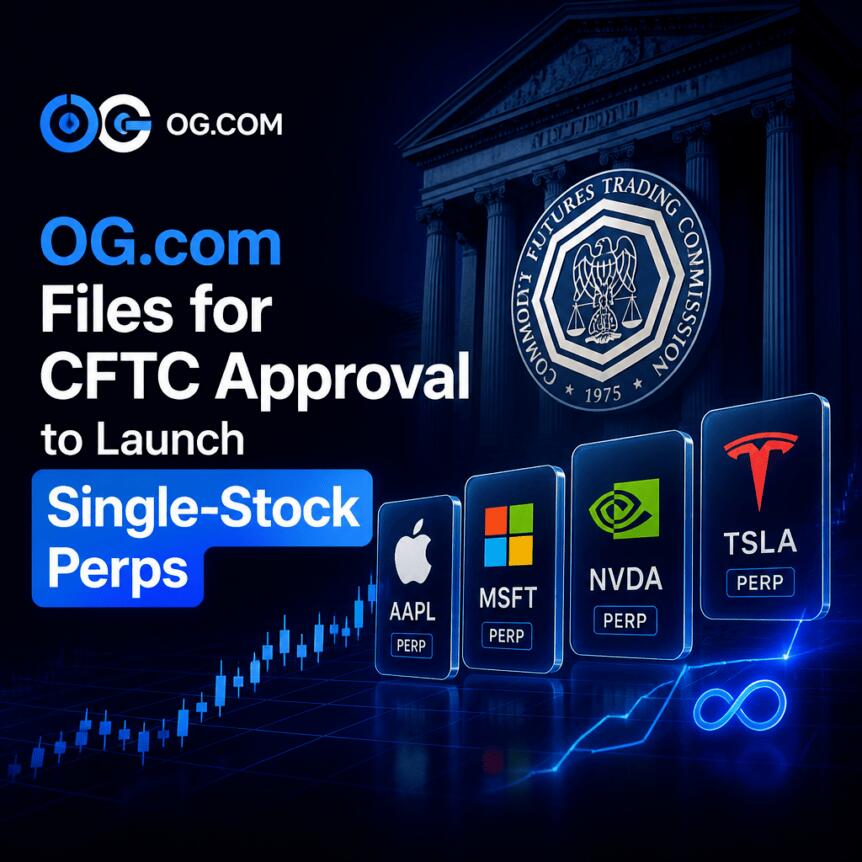
OG.com Markets has filed with the U.S. Commodity Futures Trading Commission (CFTC) to seek permission to offer cash-settled perpetual futures tied to individual stocks—an attempt to bring “pe
OG.com Markets has filed with the U.S. Commodity Futures Trading Commission (CFTC) to seek permission to offer cash-settled perpetual futures tied to individual stocks—an attempt to bring “perps” to U.S. equity derivatives.
In a filing submitted Thursday, the company proposed rules for single-stock futures that do not expire and can be traded continuously, 24 hours a day, five days a week. If approved, the structure could give traders an alternative to dated futures contracts by allowing them to maintain exposure without periodically rolling into new contracts.
Key takeaways
- OG.com Markets is seeking CFTC approval for cash-settled, perpetual single-stock futures that never expire.
- The proposed contracts would run 24/5, aiming to extend around-the-clock derivatives trading to U.S. equities.
- OG.com emerged as an independent platform after being spun out of Crypto.com, and it has since drawn attention from established market participants.
- The filing arrives amid broader efforts by other U.S. derivatives venues—including Coinbase, Kraken’s Bitnomial, and prediction market operator Kalshi—to pursue similar products.
- Regulators have been gradually creating pathways for perpetual-style crypto derivatives, setting the stage for further expansion into traditional markets.
The core of OG.com Markets’ request is regulatory authority to list cash-settled single-stock futures with perpetual terms. Unlike traditional futures—where contracts have defined expiration dates—perpetual futures are designed to keep positions open across contract cycles without requiring traders to roll into a new instrument.
According to OG.com’s Thursday CFTC filing, the company is asking for permission to trade these instruments on a nearly continuous schedule: 24 hours per day, five days per week. That trading window is aligned with how crypto markets often operate, and it reflects the industry’s push to match derivatives trading to the real-time nature of financial flows.
OG.com was recently spun out of the crypto exchange Crypto.com and re-established as an independent prediction markets and derivatives platform valued at $5 billion, as previously reported by Cointelegraph.
At the time of the spin-off, CEO Kris Marszalek said the platform planned to expand beyond prediction markets into futures and perpetual contracts. Shortly after the restructuring, Cointelegraph also reported that Robinhood took an equity stake in OG.com as part of a multi-year deal. The agreement includes plans to use OG.com’s CFTC-regulated derivatives exchange and clearinghouse for prediction markets.
While the current filing focuses on stock-linked perps, the sequence matters: OG.com is positioning itself as a venue where existing regulatory infrastructure used for derivatives and prediction markets could extend into single-stock futures.
Why perps are attracting equity market attention
OG.com’s application is part of a wider trend: trading platforms and prediction market firms are increasingly exploring whether the perpetual futures model can be adapted to U.S. equities.
In the same general push, Cointelegraph previously reported that on Sept. 18, Coinbase, Kraken’s parent through its Bitnomial exchange, and Kalshi filed applications to offer perpetual futures tied to individual U.S. stocks. The wave of filings underscores that the regulatory pathway is no longer seen as purely speculative by major market players.
At the policy level, the timing came after U.S. congressional efforts to advance the CLARITY Act stalled in the Senate on Sept. 15, according to earlier coverage by Cointelegraph. Still, regulators continued moving on targeted crypto initiatives. Just days after the vote, the SEC cleared limited onchain trading of tokenized U.S. stocks under its Innovation Exemption, while the CFTC expanded regulatory relief for software providers connecting users to regulated derivatives platforms, including those that support perpetual contracts—also previously covered by Cointelegraph.
Taken together, these steps suggest a partial but growing willingness to carve out permission structures for specific use cases, even as broader, comprehensive crypto legislation has not advanced.
CFTC groundwork for perpetual contracts
OG.com’s filing fits into work the CFTC began earlier to clarify how perpetual contracts can be reviewed. According to CFTC press materials referenced by Cointelegraph, the agency established a case-by-case review process for perpetual contracts in May, then approved Kalshi’s Bitcoin perpetual futures product.
In June, the CFTC also issued temporary relief that allowed certain registered exchanges to convert existing crypto futures into contracts without expiration dates. That matters for stock-linked perps because it indicates regulators have already been willing—at least under defined conditions—to treat perpetual structures as something beyond the initial crypto derivatives experimentation cycle.
For investors and traders, the practical question now becomes what changes once equity becomes the underlying asset. Perpetual stock futures would bring the derivative form closer to the mechanics many crypto traders know, but the economic drivers—such as stock-specific market dynamics, hedging costs, and settlement rules—could differ substantially from crypto benchmarks.
What to watch next
OG.com’s CFTC filing is a step toward making perpetual, stock-linked derivatives available in the U.S., but approval is not guaranteed. Market participants should track how the CFTC evaluates perpetual contract mechanics for single stocks—especially around settlement design and the regulatory boundaries between traditional securities markets and crypto-style trading infrastructure.
This article was originally published as OG.com Files for CFTC Approval to Launch Single-Stock Perps on Crypto Breaking News – your trusted source for crypto news, Bitcoin news, and blockchain updates.