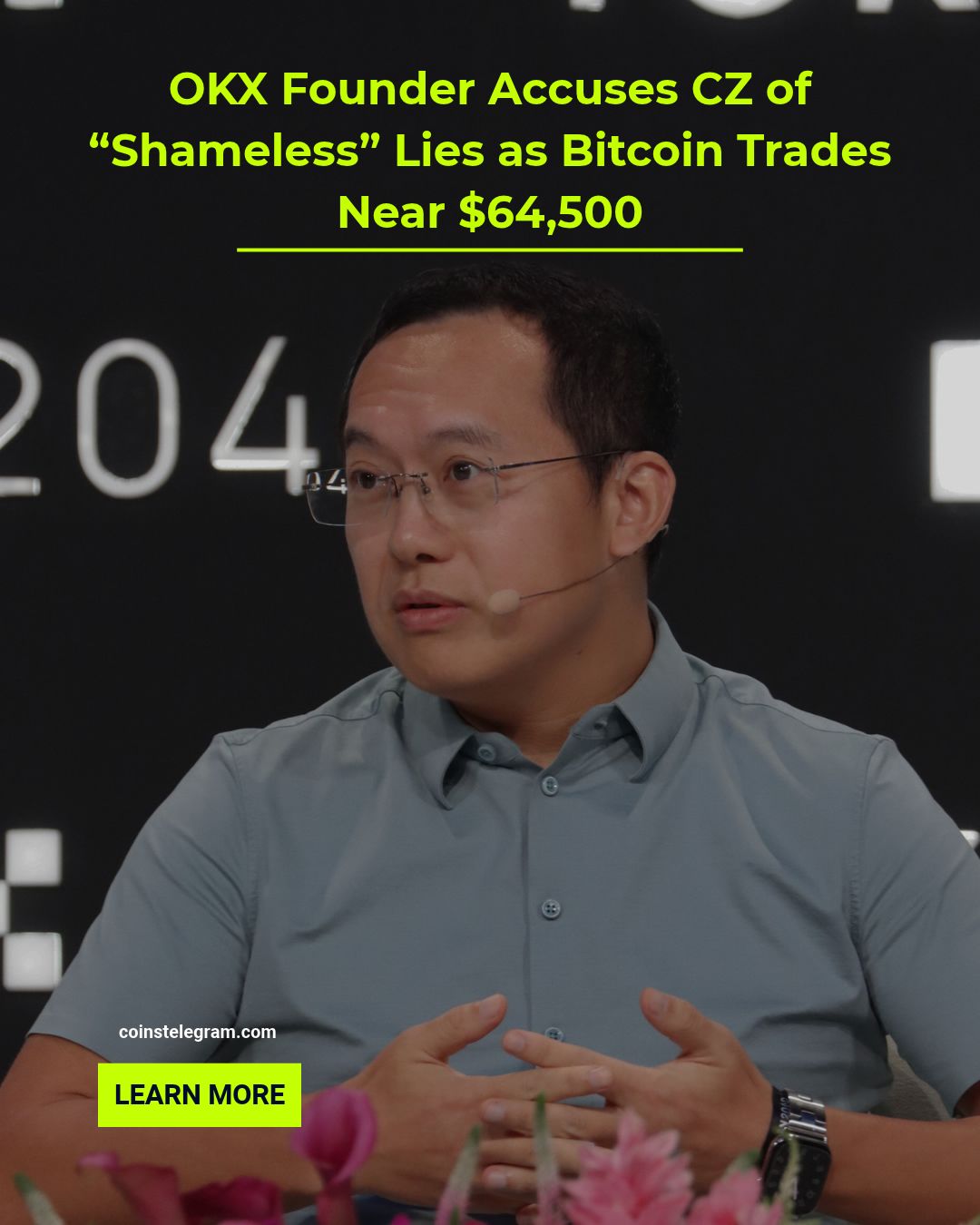
OKX founder Star Xu has renewed his criticism of Binance co-founder Changpeng Zhao, accusing the rival exchange’s leadership of misleading customers after successive October market disruption
OKX founder Star Xu has renewed his criticism of Binance co-founder Changpeng Zhao, accusing the rival exchange’s leadership of misleading customers after successive October market disruptions.
The dispute intensified on Sunday, November 15, after Zhao said he had continued buying cryptocurrency during the selloff. Xu responded with a sharply worded post questioning how an exchange could ask customers to maintain a long-term outlook after incidents he blamed for damaging the wider industry.
His remarks are accusations, not an established finding that Binance caused either market crash. Zhao has previously rejected that interpretation.
The argument comes as Bitcoin remains under pressure. At approximately 06:34 UTC on November 16, BTC traded near $64,538, according to a timestamped market-price snapshot.
Star Xu Challenges CZ’s Message to Crypto Holders
Xu’s criticism followed comments in which Zhao described his own investment activity during the downturn.
Although Xu did not name Zhao or Binance directly in the quoted passage, he was responding to a post discussing Zhao’s comments. He wrote:
While the entire crypto industry has been suffering from the consequences of their stupid incidents for two consecutive years, is there anyone who lies to the public more shamelessly than this—after repeatedly causing market crashes every October, then claiming to be responsible for protecting their customers and asking those same customers to maintain a long-term vision?
Xu also alleged that complaints from customers and community members were being dismissed as attacks organized by competitors, including OKX.
That criticism concerns accountability as much as price performance. Xu’s argument is that reimbursement commitments and long-term messaging do not resolve questions about the events that disrupted customers.
However, the post does not independently demonstrate that Binance caused the broader market decline or that particular complaints were deliberately misrepresented.
CZ Says He Bought Daily and Rejects Binance-Selling Claims
Zhao’s account of his own trading was straightforward: “I only bought, DCA every day.”
DCA means dollar-cost averaging, a strategy involving purchases at regular intervals rather than attempting to identify a single ideal entry point. Zhao’s statement describes his claimed personal activity; it is not an independently verified record of his trades.
He also said Binance did not sell cryptocurrency during the decline and previously denied that the exchange was responsible for the latest plunge.
The reporting reviewed for this article did not identify a direct response from Zhao to Xu’s latest criticism.
Two separate questions therefore remain central to the disagreement: what Zhao personally bought, and whether Binance’s operations contributed to market instability.
Evidence supporting one would not automatically settle the other. Personal purchases cannot establish the cause of a market-wide selloff, while accusations against an exchange do not disprove an individual’s trading statement.
Binance’s $6.3 Billion Hack Remains a Major Flashpoint
The latest confrontation follows Binance’s October 29 security breach, which the exchange estimated affected approximately $6.3 billion in cryptocurrency.
Binance suspended withdrawals while investigating and pledged to cover the financial impact using company resources, including its Secure Asset Fund for Users, or SAFU. Withdrawals began returning in phases on November 1.
The company subsequently distinguished funding allocated for compensation from purchases of the specific tokens needed to replace stolen assets.
In a November 4 update, Binance said it had set aside more than the full amount required and replenished approximately 98% of affected assets. It said the remaining purchases involved less-liquid tokens that were slower to acquire.
That dated update should not be presented as proof that every replacement purchase had been completed by November 16.
Likewise, replacing customer assets is different from recovering stolen cryptocurrency from attackers. Reimbursement can protect balances while leaving the exchange itself with a substantial financial loss and unresolved security questions.
The Feud Also Reaches Back to October 2025
Xu’s reference to two consecutive years connects the latest breach with the October 10–11, 2025 liquidation crisis.
He previously argued that promotional campaigns involving Ethena’s USDe encouraged leveraged positions that amplified the selloff. His criticism focused on a Binance promotion offering a 12% annualized yield and the risks associated with treating the synthetic-dollar token as dependable collateral.
Binance and Zhao disputed the claim that the exchange caused the crash.
The two October events should not be treated as identical. The 2025 controversy involved leverage, collateral and liquidation mechanics. The October 2026 incident involved a major security breach.
They can both raise questions about exchange risk without proving a single explanation for every subsequent fall in cryptocurrency prices.
Bitcoin’s Bearish Backdrop Extends Beyond the Exchange Dispute
Bitcoin’s November 16 price near $64,500 followed a recent decline toward $62,000. The rebound had not erased the broader downtrend.
Market reporting described six consecutive weekly losses and a decline exceeding 24% since early October. US spot Bitcoin exchange-traded funds also experienced substantial net withdrawals over the preceding two weeks.
These developments support describing conditions as bearish, while leaving room for short-term rebounds. A recovery from a local low does not by itself establish that selling pressure has ended.
The wider backdrop includes weak institutional flows, higher bond yields and a stronger dollar—factors that can influence demand for speculative assets independently of exchange-specific problems.
For readers assessing the feud, the key distinction is between public accusations and demonstrated causation. Xu is demanding accountability, Zhao is rejecting blame, and Binance’s recovery statements address its response to the breach. Determining the causes of the broader selloff requires evidence beyond any executive’s social-media account.