OKX is preparing to launch perpetual futures contracts for SOFTBANK, TQQQ, MVLL and MUU equities, expanding its stock-linked derivatives offering and giving crypto-native traders access to eq
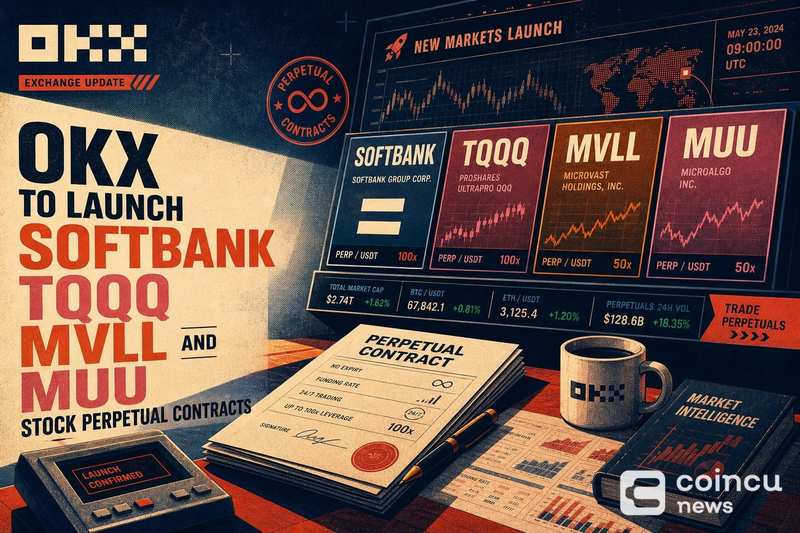
OKX is preparing to launch perpetual futures contracts for SOFTBANK, TQQQ, MVLL and MUU equities, expanding its stock-linked derivatives offering and giving crypto-native traders access to equity-themed exposure without leaving the platform.
The exchange confirmed the upcoming listings through its official help center announcement, identifying the four instruments as stock perpetual contracts. These are derivative products, not direct equity purchases, meaning traders will gain price exposure to the underlying stocks through perpetual futures settled in crypto. For related coverage, see American Bitcoin 1-for-15 Reverse Stock Split to Maintain Nasdaq Listing.
What OKX Is Adding With These Four Contracts
The four new listings cover distinct corners of the equity market. SOFTBANK refers to the Japanese conglomerate SoftBank Group, which has been making headlines recently through major investment moves, including its $1.4 billion investment in Skild AI and its $4 billion acquisition of DigitalBridge.
TQQQ is the ProShares UltraPro QQQ, a triple-leveraged ETF tracking the Nasdaq-100 index. It is one of the most actively traded leveraged ETF products in traditional markets, making it a notable addition to a crypto derivatives platform. For related coverage, see U.S. OFAC Sanctions 134 New Crypto Wallet Addresses.
MVLL and MUU round out the listing. All four contracts are perpetual futures, meaning they have no expiry date and instead use a funding rate mechanism to keep the contract price aligned with the underlying asset's spot value.
Why Equity-Linked Perpetuals Attract Crypto Traders
Stock perpetual contracts allow traders to speculate on equity price movements using crypto collateral, without needing a traditional brokerage account. For crypto-native users, this removes friction associated with accessing equity markets across different jurisdictions.
The inclusion of TQQQ is particularly notable. As a leveraged ETF product, it already amplifies Nasdaq-100 movements by three times. Wrapping that in a perpetual contract with additional leverage creates a high-volatility instrument that appeals to speculative traders seeking magnified directional bets.
OKX is not alone in this push. Binance also announced perpetual contracts for MVLL and TQQQ alongside SQQQ, offering up to 20x leverage. The parallel moves suggest growing exchange competition over equity-linked derivatives as a category.
How Stock Perpetual Contracts Work
Unlike buying shares through a broker, holding a stock perpetual contract does not grant ownership of the underlying equity. Traders hold a derivative position that tracks the stock's price. There are no dividends, no voting rights, and no claim on company assets.
Perpetual contracts use a funding rate, a periodic payment exchanged between long and short holders, to keep the contract price close to the spot price of the underlying asset. When the contract trades above spot, longs pay shorts. When it trades below, shorts pay longs.
Leverage amplifies both gains and losses. Traders who use leverage risk liquidation if the position moves against them beyond their margin threshold. Given that TQQQ itself is already a leveraged product, applying additional futures leverage compounds this risk significantly.
Strategic Implications for OKX
Adding equity-linked perpetuals signals OKX's intent to position itself as a multi-asset trading platform rather than a crypto-only exchange. This approach broadens the potential user base to include traders interested in macro equity exposure alongside their crypto portfolios.
The SoftBank listing is timely given the conglomerate's high-profile dealmaking. SoftBank has recently been active in both AI and crypto-adjacent investments, including a transaction where Tether acquired SoftBank's entire stake in Twenty One Capital. Listing a SoftBank perpetual captures trader interest around these headlines.
For OKX, product breadth serves as a competitive differentiator. Exchanges that offer a wider range of tradable instruments can retain users who might otherwise split activity across multiple platforms. Equity perpetuals fill a gap between pure crypto trading and traditional finance access.
FAQ About OKX Stock Perpetual Contracts
Do traders own the underlying stock when trading these contracts?
No. Stock perpetual contracts are derivatives that track the price of the underlying equity. Holding a contract does not confer stock ownership, dividends, or shareholder voting rights. Traders are speculating on price movement only.
What are the main risks of trading stock perpetuals?
The primary risks include liquidation from leveraged positions, funding rate costs that can erode returns over time, and potential price divergence between the perpetual contract and the underlying stock during volatile periods.
Why does TQQQ stand out among the four listings?
TQQQ is already a triple-leveraged ETF, meaning it amplifies Nasdaq-100 daily moves by 3x. Trading a perpetual contract on TQQQ with additional leverage creates layered exposure that can produce outsized gains or losses, making it one of the highest-volatility instruments available on a crypto exchange.
What does this launch mean for OKX users seeking equity exposure?
It provides a way to gain directional exposure to major equities and ETFs without leaving the OKX platform or opening a separate brokerage account. Traders can use crypto as collateral to access equity-themed markets through a familiar perpetual futures interface.
Disclaimer: This article is for informational purposes only and does not constitute financial or investment advice. Cryptocurrency and digital asset markets carry significant risk. Always do your own research before making decisions.
The post OKX to Launch SOFTBANK, TQQQ, MVLL and MUU Stock Perpetual Contracts was initially published on Coincu.