OKXICE TSV, the tokenized-securities venue owned in equal parts by Intercontinental Exchange and OKX, was set to open to eligible U.S. customers on November 23 with more than 70 assets listed

OKXICE TSV, the tokenized-securities venue owned in equal parts by Intercontinental Exchange and OKX, was set to open to eligible U.S. customers on November 23 with more than 70 assets listed, among them 59 Direxion ETFs and shares of Coinbase, Circle, Robinhood, BitGo, Better.com, Securitize and Strategy. Trading runs through permissioned automated market maker pools built on Uniswap v4 and deployed on X Layer, OKX’s Ethereum layer-2 network. The venue does not hold customer assets or keys.
That combination — a New York Stock Exchange parent on one side, a crypto exchange on the other, and an automated market maker instead of an order book in the middle — is what makes the launch worth reading past the asset count. OKXICE is not an exchange and not an alternative trading system. It operates under temporary relief the Securities and Exchange Commission granted in September, and the terms of that relief define what the venue does, what it does not do, and what nobody can yet measure.
What the exemption actually permits
The legal footing is an SEC order issued September 17, 2026, Release No. 34-106402, File No. 4-927, published at 91 Fed. Reg. 60168 on September 22. It grants two things: relief from the definition of “exchange” in Section 3(a)(1) of the Securities Exchange Act for venues that trade tokenized NMS stocks through AMM liquidity pools, and relief from the definition of “dealer” in Section 3(a)(5) for the firms that supply liquidity into those pools.
“The Commission hereby issues these temporary, conditional exemptions to facilitate the permissioned trading of tokenized NMS stock using innovative automated market makers (‘AMMs’) and liquidity pools …”
Note the adjectives. Temporary and conditional. The order is paired with a request for comment, which places the structure somewhere between a pilot and a rule: it can run, but its continuation depends on the Commission, not on the venue’s trading volume.
The order also draws a line that matters for anyone reading a token symbol on the venue. “Tokenized NMS Stock” covers a listed stock tokenized by its issuer or by an unaffiliated third party. It excludes synthetic exposure — a third party’s own security that merely tracks an underlying stock, such as a tokenized linked security or a tokenized security-based swap. In other words, the exemption legitimises a wrapped share. It does not legitimise a tracker.
No order book, no registration, no fair-access duty
The venue’s own public notice, dated November 20, is blunter than any press release. OKXICE TSV, it states, “is not registered with the Securities and Exchange Commission … in any capacity for the activities performed under the TSV Exemption” The same document confirms the venue “is not subject to the fair access requirements applicable to registered national securities exchanges and alternative trading systems …” and “is not subject to Regulation NMS.”
Regulation NMS is the rulebook that gives U.S. equity investors order protection, best-execution across venues and a consolidated price feed. A venue outside it has no national best bid and offer to honour, because it has no quotes to publish in the first place. Liquidity sits in pools, prices come from a bonding curve and pool balances, and trades settle against a smart contract rather than a matching engine.
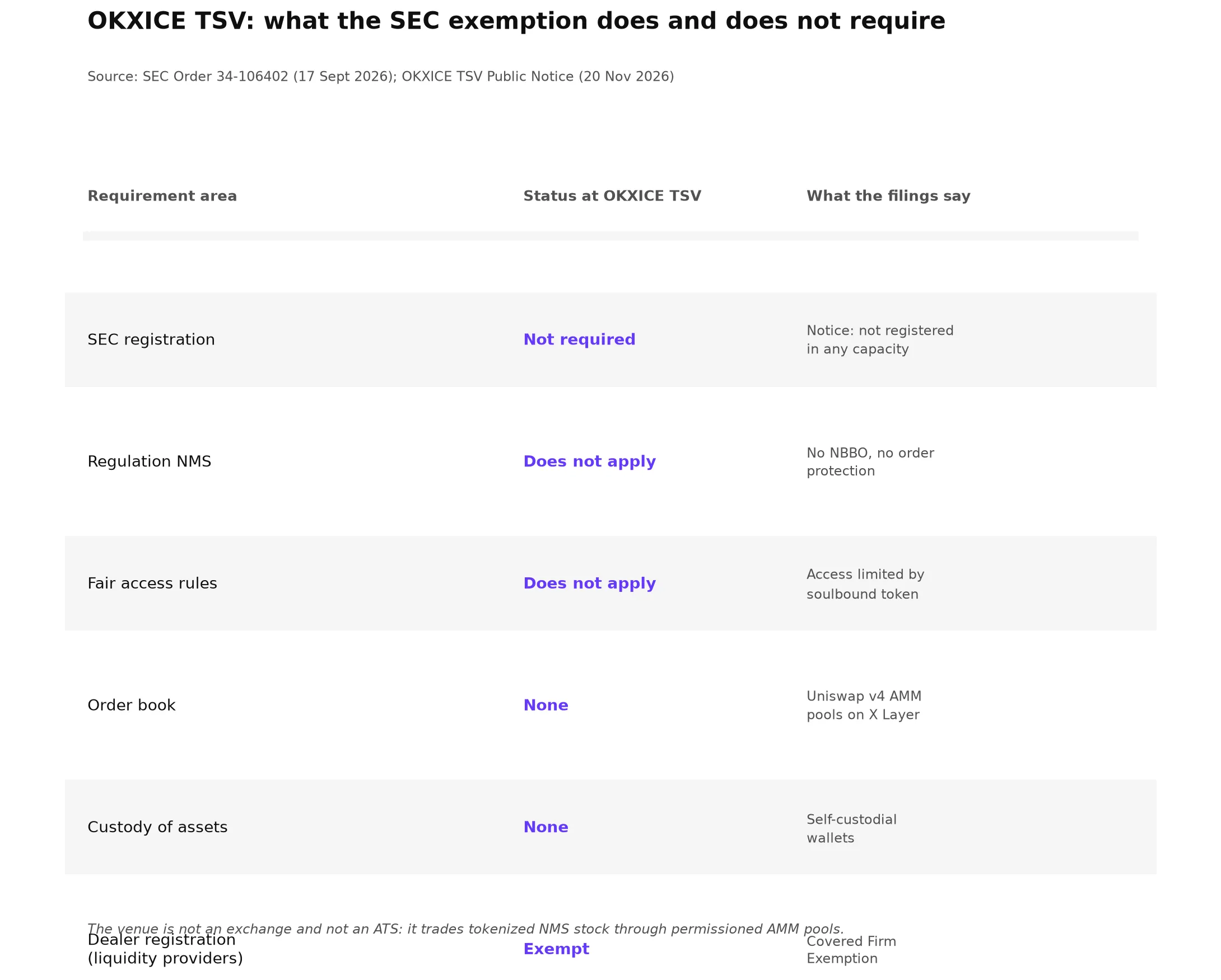
What the September exemption requires of OKXICE TSV, and what it leaves out. Source: SEC Order 34-106402 (17 Sept 2026); OKXICE TSV Public Notice (20 Nov 2026).
Access is gated the same way the pools are. Only wallets holding a soulbound token issued by OKXICE TSV may trade in or provide liquidity to a pool, and the venue’s notice says only OKXICE TSV may create pools using its Hook contract, the smart-contract extension that enforces that permissioning. The notice is equally explicit about what the venue does not do: “OKXICE TSV does not operate an order book, does not hold or take custody of TSV Participants’ assets, does not extend credit, and does not conduct primary offerings of securities.”
Fifty-nine of seventy is the actual headline
The roster number deserves arithmetic rather than repetition. If 59 of the “more than 70 assets” are Direxion ETFs, then ETFs are at least 84% of the lineup. Run the same sum from the other side: OKX names seven corporate issuers — Better.com, BitGo, Circle, Coinbase, Robinhood, Securitize and Strategy — which leaves roughly four slots unaccounted for in a roster described as 70-plus. The venue is, by composition, a levered and thematic fund shelf with a handful of individual stocks attached, and Strategy’s preferred shares extend that shelf rather than adding a new company.
That mix is not an accident of marketing. It is what remains after the objections. BlockchainReporter reported in October that 22 issuers objected to having their shares traded on the venue and that nine U.S. companies moved to block tokenized trading on OKXICE outright. The blue-chip names that would have made the launch a genuine equity market are largely absent from the notice-and-launch record, and the ETFs that fill the gap carry issuers who sold the wrapper themselves.
The earlier reporting on this thread is worth keeping in view: the November 23 roster was announced on November 12, the nine blocking companies were reported on October 18, and the 22 objections were reported on October 25. What changed today is not the roster. It is that the venue is now operating, with the legal architecture above as its foundation.
Securitize holds the wrapper, the wallet stays yours
Securitize supplies the tokenization layer. Each token, per OKX, represents a security entitlement backed one-to-one by an underlying U.S. share, carrying dividends, voting rights and participation in corporate actions. Customers hold the tokens in self-custodial wallets, which is the structural counterpart to the venue’s refusal of custody: there is no broker-dealer balance sheet in the middle, and no venue-held private keys to lose or to freeze.
Both co-chairs framed the launch as a permissions story rather than a product story. Governor Andrew M. Cuomo, Co-Chair of OKXICE: “The SEC has created a real opening for American markets to lead the next era of finance. OKXICE TSV gives first movers the opportunity to bring their securities onchain through a compliant venue built for 24/7 markets and real shareholder rights …” Trabue Bland, also Co-Chair, put the same point in narrower terms: “With the OKXICE TSV, eligible investors will be able to access tokenized U.S. securities around the clock, under the framework of the SEC’s Innovation Exemption.”
The ownership behind those quotes is a 50/50 split. OKXICE LLC is a Texas limited liability company, half owned by Intercontinental Exchange Holdings and half by OKC USA Holding, according to the public notice. ICE’s side of the relationship began in March, when it invested in OKX at a $25 billion valuation, took a board seat and agreed to license OKX spot crypto prices for U.S.-regulated futures while routing its tokenized equities and futures markets toward OKX’s stated 120 million accounts.
What today does not tell us
Three things are unverified at publication, and they are not small. First, volume. OKX said trading begins November 23; BlockchainReporter could not independently confirm executed trades, and the venue’s design makes that harder than usual — there is no tape to watch, only pool balances and swap events on X Layer. Second, whether the tokenized shares trade anywhere near the underlying price once pools are thin, which is the chronic risk of AMM-based equities and the reason a market in an order book and a market in a pool are not the same instrument. Third, whether the temporary relief becomes durable: the exemption is conditional, comment is open, and a venue whose entire legal basis can be revisited is a venue whose liquidity providers will price that risk.
What is verifiable is narrower and firmer. As of today, a U.S. investor with an eligible OKX account can hold a tokenized share of Coinbase or a Direxion fund in a self-custodial wallet, trade it around the clock against a stablecoin in a Uniswap v4 pool, and do so on a venue that is not registered with the SEC, is not bound by Regulation NMS and owes no fair-access duty to anyone. That is a real change in what a U.S. equity venue can be, and it arrived under an exemption the Commission can end.
Read the primary documents rather than the launch copy: the OKXICE public notice of November 20 and OKX’s own description of how the venue works.
The post OKXICE Opened With 70 Tokenized Assets. The SEC Let It Skip Registration, Reg NMS and Fair Access appeared first on BlockchainReporter.
