Ondo Finance has unveiled the infrastructure it says will power its next generation of trading products, and it looks nothing like a traditional blockchain. The company introduced the Ondo Ne
Ondo Finance has unveiled the infrastructure it says will power its next generation of trading products, and it looks nothing like a traditional blockchain.
The company introduced the Ondo Network on July 27, describing it as an execution layer designed to be fast and private like a centralized exchange, while still being verifiable like a blockchain and non-custodial by design, meaning users keep control of their own funds throughout.
The first product running on it is Ondo Perps, the perpetual futures trading platform Ondo launched last week.
Related: Ondo Finance clears a major hurdle for tokenized stocks in U.S.
Ondo by the numbers
The launch comes from one of the biggest names in tokenization, the business of issuing traditional assets such as Treasuries and stocks as blockchain tokens.
Ondo has surpassed roughly $2.5 billion in total value locked and about $3.4 billion in platform assets, making it the largest issuer of tokenized U.S. Treasuries and tokenized stocks. Its USDY Treasury token has grown past $2 billion across eight blockchains, and Ondo Global Markets passed $1 billion in under eight months while listing more than 260 stock and ETF symbols. Its ONDO token ranks among the larger real-world-asset tokens by market value.
The backdrop is a fast-growing market. The value of tokenized real-world assets on public blockchains has reached about $31 billion, up from $5.4 billion at the start of 2025, with tokenized Treasuries the largest slice at roughly $15 billion and BlackRock's BUIDL fund alone near $2.4 billion.
Consulting firm BCG has projected the category could reach $16 trillion by 2030 — a forecast that helps explain why infrastructure like Ondo's is being contested so hard.
Why Ondo didn't just build another blockchain
Ondo originally set out to build its own blockchain, called Ondo Chain. But while developing Ondo Perps, the company says it realized the real bottleneck wasn't settlement, the part blockchains typically do well, but execution, the actual matching, risk, and margin calculations that need to happen instantly during a trade.
Traditional blockchains slow this down because every transaction gets copied across every node on the network and made publicly visible. That's great for security and transparency, but it's a poor fit for trading, where speed and privacy matter most.
Centralized exchanges solve the speed problem but require users to trust the operator completely. Other approaches, like app-specific blockchains or fully permissioned networks, each end up trading away one property to protect another.
Trending on TheStreet Roundtable:
How the Ondo Network actually works
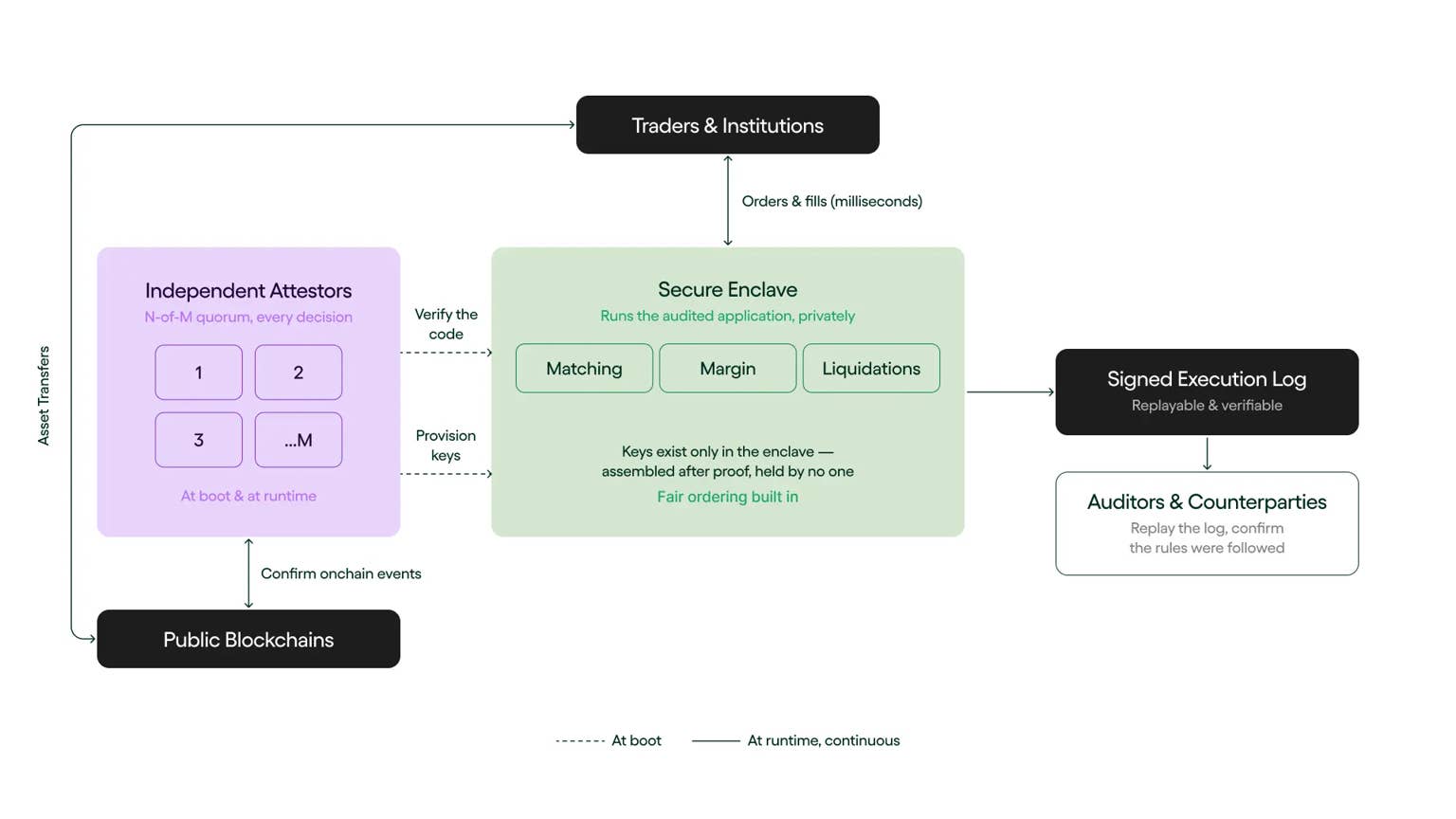
Instead of forcing execution and settlement into the same system, Ondo Network separates them entirely. Trade execution runs inside secure hardware enclaves, isolated computing environments that even the machine's own operator cannot inspect or tamper with.
Each enclave carries a cryptographic fingerprint of the exact code it's running, so if even a single byte changes, that fingerprint changes too, and the system rejects it.
A separate group of independent operators, called attestors, forms the trust layer around those enclaves. Before any enclave can run, a quorum of attestors has to independently verify its code matches the approved version.
Source:
Ondo FinanceAttestors also hold pieces of the cryptographic keys needed to move user funds, split up so that no single attestor, and not even Ondo itself, can ever reconstruct a complete key alone. Asset transfers ultimately settle on public blockchains, giving the system a durable, verifiable record that lives separately from the execution layer itself.
Every action the enclave takes gets recorded in a signed log that outside auditors, counterparties, or regulators can independently replay to confirm the rules were actually followed, without needing to trust Ondo's word for it.
What this actually solves for traders
The design gives traders speed close to what a centralized exchange offers, since execution isn't slowed down by replicating every transaction across a network.
At the same time, it keeps trading activity private, since sensitive information like order flow and open positions doesn't need to be broadcast publicly the way it would on a typical blockchain.
And because keys only ever exist inside verified enclaves, no operator, including Ondo, can move user funds without the system's approved rules being followed.
Where this is headed next
Ondo says execution currently runs inside a single high-performance enclave rather than a replicated network, and it describes its attestor set only as multiple operators, so the system is more concentrated today than a live public blockchain.
The company says the network will keep decentralizing over time, potentially opening up its attestor set to more independent, bonded participants, separating out responsibilities like code verification and key custody, and adding new cryptographic proof systems that let anyone verify the network's behavior without needing to trust Ondo directly.
The push also follows a busy stretch for the company. On July 23, Ondo's Oasis Pro Markets unit secured FINRA authorizations to offer tokenized equities and funds to U.S. investors, and a week earlier it partnered with Japan's SBI Group to bring Japanese equities onchain.
Related: Aptos climbs to the top 4 blockchains in transaction count