OPay is installed on 69% of smartphones used in Nigeria, making it the most widely present banking and fintech app in the country, according to the Nigeria Smartphone Study 2025 released by O
OPay is installed on 69% of smartphones used in Nigeria, making it the most widely present banking and fintech app in the country, according to the Nigeria Smartphone Study 2025 released by Orange Group and KPMG.
The figure places OPay far ahead of every other financial app captured in the study. PalmPay ranks second at 29%, while Access Bank records 16% and Moniepoint 14%. UBA and GTBank follow at 11% each, FirstBank at 10%, Zenith Bank at 9%, and Kuda at 8%. PayPal trails with 7%.
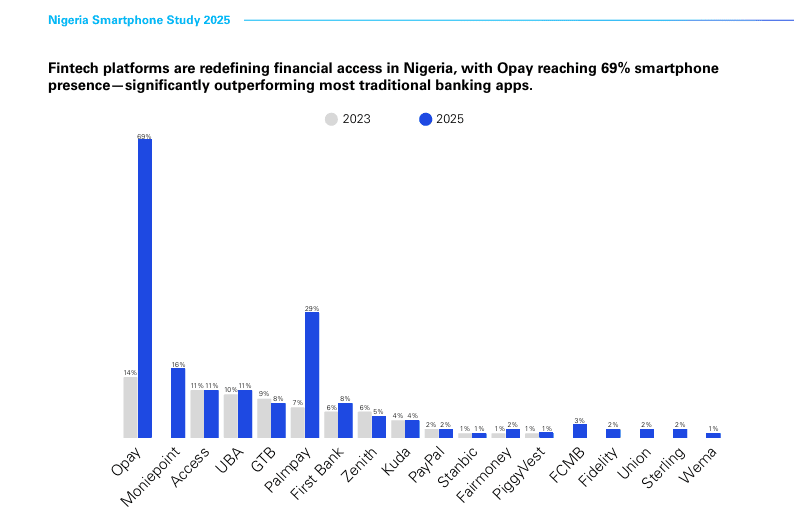
The report identifies OPay, PalmPay and Moniepoint as the three most common banking and fintech apps on Nigerian smartphones, a ranking that underlines how deeply fintech platforms have settled alongside traditional banks in the daily financial lives of Nigerians.
Similar read: Nigerians moved ₦18.78tn through POS in Q1 2026, but where did the money really go?
The study draws on responses from 13,251 people across 12 cities, including Lagos, Ibadan, Abuja, Kano, Port Harcourt, Benin City and Kaduna. It also found that smartphone penetration in Nigeria rose to 75% in 2025, up from 64% in 2023.

OPay’s lead and what it signals
The study describes OPay’s 69% presence as a commanding lead over both fintech rivals and conventional banks, and it ties the wider rise of fintech apps to how Nigerians now use their phones for transfers, bill payments, airtime top-ups and a growing list of everyday financial tasks.
That shift has pushed traditional banks into the same mobile space as fintech firms, where app speed, ease of use and digital services increasingly shape how customers judge them.
The 69% figure, however, should not be read as 69% of Nigerians using OPay, or as OPay holding 69% of the country’s banking customers. It refers only to the app’s presence on smartphones among the study’s respondents.
The finding lands as smartphone ownership keeps climbing. In the 2025 study, 75% of respondents owned a smartphone, up from 64% in 2023.
With more Nigerians turning to their phones as the main gateway to financial services, the contest between fintechs and traditional banks is increasingly being fought on the handset itself.
Also read: Eight years on, OPay keeps Nigerian businesses moving
