OpenAI says its GPT-6 models can generate novel protein structures and the underlying amino acid sequences using just reasoning and code, not a specialized biology model. The claim can be fou
OpenAI says its GPT-6 models can generate novel protein structures and the underlying amino acid sequences using just reasoning and code, not a specialized biology model.
The claim can be found in a preprint that was published on Tuesday and has not been peer-reviewed.
The paper is titled “GPT-6 as a Universal Foundation Model for Protein Biology: Beyond Specialized Models.” OpenAI presents the work as proof that a single general model can perform tasks that presently call for several specialized models, each with unique inputs and retraining needs.
Prompts replaced retraining in 14 benchmark tasks
The difficult part of protein design is moving from a desired function to a workable amino acid sequence. Specialized generators made it doable, but using them required real skill.
Only prompts guided the new designs. They specified how many coils or strands a minibinder should have and where it should bind to its target.
OpenAI says that its internal model followed those instructions with nearly perfect fidelity and without the need for retraining.
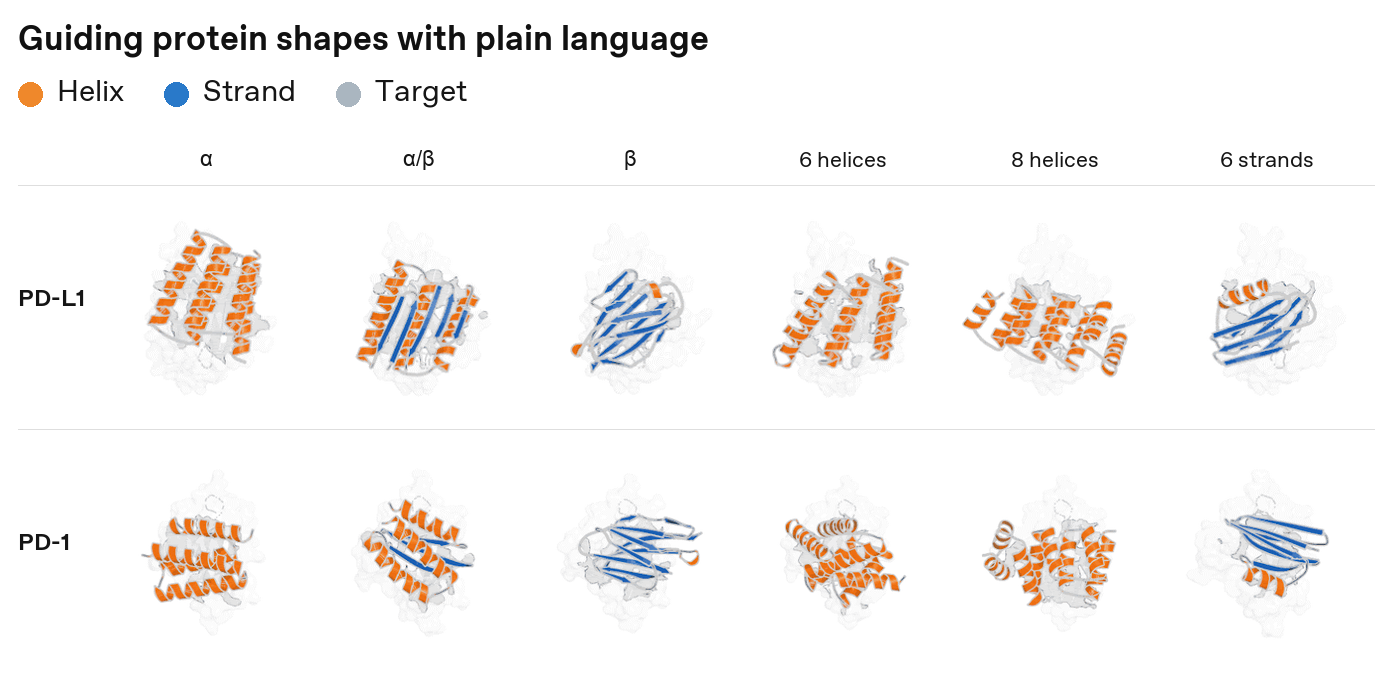
Protein shapes the company says its models produced from plain-language instructions, for the PD-L1 and PD-1 targets, in research published by
OpenAI on November 24, 2026.
When requested to generate a small protein that could bind to the receptor IL-7Rα, GPT-6.2 suggested a potential fit between the two proteins, constructed a structure out of five coiled components, and ran code to test the interaction. On most of the 14 protein tasks examined computationally, OpenAI’s latest internal models either matched or performed better than specialized tools.
Predicting an entire protein structure remained a glaring shortcoming. The internal model produced an average TM-score of 0.38, whereas the specialized structure-prediction model ESMFold2 produced an average of 0.93.
35 of 322 minibinders bound their targets in Onava’s lab
Research partner Onava finished the wet-lab work by building small proteins using 3D structures produced by a pre-release GPT-6.2. It was found that 35 minibinders, or 10.9% of the 322 minibinders tested against five targets, bound.
IL-17A had 18 hits, VEGF-A had 8, PD-L1 had 5, IL-7Rα had 3, and TrkA had 1. According to OpenAI, the initial RFdiffusion study showed higher hit rates.
GPT-6.2 was pushed at sequence design using separate runs. Of the 107 proteins that were created using its novel minibinder sequences, 14 bound to their target.
The antibody work received a higher score. New binding loops continued to bind IL-4Rα in 128 out of 182 designs, while PD-1 or PD-L1 remained bound by 179 out of 272 fragments from five therapeutic antibodies.
GPT-6.2 was not functioning on its own. After a specialized model called SolubleMPNN supplied the amino acid sequences that transformed its forms into testable proteins, Boltz-2, OpenDDE, and ESMFold2 screened the candidates.
“Our results therefore do not yet establish that our models can generate de novo minibinders end-to-end in a zero-shot setting without help from specialized models,” OpenAI wrote.
Only internal models that are not yet publicly available surpassed RFdiffusion, which did marginally better computationally than GPT-6.2’s own three-dimensional designs.
Binding is not a biological function. According to OpenAI, specificity, stability, biological activity, safety, and efficacy have not yet been determined.
“I believe the large language model can technically beat every specialized model in even each capability,” Masatoshi Uehara, an OpenAI researcher, told Nature.
The caution remains in other places. According to Cryptopolitan, Vas Narasimhan, CEO of Novartis, discounted predictions of an AI cancer cure within ten years and assessed scientists’ comprehension of the human body at about 5%.
This has also been demonstrated in various circumstances by the OpenAI model family. Although GPT-6 Astra outperformed rivals on robotics benchmarks, it was far too slow and inaccurate to be used in production.
For now, the protein work is a research project with lab signals rather than a deployed technology. OpenAI seeks to design for post-binding processes and identify minibinders for more difficult targets.
If you're reading this, you’re already ahead. Stay there with our newsletter.