OpenAI doesn’t want ChatGPT merely to respond to inquiries. The company intends to conduct tests aimed at combining the ChatGPT bot and Work business agent features into one interface. Users
OpenAI doesn’t want ChatGPT merely to respond to inquiries. The company intends to conduct tests aimed at combining the ChatGPT bot and Work business agent features into one interface. Users will switch from asking a question to finishing a project without having to switch interfaces.
OpenAI will first test the merged interface with a small group of users, according to an email seen by BleepingComputer. The change raises another question for users: how much of their allowance will longer tasks consume?
From answers to finished deliverables
OpenAI describes Chat as the place for quick questions and brainstorming. Work handles bigger jobs, from research and spreadsheets to reports, presentations and published Sites.
The users have the ability to upload files and utilize the connected plugins while monitoring and guiding the work done by the agent. The impending merger would combine everything into one conversation. Codex will still remain a standalone platform.
Anthropic got there first
Anthropic moved first. In its September 16 announcement, the company said:
“Cowork and chat are merging into one Claude.”
The unified experience began rolling out to Pro, Max and Ultra subscribers. Enterprise followed on October 23, with Team and Free plans still to come.
Anthropic also introduced Claude Docs and Slides, allowing users to edit documents and presentations. ChatGPT Work offers similar capabilities, including publishing Sites. Both companies want users to move from asking questions to completing tasks without having to switch tools.
Where the usage meter comes in
Consolidation of tasks into one interface also highlights the costs associated with usage. As per the existing rules of OpenAI, Work and Codex already have a shared allowance structure. Credits can be bought when the usage allowance is consumed.
Faster performance comes at a higher cost. On the Pro $500 plan, Ultrafast consumes included usage at eight times the standard rate. After that, it draws credits at six times the standard rate.
Another change takes effect in December. Plus, Pro and Business subscribers will share a token-based allowance across ChatGPT and Codex. Instant chat won’t count toward that limit. Users will also be able to check their remaining allowance and reset times under Settings > Usage.
The move follows OpenAI’s October 29 decision to double Work and Codex allowances for Pro $100 and $500 subscribers. Affected Pro $200 accounts also received higher limits.
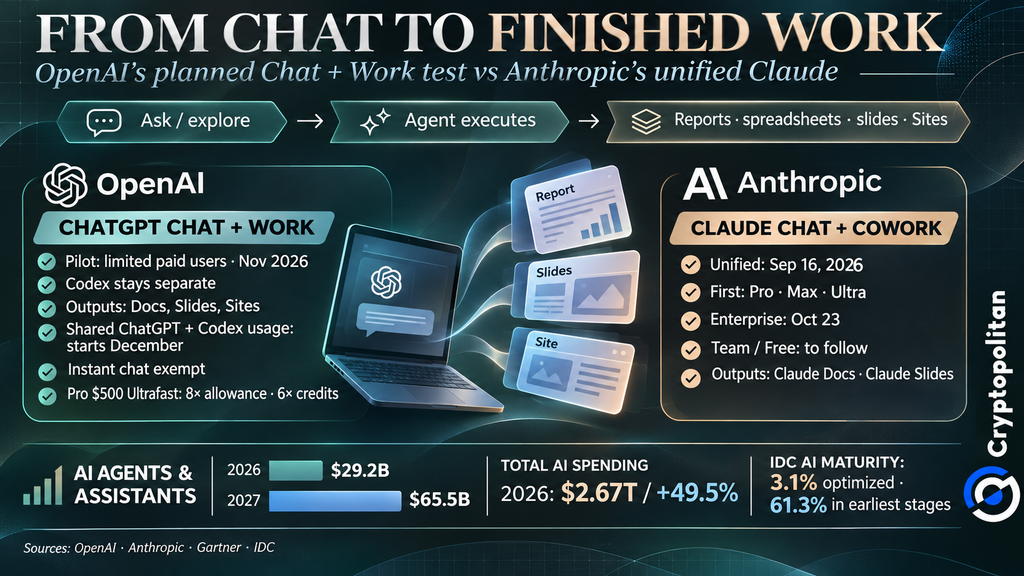 OpenAI ChatGPT Work Merge vs Claude Cowork: Usage Costs and AI Market Outlook
The economics that decide winners
The stakes are growing. Gartner expects spending on AI agents and assistants to jump from $29.2 billion in 2026 to $65.5 billion in 2027. Total AI spending could hit $2.67 trillion this year, up 49.5%.
Yet adoption remains uneven. An IDC study covering 1,900 organizations found just 3.1% at the highest AI-maturity stage. Another 61.3% were in the two earliest stages.
Price predictability could be decisive. Cryptopolitan reported complaints from Codex users whose allowances appeared to drain unusually fast. OpenAI executive Thibault Sottiaux disputed allegations of undisclosed cuts. Kingy AI initially judged those claims:
“Supported but unproven.”
It later changed its assessment to “partly confirmed; blanket cut unproven” after acknowledging cache-efficiency problems. As assistants take on more work, predictable costs may matter as much as their capabilities.
Don’t just read crypto news. Understand it. Subscribe to our newsletter. It's free.