Open Standard launched Open USD (OUSD) on June 30, 2026, with backing from over 140 institutional partners, including Visa, Mastercard, and BlackRock. Following the announcement, Circle’s sto
Open Standard launched Open USD (OUSD) on June 30, 2026, with backing from over 140 institutional partners, including Visa, Mastercard, and BlackRock.
Following the announcement, Circle’s stock (NYSE: CRCL) fell to $62, a 16.55% drop in 24 hours, compounding a prior 32.8% decline over the past month. The stock’s loss varied by source, reflecting intraday selling pressure.
The issue lies in the business models of Circle and Tether, which rely on income from U.S. Treasury instruments that back their stablecoins.
In contrast, OUSD channels reserve income to participating businesses after a small management fee, presenting a significant threat in a $312Bn stablecoin market where USDC holds about 25% and USDT 62%.
Open USD Reserve-Sharing Mechanics: How OUSD Structurally Inverts the Issuer-Keeps-the-Float Model
OUSD’s architecture differs from existing stablecoins by allowing businesses to mint and redeem it without fees while sharing the income from the US Treasury debt backing the token.
Unlike Circle’s USDC and Tether’s USDT, where the issuing companies retain interest on reserves, Open Standard only charges a small management fee.
This structure promotes collaboration, as its governance board comprises partner companies, thereby preventing single-entity control.
Alvin Kan from Bitget Wallet notes that OUSD’s zero-fee model and revenue sharing offer payment networks compelling reasons to adopt it.
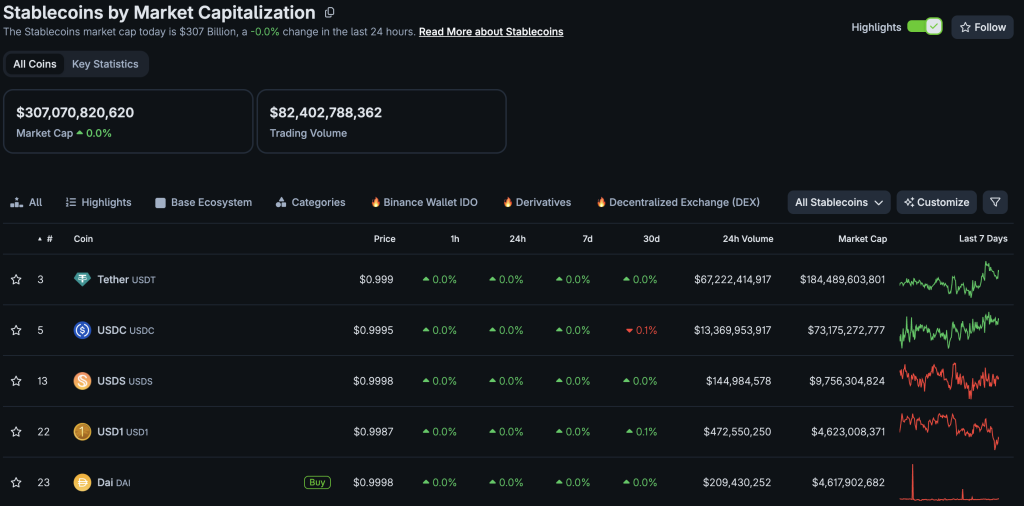 SOURCE: CoinGecko
Issuer-Keeps-the-Float vs. Consortium Revenue Sharing: What 140+ Institutional Partners Mean for USDC’s Distribution Moat
The competitive threat to Circle isn’t about OUSD’s initial zero supply, but rather who controls the distribution. Coinbase, a co-founder of the Center Consortium with Circle in 2018, is now a founding partner of OUSD.
After dissolving Center in August 2023, Circle paid Coinbase roughly $209.9M to acquire its remaining stake. With Center closing by December 2023, Coinbase’s return to stablecoin governance across over 140 firms makes that payment seem like a temporary shield.
Will Harborne, CEO of Rhino.fi, noted that OUSD changes the competitive landscape because it overlaps with USDC’s market, leading to real-time competition.
He also mentioned the operational challenges for consumer-facing businesses, where payment discrepancies between stablecoins can complicate transactions and customer support.
Additionally, Ripple joined OUSD as a day-one partner while keeping its own stablecoin, RLUSD, effectively hedging its position in this competitive space.
Circle CRCL Stock Drop: Dual Catalyst of Russell Index Removal and OUSD Launch Compresses the Equity in a Single Week
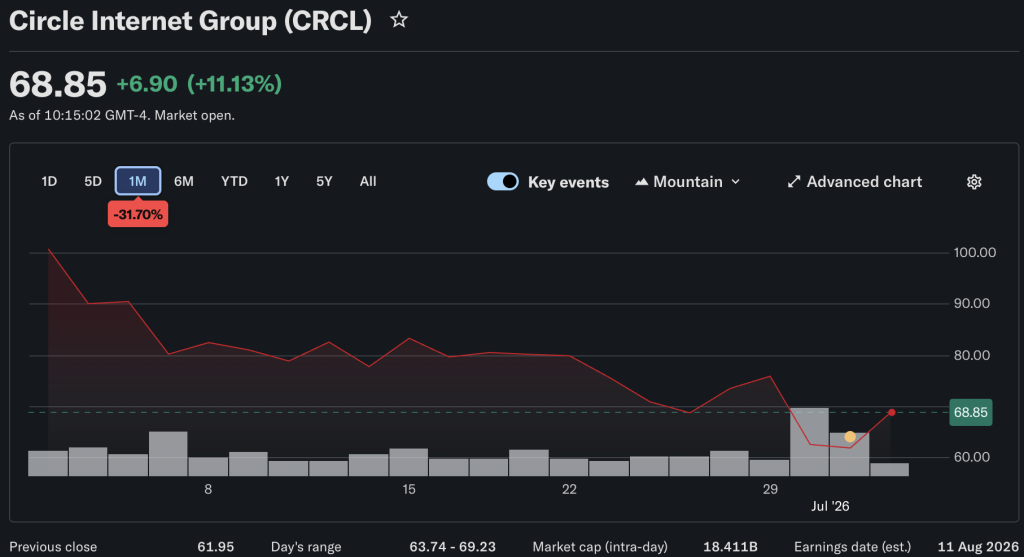 SOURCE: Yahoo Finance
CRCL’s 16.55% decline on June 30 resulted from two compounding structural issues. First, Circle was removed from several Russell indexes on June 26, prompting passive funds and ETFs to sell off CRCL holdings and increase selling pressure.
By the time OUSD launched, CRCL was already in decline, down 32.8% over the previous 30 days. The market reacted by considering that if businesses using USDC could earn yield through OUSD, it would impact Circle’s future income.
This shift didn’t require OUSD to replace USDC immediately; it simply lowered investor confidence in Circle’s revenue stability.
In contrast, Galaxy Digital’s inclusion in the Russell 1000 in June 2026 showed how index changes can drive institutional buying and enhance price appreciation.
The author does not hold or have a position in any securities discussed in the article. All prices were quoted at the time of writing.
The post OUSD Launch Sends Circle Stock Down 17% as 140+ Partners Back Yield-Sharing Rival appeared first on Tokenist.