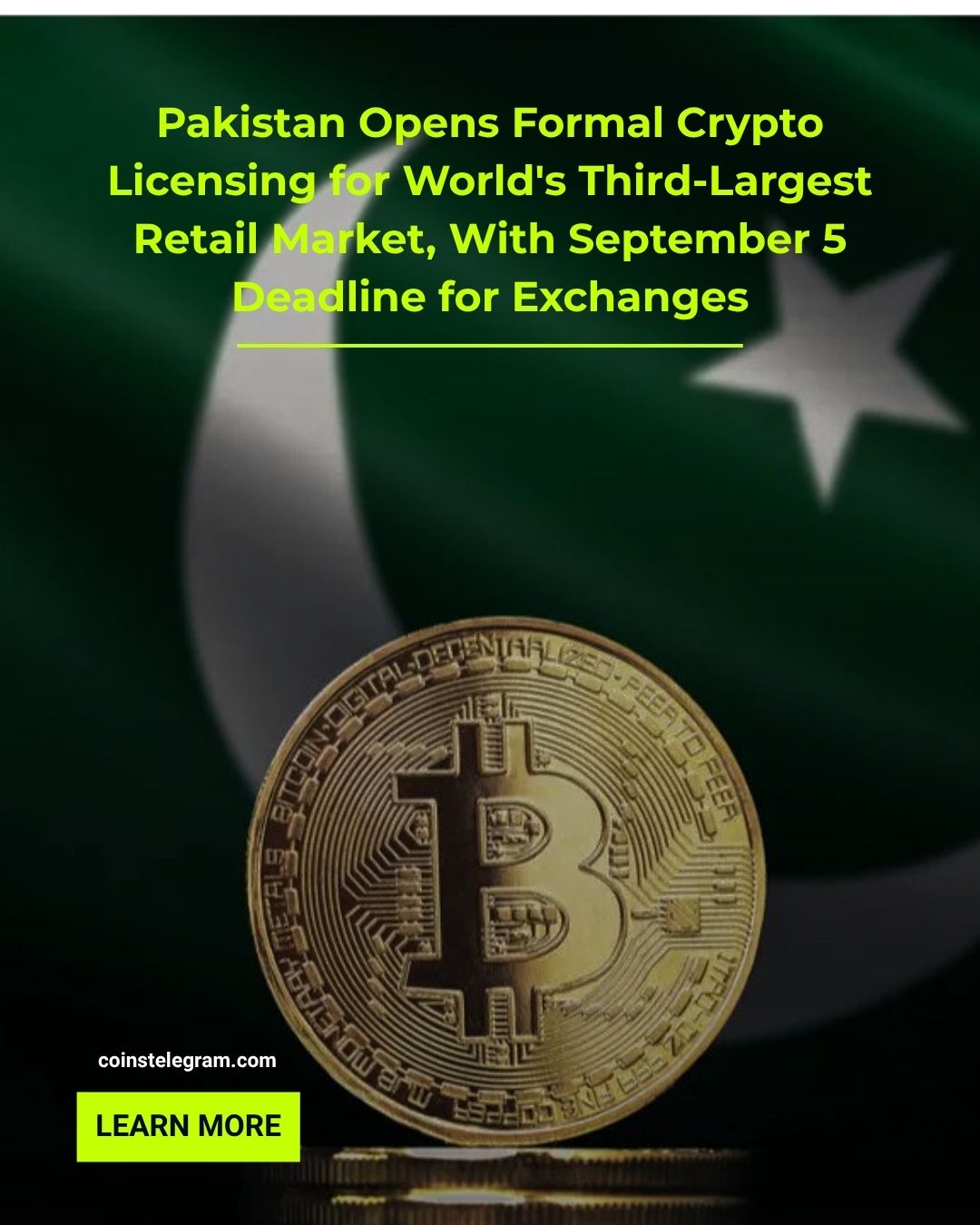
Pakistan has officially launched mandatory licensing for cryptocurrency businesses, ending nearly a decade of regulatory limbo and opening a formal, government-supervised pathway for exchange
Pakistan has officially launched mandatory licensing for cryptocurrency businesses, ending nearly a decade of regulatory limbo and opening a formal, government-supervised pathway for exchanges, custodians, brokers, and other virtual asset service providers (VASPs) to legally operate in the country.
Companies now have until September 5, 2026, to submit license applications or face being forced to shut down local operations entirely.
How Pakistan Got Here
The new regulatory framework did not emerge overnight. It began in July 2025, when President Asif Ali Zardari signed the Virtual Assets Ordinance, establishing the initial legal foundation for crypto regulation in Pakistan.
That temporary ordinance was subsequently formalized in March 2026, when the National Assembly passed the permanent Virtual Assets Act, 2026, replacing the earlier stopgap measure with a definitive statutory framework and formally creating the Pakistan Virtual Assets Regulatory Authority (PVARA), an autonomous federal body tasked with licensing and supervising the country’s crypto industry.
The process reached its operational milestone on August 22, 2026, when PVARA officially notified its final licensing regulations and activated its online licensing portal, opening the Pakistani market to both local and international crypto operators for the first time under a structured legal regime.
What Companies Need to Do
PVARA’s licensing system covers 10 distinct categories, spanning exchanges and custody providers through to derivatives platforms and mining operations. Any virtual asset service provider currently operating in Pakistan — or seeking to enter the market — must submit an application through PVARA’s newly launched portal by the September 5 deadline. Companies that fail to apply by that date risk being required to cease operations within the country, effectively shutting them out of one of the world’s largest cryptocurrency user bases.
Why Pakistan’s Market Matters So Much
Pakistan’s decision to formalize crypto regulation carries outsized significance because of the sheer scale of its existing user base. The country is home to an estimated 20 million to 40 million cryptocurrency users, positioning it as one of the largest and fastest-growing digital asset markets anywhere in the world. Pakistan routinely ranks among the top countries globally for grassroots and retail crypto adoption, frequently placing third worldwide according to blockchain analytics and regulatory assessments.
That adoption has been driven less by speculative enthusiasm and more by economic necessity. High inflation, a volatile national currency, and limited access to traditional global financial infrastructure have pushed large numbers of Pakistani citizens — particularly younger users — toward stablecoins and other digital assets as practical tools for preserving value and facilitating payments, rather than purely as investment vehicles.
From Prohibition to Regulation: What Changes
For years, Pakistan’s crypto market operated in a legal gray zone: transactions were widespread and enforcement was inconsistent, but there was no formal licensing structure, meaning millions of users transacted through platforms with no local regulatory oversight, no consumer protection framework, and no clear legal accountability if something went wrong.
The shift to a licensing regime fundamentally changes that dynamic. VASPs operating legally in Pakistan will now be subject to direct regulatory supervision, likely including anti-money laundering requirements, capital adequacy standards, and consumer protection obligations — the same categories of oversight that have become standard in more mature crypto regulatory jurisdictions like the UAE, Singapore, and the EU under MiCA.
For international exchanges, the licensing requirement creates a clear choice: invest in formal compliance to legally access tens of millions of Pakistani users, or exit the market entirely. Given the size of Pakistan’s user base, most major global exchanges are likely to pursue licensing rather than abandon the market, which should accelerate consolidation around compliant, regulated platforms and push out smaller or less scrupulous operators who have historically served Pakistani users without any oversight.
The World Liberty Financial Connection
Pakistan’s regulatory formalization arrives against the backdrop of a notable prior diplomatic and commercial development: in January 2026, PVARA signed a memorandum of understanding with SC Financial Technologies, a company described as an affiliated entity of World Liberty Financial — the crypto venture tied to the family of U.S. President Donald Trump. That agreement was aimed at exploring the use of World Liberty’s USD1 stablecoin for cross-border payments, with PVARA describing it as enabling “dialogue and technical understanding around emerging digital payment architectures.”
That earlier arrangement adds a geopolitical dimension to Pakistan’s broader crypto strategy, suggesting the country’s regulatory buildout is occurring alongside active courtship of major international crypto players — including those with direct ties to U.S. political leadership — as Pakistan positions itself as a serious jurisdiction for digital asset commerce rather than merely a large but unregulated user base.
What This Means for the Regional Crypto Landscape
Pakistan’s move places it alongside a growing list of jurisdictions — including the UAE, Kazakhstan, and various EU member states under MiCA — that have transitioned from ambiguous or restrictive crypto policies toward structured licensing regimes over the past several years. For South Asia specifically, Pakistan’s framework could set a regional benchmark, particularly given its market size relative to neighboring countries with far more restrictive or entirely prohibitive crypto policies.
The practical effect for the broader industry is significant: a licensed, regulated Pakistan effectively brings tens of millions of previously unregulated crypto users into a formal compliance framework almost overnight. That shift is likely to attract renewed institutional and exchange interest in the market, while simultaneously giving Pakistani regulators meaningful leverage — through licensing requirements — to shape how the industry operates within the country going forward, rather than reacting to activity happening largely outside their oversight, as had been the case for nearly a decade.
What Comes Next
With the licensing portal now live and the September 5 application deadline fast approaching, the coming weeks will reveal how many of the exchanges and service providers currently serving Pakistani users choose to formally register versus exit the market. PVARA’s handling of this initial licensing wave — including how quickly and rigorously it evaluates applications — will likely shape international perception of Pakistan’s regulatory credibility and influence whether major global exchanges treat the country as a priority market going forward.