Palantir stock did not rise this week because Palantir won an air traffic control contract. It rose because a rival won one. On Wednesday PLTR traded as high as $193.67, a fresh 2026 high and
Palantir stock did not rise this week because Palantir won an air traffic control contract. It rose because a rival won one. On Wednesday PLTR traded as high as $193.67, a fresh 2026 high and the first print above $190 since December, after the Federal Aviation Administration switched on an AI airspace tool called SMART in Washington, D.C. airspace. The prime contractor on that programme is Air Space Intelligence, a startup that beat Palantir and Thales to a 12-year, $875 million award back in June.
That gap — between what the market priced and what the contracting record says — is the most instructive thing to happen to the government AI trade all month. Having covered defence and civil-agency software procurement through three budget cycles, I have seen plenty of halo trades. This one is unusual because the halo is attached to a loss. The market is not mistaking Palantir for the winner so much as concluding that the winner's existence proves the category is real, and that Palantir is the liquid way to own the category. Whether that reasoning survives contact with the next award cycle is the question underneath a $190 share price.
Quick Take
- The FAA's SMART platform went live in limited Washington, D.C. operations on Monday 21 September 2026.
- Air Space Intelligence (ASI) — not Palantir — is the prime contractor on the 12-year, $875 million award covering SMART and FMDS.
- Palantir and Thales both bid and lost. Palantir retains separate, smaller FAA safety work.
- PLTR rose roughly 3.8% on Wednesday to an intraday $193.67, its highest of 2026.
- The trade is a category bid, not a contract bid — and that distinction is what makes it fragile.
Key Facts
- FAA award to Air Space Intelligence: $875 million over 12 years, announced 22 June 2026 — ExecutiveBiz, June 2026
- Palantir Q2 2026 revenue: $1.935 billion, up 93% year over year — Palantir/BusinessWire, 3 August 2026
- Palantir US commercial revenue: $764 million, up 149% year over year — same release
- FY2026 revenue guidance midpoint: $8.154 billion, 82% growth — same release
- SMART integrates roughly 200 data streams covering weather, flight paths, airport capacity, traffic flow and controller staffing — ExecutiveGov, September 2026
- Rosenblatt reiterated a Buy rating with a $225 price target on the SMART rollout
- PLTR intraday high on Wednesday: $193.67, first trade above $190 since December 2025
What the FAA Actually Bought, and From Whom
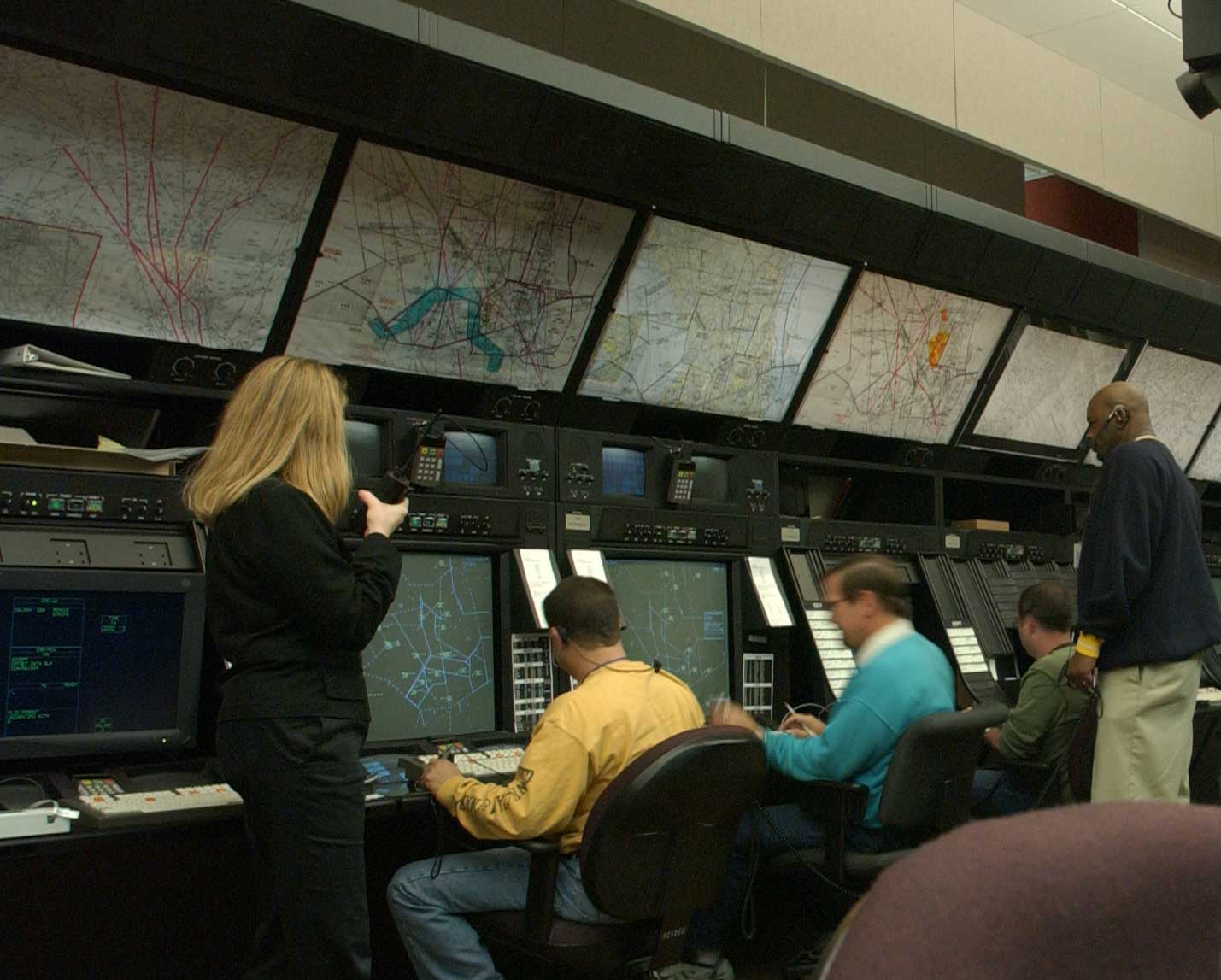
The contract in question covers two systems. FMDS — Flow Management Data and Services — is intended to replace the Traffic Flow Management System that sits underneath the FAA's Air Traffic Control System Command Center. SMART, which stands for Strategic Management of Airspace, Routes and Trajectories, is the forward-looking layer: a cloud platform that ingests airline schedules, weather forecasts, airport capacity and airspace conditions, then flags conflicts before they materialise.
In plain terms, the FAA has been running national traffic flow on a platform designed for a world with far fewer flights and far coarser weather modelling. SMART is the attempt to move from reacting to congestion to forecasting it. The system pulls roughly 200 data streams into a single operational picture — weather patterns, flight paths, traffic flow, controller staffing — and shows where aircraft are heading, how much traffic the network can absorb, and where bottlenecks are likely to form.
The important operational caveat, and one that gets lost in the excitement: SMART recommends, it does not command. FAA personnel review the system's outputs. It does not replace controllers and it does not take control of aircraft. Anyone modelling this as autonomous air traffic control is modelling something that does not exist.
Transportation Secretary Sean Duffy framed the launch in economic terms rather than technical ones. "By fundamentally reshaping how we manage our airspace and preventing problems before they happen, SMART will slash those frustrating delays, reduce stress on air traffic controllers, and lower travel prices," he said. United Airlines chief executive Scott Kirby was more measured, saying the platform "has the potential to significantly reduce delays and cancellations during weather events" — a conditional endorsement that is worth reading twice. Chris Sununu, president and chief executive of Airlines for America, called it "one of the most exciting and bold initiatives taken on by the FAA in decades."
None of those three people work for Palantir. Neither does the prime contractor. Air Space Intelligence, announced by Duffy and FAA Administrator Bryan Bedford on 22 June 2026, beat both Palantir and Thales — two bidders with vastly more federal contracting history and vastly deeper balance sheets. Deployment began this autumn with a full rollout targeted for 2028.
The Response: What Palantir Is and Is Not Saying
Palantir has not claimed the SMART contract. It has not issued a release tying itself to Monday's rollout, and its investor relations page carries no FAA announcement in September. That silence is itself reporting: a company that announces materially smaller wins routinely has declined to associate itself with the single most visible civil-aviation AI deployment in the United States, for the straightforward reason that it is not the prime.
What Palantir does hold is separate FAA safety work, and that is the thread Rosenblatt pulled. The firm reiterated a Buy rating with a $225 target on the view that the FAA is expanding Palantir's existing use cases in air traffic control safety now that SMART has normalised AI inside the agency. That is a coherent argument. It is also a materially different argument from "Palantir won $875 million," and the two got conflated inside a single trading session.
The conflation was visible in real time. Sell-side commentary and retail channels alike ran the FAA headline next to the PLTR ticker, and at least one account publicly threatened to file complaints with the Securities and Exchange Commission over what it characterised as promotion of Palantir via FAA announcements the company had no part in. I would not read that as a credible enforcement risk. I would read it as evidence that the attribution problem was obvious enough, on the day, for market participants to be arguing about it.
Air Space Intelligence, for its part, has every incentive to be loud and has been comparatively quiet, which is what you would expect from a startup twelve years into a contract clock with a 2028 full-deployment milestone and an agency counterparty that dislikes surprises.
Palantir's own commercial story needs no FAA help. In the second quarter the company reported revenue of $1.935 billion, up 93% year over year and 19% sequentially, with US commercial revenue of $764 million growing 149%. Management raised full-year 2026 revenue guidance to a midpoint of $8.154 billion, or 82% growth, and full-year US commercial guidance above $3.424 billion. Chief executive Alex Karp put it characteristically: "Demand for AI sovereignty has now been unleashed. And Palantir is the only company that has demonstrated it can transform tokens into actual economic value." Our earlier coverage of Palantir and Nvidia restricting Anthropic's AI over data-security and IP concerns is a useful companion on how the company guards that positioning.
Market Impact: Pricing a Category, Not a Contract
Here is the synthesis that neither the contract documents nor the earnings release states on its own. Palantir's second-quarter US commercial revenue was $764 million. The entire ASI award is $875 million — spread over twelve years. On a straight-line basis that is roughly $73 million a year, or about 9.5% of what Palantir's US commercial arm booked in a single quarter.
Put bluntly: even if Palantir had won the FAA contract outright, it would have been financially immaterial to a company guiding to $8.154 billion of revenue this year. The stock added several billion dollars of market value on Wednesday. The contract it did not win is worth $875 million over more than a decade.
That arithmetic tells you the move was never about the cash flows. It was a re-rating of the probability that federal civil agencies — not just defence and intelligence — become a durable buyer of decision-support AI. The FAA is a conservative, safety-first, famously slow-moving procurement organisation. If it will run an AI layer over national traffic flow, the addressable set of federal customers widens considerably, and Palantir is the largest listed pure-play on that widening.
The cross-industry parallel worth drawing is to electronic trading venue infrastructure in the mid-2000s. When a major exchange first replaced a legacy matching engine with a low-latency commercial platform, the direct contract was small and the vendor that won it was not the one that re-rated most. What re-rated was the whole category of venue technology suppliers, because a single conservative buyer had validated that the switch was survivable. Brokers and liquidity providers reading this will recognise the pattern: the first reference customer is worth far more than the first invoice. Palantir is currently being paid for someone else's reference customer.
The bull reading
The bear reading
FAA adoption validates civil-agency AI, widening Palantir's federal TAM well beyond defence
Palantir bid this contract and lost it to a startup with a fraction of its resources
Existing FAA safety work gives Palantir a foothold to expand into adjacent use cases
Incumbency in a small programme has not historically converted into primes on large ones
93% revenue growth and 149% US commercial growth mean the stock does not need FAA revenue
If the stock does not need FAA revenue, a 3.8% move on FAA news is unanchored
Rosenblatt's $225 target implies roughly 16% upside from Wednesday's high
Consensus target sits near $195.57, below where the stock traded intraday
That last row deserves emphasis because it is the cleanest bear datapoint available. On Wednesday the stock traded through the consensus price target. Rosenblatt's $225 is a genuine outlier to the upside; the base case among analysts clusters at $195–$200, with bears near $170. A stock trading above consensus on news it was not party to is, definitionally, running on multiple expansion.
Regulatory Tension: Procurement Is the Real Gatekeeper
The interesting regulatory story here is not privacy or model governance. It is procurement reform, and it cuts against the incumbents.
The FAA choosing ASI over Palantir and Thales is a data point in a multi-year federal shift toward awarding technically demanding, mission-adjacent work to smaller, faster suppliers rather than traditional systems integrators. That shift is what created Palantir's original government franchise — the company famously litigated its way into Army consideration by arguing that the procurement process illegally excluded commercial products. The uncomfortable symmetry is that Palantir is now on the receiving end of exactly the dynamic it helped establish. Once an agency is comfortable buying commercial software from a challenger, it can buy it from a challenger that is not you.
There is a second tension around scrutiny. Palantir's public-sector work attracts sustained political attention on both sides of the Atlantic; the UK's NHS data contract remains a live controversy, and US civil-liberties groups continue to press on the company's immigration and policing deployments. Civil aviation is, by comparison, an unusually benign venue — nobody objects to fewer weather delays. If Palantir does expand inside the FAA, it will be doing so in the least politically costly corner of the federal government it has ever operated in. That is a genuine strategic advantage, and it is under-discussed relative to the contract noise. For context on how Palantir's ownership base has been repositioning around these themes, our breakdown of the Peter Thiel portfolio rebuild covers the 13F picture.
Regulators are also, separately, taking an interest in how AI-adjacent equities trade. The SEC has no announced inquiry here and nothing in this episode suggests wrongdoing by Palantir. But an environment in which a large-cap re-rates on a contract awarded to a private competitor is precisely the environment in which disclosure standards for third-party attribution get revisited.
What Happens Next
Prediction one: the FAA relationship gets clarified within two quarters, and it will be smaller than the market currently implies. Palantir has a strong incentive to quantify its existing FAA footprint on the Q3 call, because the alternative is letting an $875 million number it did not win sit in investors' heads. The causal chain is straightforward — management is asked directly, management answers precisely, and the answer resets expectations downward while the category thesis survives intact.
Prediction two: the next FAA modernisation tranche is the real catalyst, not SMART's rollout. ASI's contract runs to full deployment in 2028. The FAA's broader modernisation backlog — surveillance, surface movement, data comms — will generate further awards in that window. Palantir either primes one of them or it does not, and that binary is worth far more to the stock than Monday's switch-on. Watch award notices rather than press coverage.
Prediction three: the category bid outlives the attribution error. Even readers who think Wednesday's move was irrational should separate the mechanism from the conclusion. The mechanism was sloppy. The conclusion — that conservative civil agencies are now buyers of operational AI — looks right, and it is the reason a $225 target is defensible while a $170 floor is also defensible. Both can be true when the disagreement is about how fast a procurement culture changes.
For brokers and platforms fielding client questions this week, the useful framing is not whether Palantir deserves $190. It is that a 12-year, $875 million civil contract just moved a multi-hundred-billion-dollar equity that has no claim on it. That is a liquidity and positioning story as much as a fundamental one — the same crowding dynamic we examined in the Nasdaq 100 rebalance and its forced passive bid. When a name becomes the designated expression of a theme, it trades on the theme's news, not its own.
Frequently Asked Questions
Did Palantir win the FAA's $875 million contract?
No. Air Space Intelligence is the prime contractor on the 12-year, $875 million award covering the FMDS and SMART programmes, announced on 22 June 2026. Palantir and Thales both bid and lost. Palantir does hold separate, smaller FAA safety work, which is what analysts cited when the stock rose.
Why did Palantir stock rise if it lost the contract?
The market treated the FAA's willingness to deploy operational AI as validation of the whole civil-agency category rather than of one supplier. Palantir is the largest listed pure-play on government decision-support software, so it absorbed the category bid. Rosenblatt also reiterated a Buy rating with a $225 target, citing scope for Palantir to expand its existing FAA safety work.
What is the FAA SMART system?
SMART — Strategic Management of Airspace, Routes and Trajectories — is a cloud platform that pulls roughly 200 data streams, including weather, flight paths, airport capacity and controller staffing, into one operational view and flags congestion before it forms. It began limited operations in Washington, D.C. airspace on Monday 21 September 2026. It advises FAA personnel; it does not control aircraft.
How material would the FAA contract have been to Palantir's revenue?
Barely material. Spread across twelve years, $875 million is roughly $73 million annually — under 10% of the $764 million Palantir's US commercial segment booked in the second quarter of 2026 alone, against full-year guidance of $8.154 billion. The stock's move reflected category re-rating, not lost cash flow.
What is Palantir's current analyst price target?
Consensus sits near $195.57, with a base case of roughly $195–$200, a bear case around $170 and a bull case of $225 from Rosenblatt. Notably, the stock traded above consensus at Wednesday's $193.67 intraday high, meaning it is running ahead of the average sell-side view.
What should investors watch next?
Two things: management's quantification of its actual FAA footprint on the next earnings call, and the FAA's subsequent modernisation award notices through to the 2028 full-deployment milestone. Whether Palantir primes one of those awards matters far more to the stock than the SMART rollout did.