Why Peter Schiff Says Renting Beats Buying a Home Right Now Renting can win when owning costs more than rent and the difference gets invested. The result depends on mortgage rates, local pric
Why Peter Schiff Says Renting Beats Buying a Home Right Now
Renting can win when owning costs more than rent and the difference gets invested. The result depends on mortgage rates, local prices, taxes, upkeep, and returns. Peter Schiff backs renting today, but his housing-crash calls remain forecasts.
Is a mortgage still the smartest way to build wealth? Economist Peter Schiff says no, and his view that renting beats buying has sparked a loud debate online.
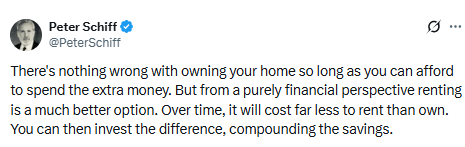
Schiff argued on X that renting costs far less over time, and the savings can compound if invested. This guide tests that claim against US housing market trends and compares renting vs buying a house with real numbers.
Figures were last checked on November 28, 2026. Each one is labeled as Schiff's estimate, a research estimate, or independent data.
What Is Peter Schiff's Argument Against Buying a Home?
Schiff's post was short. Owning is fine for anyone who can afford to waste the extra cash, he wrote, but renting is the smarter financial move.
Over time, he said, renting costs far less than owning. Investors can then put the difference to work and let it compound.
One reply on X pushed back. That user preferred a mortgage, land, and trees over any landlord, treating ownership as control rather than cost.
In early November, Schiff also argued on a podcast that mortgage lenders sit in worse shape than at the depths of the 2008 crisis. That's his view, not an established fact.
How Much Does It Really Cost to Own a $600,000 Home?
A mortgage payment is only one piece of the bill. Property taxes, insurance, maintenance, and closing costs all add up.
Mortgage amortization matters too. It's the schedule that splits each payment between interest and principal, and early payments are mostly interest. Then comes opportunity cost, the return a down payment could earn elsewhere. A $120,000 deposit tied up in a house can't also sit in an index fund.
Price-to-rent ratio, meaning home price divided by yearly rent, helps compare cities. A higher ratio usually favors renting.
Is Renting Cheaper Than Buying in 2026? A Worked Example
This is a hypothetical US case, not a market quote or forecast.
Input
Example
Home price
$600,000
Down payment
$120,000
Mortgage
$480,000
Term and rate
30 years at 7.21%
Monthly rent
$2,500
Principal and interest
about $3,260
The loan payment runs roughly $760 above rent, before taxes, insurance, and upkeep. That gap alone doesn't prove renting wins.
A fair test also counts the renter's invested $120,000 and monthly savings. It adds the owner's home equity, price change, and selling costs. The point where both paths match is the break-even period. In the early years, owners often trail.
What Do the Numbers Say About Rates and Home Prices?
Attribution matters here, so each claim carries a label.
Claim
Who says it
Label
30-year rate averaged 7.21% in the week ending November 25
Weekly lender survey
Independent data
Rates above 7.5%
Podcast host, early November
Quoted figure
Home prices tripled in 20 years
Schiff
His estimate
Payments up 97%, incomes up 33%, prices up 48% since January 2020
Housing research firm
Assumes 5% down, 30-year fixed, mortgage insurance
$2 trillion in losses on $8.5 trillion of fixed-rate mortgages
Schiff
His estimate
October home sales down 5.5%, median price $416,700
National housing report
Independent data
Current mortgage interest rates sit below the 7.5% quoted earlier, though still well above levels from a year ago. That's the housing affordability crisis in one line: payments have outrun incomes.
The $2 trillion figure needs care. Mark-to-market means a loan is valued at today's price, not its original face value. Those paper losses become real only if a bank must sell, and they don't prove insolvency.
Schiff's $3 trillion scenario also assumes rates reach 8.5%. Sales fell, but prices didn't collapse. The median price rose 0.4% from a year earlier, the 40th straight yearly gain. So far, that cuts against a crash call.
Where Should Investors Put Their Money When Renting Beats Buying?
Schiff's post didn't name assets. His wider public stance favors hard assets, especially gold and silver.
Four options usually come up in this debate.
- Gold and Silver for Wealth Preservation
Supporters see precious metals as wealth preservation when inflation erodes cash. But metals pay no rent or dividends, and prices can slide for years. Gold doesn't guarantee protection against inflation. Any gold price prediction carries the same uncertainty as any forecast.
- Stocks and Equity Markets for Long-Term Growth
Shares represent ownership in real businesses and have historically outpaced inflation over long periods. Dividends add income. Yet equities can drop sharply in one year. Inflation-adjusted returns depend on time horizon, and the stock market outlook can change fast.
- Real Estate Investment Through REITs
A REIT is a company that owns income-producing property and pays out most of its earnings. Real estate investment trusts give property exposure without a mortgage. But REIT prices swing with interest rates and stock markets.
- Cash and Bonds for Liquidity
Cash and short-term bonds protect flexibility. But inflation quietly shrinks buying power, and rising yields can hurt bond prices.
Why Does Peter Schiff Prefer Gold as an Investment?
Inflation is the thread running through his commentary. He said mortgage rates rise for the same reason Treasury yields do, since lenders want payback for lost purchasing power.
Gold, in his framework, guards against that loss. Governments can't print it, and supply grows slowly. So what happens to every long-term asset tied to cheap money if yields keep climbing?
Gold vs real estate then becomes income against insurance. Property earns rent. Gold earns nothing, yet supporters say it holds value in a crisis.
Could Renting and Investing Build More Wealth Than Homeownership?
Maybe. If rent runs below the full cost of owning, investing the gap each month could grow over decades.
Renting seems like the obvious winner. Actually, scratch that. Renting beats buying only when rent stays reasonable and the difference really gets invested. But discipline decides everything. Many renters spend the gap instead of investing it, while a mortgage works as forced saving.
And rent inflation can erode the renter's edge. Capital gains tax can also trim investment profits.
What Could Prove Peter Schiff Wrong?
Falling mortgage rates would cut payments and lift demand. Rising incomes would ease affordability.
Limited housing supply could keep prices firm. Refinancing could lower payments for owners who bought at higher rates. Long-term owners can also gain from appreciation. Prices have kept rising so far, even as sales slumped.
Key Risks Investors Should Consider Before Choosing Assets
Schiff's crash and banking-crisis forecasts are predictions. He warned that home prices could fall through the floor and of abanking crisis worse than 2008.
Timing remains the biggest unknown. The affordability argument is stronger, since payments and incomes are measurable. Shifts in inflation and interest rates hit every asset class, and none wins every cycle. Rents can rise, metals can fall, and stocks can slide.
Final Thoughts: Should Investors Rent, Buy, or Invest Elsewhere?
The renting beats buying debate won't end soon, because local rents, taxes, and time horizons change the answer. Schiff's case is clearest on affordability, where payments have outrun incomes.
What remains unproven is how hard prices fall, or when. His gold preference is a strong view, not a settled fact. Next step: compare rent with full ownership costs, test assets against inflation, and build a long-term investment strategy with a licensed adviser.
Disclaimer
This article is for informational purposes only and isn't financial, investment, or legal advice. Housing and asset prices can fall, and predictions may prove wrong. Readers should do their own research and consult a licensed adviser before investing.