Eleven months ago, Dára Sobaloju‘s entire company was a single tweet and a promise to build in public. On Friday, July 17th, at the inaugural LUMEN event in Lagos, standing in front of a room
Eleven months ago, Dára Sobaloju‘s entire company was a single tweet and a promise to build in public. On Friday, July 17th, at the inaugural LUMEN event in Lagos, standing in front of a room packed with early adopters who validated that dream, he unveiled Pewbeam2.0, an AI-powered ecosystem designed to eliminate friction in church media transmission.
The update comes with live transcription and translation in French, Spanish, and major Nigerian languages, including Yoruba, Hausa, and Igbo; AI-generated slides; a tool that surfaces Greek and Hebrew word meanings mid-sermon; and PewNote, a mobile app designed to make sure a sermon doesn’t end when the service does.
What began as a narrow fix for a single Sunday-morning problem, getting the right Bible verse on screen before a pastor finishes the sentence, has metamorphosed into a global software-as-a-service (SaaS) phenomenon: a bet that the sermon itself, not just its live projection, is the product worth building around.
The origin story has become part of Pewbeam’s identity by now, and Sobaloju retold it on Friday with the practised rhythm of someone who’s told it many times. On August 21, 2025, at 9:12 a.m., he posted an idea on X: an AI agent that would display Bible verses on screen as a pastor preached, and he’d build it entirely in the open. He says the tweet pulled around 1.7 million views.
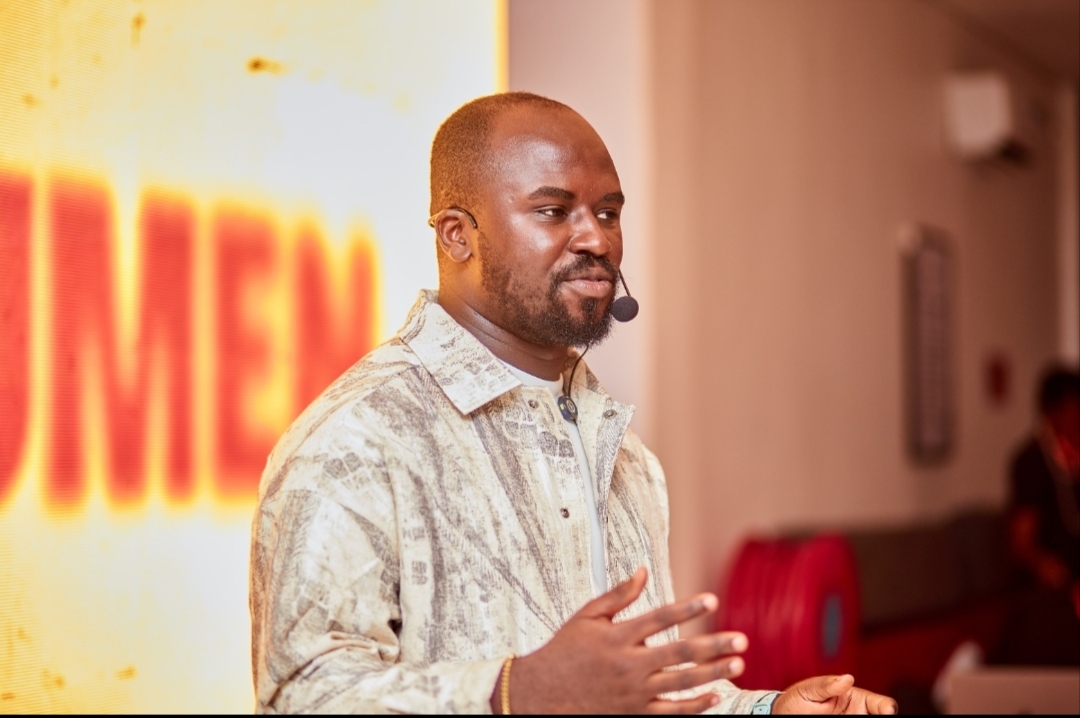
Dára Sobaloju, co-founder and CEO of Pewbeam
Today, the platform’s growth trajectory is staggering. Pewbeam is currently used by nearly 400 churches across 15 countries. On a single Sunday in June alone, over 6,200 churches across 28 countries engaged with the software. “This is a revolution,” Sobaloju stated emphatically, acknowledging that while they aren’t the only ones attempting to solve this problem, their hyper-focus on community feedback has definitively set them apart.
Speaking to why he’d built the whole thing around a launch event rather than simply shipping an update, he said, “We’ve been speaking to our customers; we’ve had complaints; we’ve been speaking to a tonne of them, and we just thought we could use all of these complaints and feedback to build something more useful that is going to solve their particular pain point.
We felt like the best way to launch it was to actually launch it by showing it to the people who helped us build it. “That’s also where the event’s name came from. “PewBeam is all about communication and presentation. So the closest thing to that is light, which means ‘lumen’ in Latin,” he explained. “This event is not just going to be a one-time event. Think about Figma Config. Think about Apple events and Airbnb’s summer release. This is our own Pewbeam Lumen.”
What actually changed in Pewbeam 2.0
The transition from version 1.0 to 2.0 was driven by customer feedback and a commitment to seamless functionality. Head of Product, Alo Praise, described the first iteration as a “launch pad” that, despite its utility, was plagued by latency issues and bloated file sizes. “With a 1.0 average, you’d see a load time of three minutes, four minutes,” Praise admitted to the audience. To resolve this, the development team redesigned the software architecture, slashing the startup time to 10 to 20 seconds.
The app itself has shrunk from 800–900MB to roughly 70MB, with extra components, the online transcription model, and the offline model- downloading only when a church actually switches them on. Offline mode, previously exclusive to Mac, now runs on Windows.
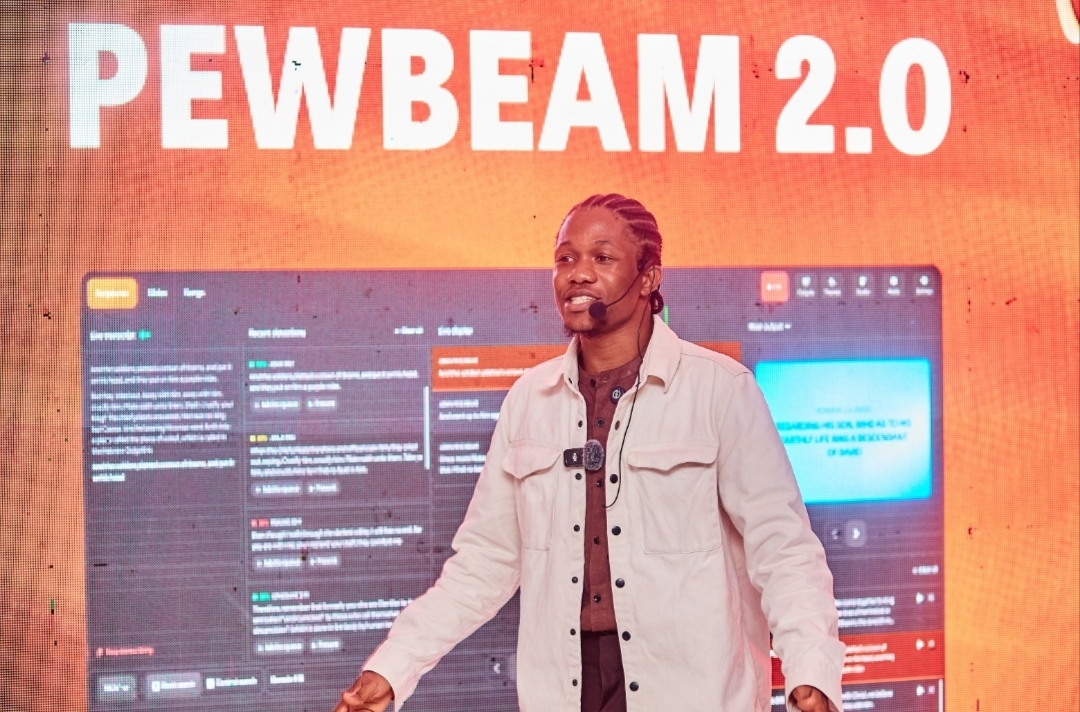
Alo Praise, Head of Product at Pewbeam
The two features Pewbeam is clearly proudest of are new. In Sobaloju’s own words: “The biggest thing is slides. It’s sent to the screen by our AI system. You can generate a slide; you don’t need to sit down and start creating designs. The pastor can literally give you the sermon note, put it inside PewBeam, and it immediately generates your slides for you, ready. And it’s also controlled by voice command. You don’t have to keep saying “next, next”. The second is Lexicon: the moment a pastor references a Greek or Hebrew root word, the term and its meaning appear on screen live, without anyone in the media booth needing to look anything up.
Brand and Product Designer Tony Adeoye introduced a third piece, Content Studio, framed around an observation he clearly enjoyed making: “every church is a mini publishing house”, from the midweek newsletter to the Sunday tract. Content Studio takes a single sermon transcript and automatically reformats it into roughly five other outputs: tracts, daily devotionals, and more, so the sermon a pastor spent ten hours preparing doesn’t evaporate the moment the service ends.
The PewNotes mobile appThat question is really the pitch for Pewbeam’s other big reveal: PewNotes, a standalone mobile app. Where Pewbeam lives in the media booth, PewNotes lives in a member’s pocket. Once a sermon is published from the desktop app, its transcript becomes a note on the member’s phone automatically, rendered in one of three tones (the church’s default setting, an “explanatory” version, and a third option), never adding what the pastor didn’t say.
This is where the sharpest question of the night landed. Given that Pewbeam was built to solve one narrow, specific problem, wasn’t a whole second app a distraction? Sobaloju said, “We are not thinking about it as many things. We are thinking about it as an ecosystem, which has different players in it: the pastor, the media guy, and the members,” he said. “Sunday is what, two hours, three hours for some members, so we wanted something that could follow them home. We wanted them to be able to interact with their phone as though they were interacting with their pastor.”
Members can also type their own notes and merge them with the published sermon note, building what the team described as a personal, searchable record over time, something a member could, in theory, open years later and ask a question of.
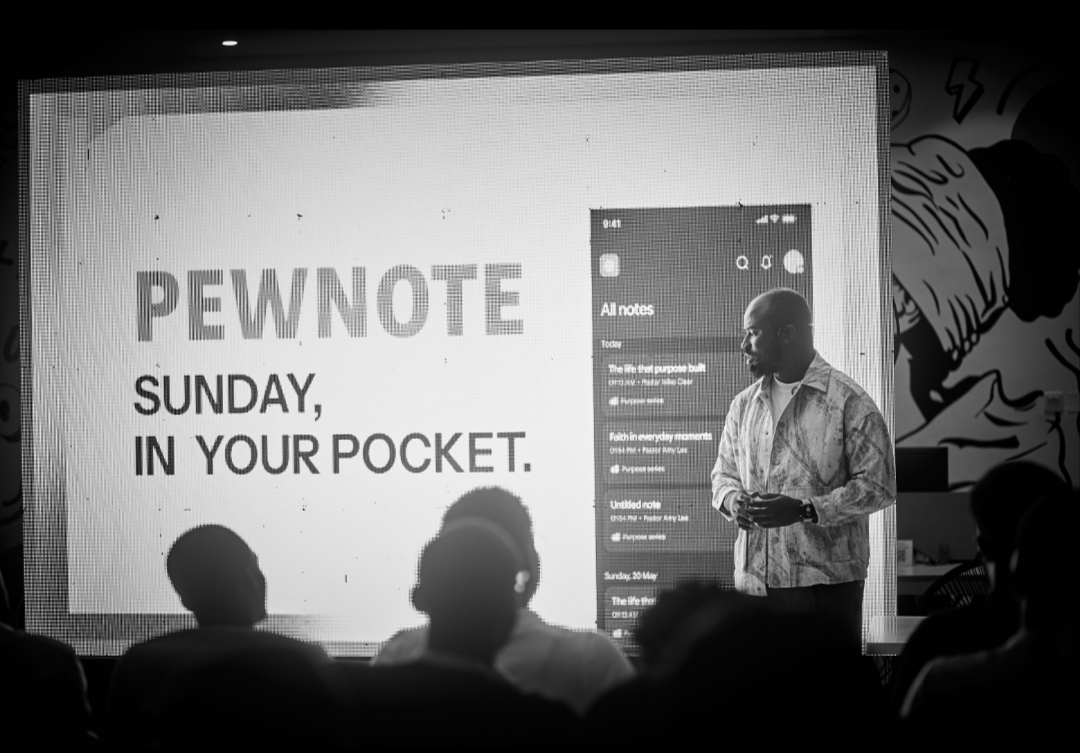
Dára Sobaloju, co-founder and CEO of Pewbeam
On privacy, Sobaloju explained, “For the Pewbeam desktop app, there is no data of the customer that leaves their laptop,” he said. “The transcript does not come to us unless they click on publish. We store this sermon on a secure database which most of the big guys in the world use.” He added that the company’s third-party vendors are listed in its terms of service: “We are not even thinking about if our competitors would use the same platforms we are using so that they can gain a competitive advantage, because for us our customers are more important to us.”
On pricing, he was similarly direct.
“We’ve always had a price; there’s been a free version, and our free version is going to remain,” he said. “For now, we don’t have any plans to increase our price. Some of the new features we are introducing, because it’s AI and AI costs a lot of money, we are going to make tiered.”
He said any change would follow consultation with paying customers.
Asked what would prevent a better-funded rival from simply copying PewBeam now that the concept was proven, Sobaloju laughed and turned the question around: “First of all, how do you know we are not well funded?” Asked plainly whether he’d raised money, he said, ‘That’s not a question I’m willing to answer right now.” But said they were considering fundraising.
From there he pivoted to his team as Pewbeam’s real defence against copycats. “Every member of the team has either been on the media team of their church or has even been on the pulpit preaching,” he said. “I think we are the best team to do this, not because we have the technical skills but because we have a deep understanding of the problem.”