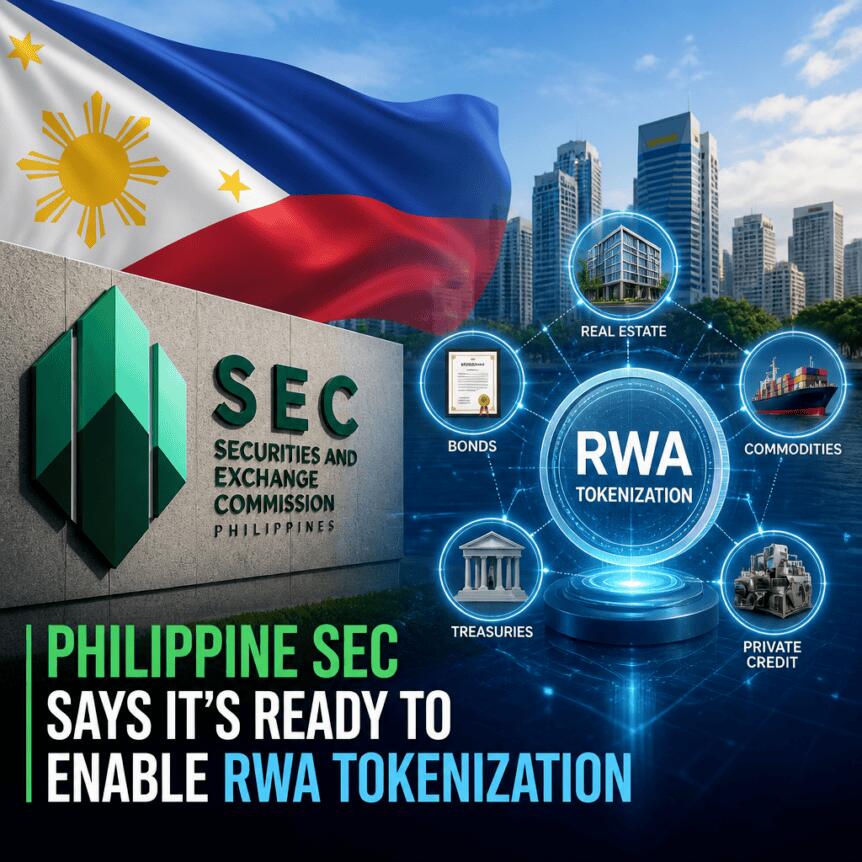
The Philippine Securities and Exchange Commission (SEC) has indicated it is prepared to regulate the tokenization of real-world assets (RWAs), arguing that the legal and supervisory framework
The Philippine Securities and Exchange Commission (SEC) has indicated it is prepared to regulate the tokenization of real-world assets (RWAs), arguing that the legal and supervisory framework needed for the next wave of capital-markets infrastructure is already in place. Speaking at Philippine Blockchain Week 2026, SEC Commissioner Rogelio Quevedo said he believes the regulator now has the “proper law” and the “proper regulatory mind and background” to support asset tokenization.
Quevedo’s comments also tied tokenization to a consumer-protection goal: expanding legitimate investment channels for overseas Filipino workers (OFWs), who often have capital but limited avenues to put it to work safely. He said enhanced enforcement—including the use of artificial intelligence—has improved the SEC’s ability to respond to scams, and that the agency is working with major online platforms to remove illegal offerings.
Key takeaways
- The Philippine SEC signaled readiness for regulated RWA tokenization, with Commissioner Rogelio Quevedo saying the legal and regulatory groundwork is in place.
- Quevedo framed tokenized products as a potential way to offer more legitimate investment options for OFWs amid persistent scam activity.
- The SEC is leveraging enforcement tools, including AI, and collaborating with online platforms to target fraudulent investment promotions.
- The SEC’s Strategic Sandbox (StratBox) provides a controlled environment for fintech firms to test new models while remaining subject to existing laws.
Tokenization positioned as innovation—and protection
Quevedo said the SEC’s confidence in tokenized assets stems from both legal authority and operational capacity. In his remarks, he suggested that asset tokenization could stimulate broader innovation within the capital markets and potentially reshape how exchanges function, describing the technology as having the potential to “revolutionize” stock exchange activity.
Just as important to the commissioner’s framing was investor protection. According to Quevedo, many OFWs have funds available but may struggle to identify credible investment routes. He pointed to scams that promise returns and target Filipinos looking for ways to grow their money. By supporting tokenized investment products within a regulatory structure, the SEC appears to be aiming to reduce the gap between where investors want to deploy capital and the quality of products available to them.
Quevedo also highlighted the regulator’s enforcement evolution. He said the SEC is using artificial intelligence to pursue “unscrupulous scams” and is coordinating with platforms such as Google and TikTok to remove illegal investment offerings. That combination—technology-assisted monitoring alongside platform-level takedowns—signals a more aggressive approach to combating fraudulent activity in parallel with any move toward tokenization.
StratBox: testing new models under SEC supervision
Quevedo’s statements build on the SEC’s existing sandbox mechanism, known as the Strategic Sandbox (StratBox). The framework, described in an SEC memorandum circular, is designed to let fintech companies test new products and business models in a live environment while remaining under regulatory supervision. The SEC may waive or modify certain regulatory requirements for individual sandbox participants—within the boundaries of its legal authority.
Just as the sandbox can offer flexibility, it does not create a blanket exemption. Participation does not automatically excuse firms from complying with applicable laws, and the sandbox cannot be used to sidestep legal or regulatory obligations. For investors and market participants, that distinction is crucial: tokenization may be explored in controlled conditions, but compliance expectations remain in view.
Earlier sandbox admissions hint at tokenization’s direction
The SEC’s sandbox approach has already included test cases relevant to tokenization and digital-finance workflows. In November 2025, the SEC said four companies were admitted to the StratBox, including one testing a tokenized real estate offering. Other participants were reported to be testing access to United States equities, while BlockShoals Technologies received in-principle approval to test crypto-related products and services, as described in coverage of the SEC sandbox process.
These prior admissions suggest the SEC’s sandbox is being used not only to observe digital finance features in isolation, but to evaluate how tokenized or crypto-adjacent models might interact with traditional investment access and regulatory expectations. At the same time, the commissioner’s 2026 remarks indicate that tokenization is no longer just an experimental topic—it is now being discussed as a policy priority backed by institutional readiness.
Why the SEC’s position matters for Philippine capital markets
If the SEC follows through on its readiness narrative, tokenization could become a more structured part of the Philippines’ capital-market development rather than a purely offshore or unregulated trend. For potential issuers, the key takeaway is that the regulator is signaling willingness to accommodate asset tokenization under a framework that includes legal structure, supervision, and enforcement capability.
For investors—especially those with cross-border ties—this could translate into a wider menu of regulated investment options. Quevedo’s remarks about OFWs underscore that the SEC is explicitly thinking about who is most exposed to scam targeting and what kinds of legitimate products might reduce that vulnerability. The enforcement emphasis, including AI-assisted pursuit of fraudulent schemes and engagement with large social and search platforms, also signals that the SEC is trying to close the channel through which illegal offerings are often promoted.
However, the sandbox model also implies a measured pace. Because StratBox participants are expected to remain subject to existing laws, tokenization in practice will likely advance through controlled pilots and specific approvals rather than open-ended experimentation. The details of how specific tokenized products would be authorized and supervised—especially across categories such as real estate, equities access, and other RWAs—remain for future regulatory guidance and individual approvals.
Readers should watch for how the SEC translates commissioner-level confidence into concrete licensing, product rules, and sandbox outcomes—particularly whether tokenized real estate and tokenized market access cases move from controlled testing toward broader authorization. Equally, the SEC’s use of AI and platform cooperation will be a key indicator of how quickly enforcement can keep pace with any expansion of tokenized offerings.
This article was originally published as Philippine SEC Says It’s Ready to Enable RWA Tokenization on Crypto Breaking News – your trusted source for crypto news, Bitcoin news, and blockchain updates.