Pi Network’s prolonged decline is raising fresh questions about the token’s near-term outlook. After sliding nearly 33% over the past month, Pi Network price continues to underperform the bro
Pi Network’s prolonged decline is raising fresh questions about the token’s near-term outlook. After sliding nearly 33% over the past month, Pi Network price continues to underperform the broader crypto market as persistent token unlocks, subdued demand, and weakening investor sentiment keep sellers firmly in control. Recent geopolitical tensions have added another layer of pressure, making it even harder for bulls to stage a sustainable recovery. The result is a market increasingly focused on one question: Has Pi Network found its bottom, or is the prolonged selloff still far from over?
Why Does Pi Network Price Keep Falling?
Pi Network’s weakness is no longer tied to a single market event. Instead, it reflects a combination of structural challenges that have steadily eroded investor confidence over recent weeks. The biggest overhang remains the project’s ongoing token unlock schedule. As additional PI tokens continue entering circulation, buying demand has struggled to absorb the growing supply, creating persistent selling pressure that has repeatedly capped every recovery attempt. Without stronger demand entering the market, short-term rallies have quickly turned into fresh opportunities for sellers.
At the same time, Pi Network has failed to benefit from the broader crypto market’s recovery. While Bitcoin and several leading altcoins have regained momentum, PI has remained locked in a sustained downtrend, highlighting cautious market participation and limited capital inflows. Recent geopolitical tensions have also weighed on the broader cryptocurrency market, triggering another round of risk-off sentiment. Although most digital assets experienced short-term weakness, Pi Network once again underperformed many of its larger peers, reinforcing concerns that the token remains particularly vulnerable during periods of market uncertainty.
Pi Network Price Analysis: Bears Continue To Tighten Their Grip
PI continues to trade inside a well-defined bearish structure, consistently printing lower highs and lower lows over the past month. Every rebound has stalled below resistance, confirming that buyers have yet to regain meaningful control of the trend. The token is now hovering just above the crucial $0.10 support zone. Holding this level is becoming increasingly important, as a decisive breakdown could expose the next major support around $0.08, extending the current correction.
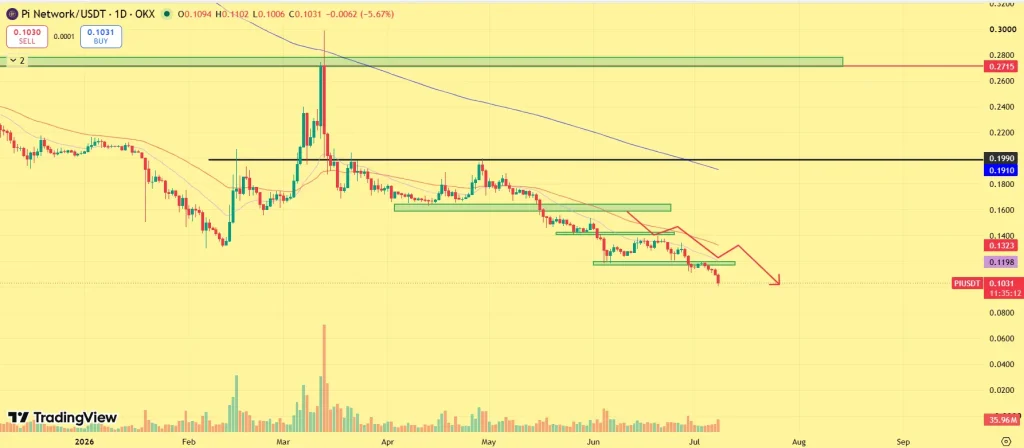
On the upside, the first sign of improving momentum would be a recovery above $0.12, followed by a breakout through the stronger $0.14-$0.15 resistance area. Until those levels are reclaimed, the prevailing trend continues to favor sellers, with downside risks outweighing bullish momentum.
Can Pi Network Price Recover Anytime Soon?
A recovery remains possible, but it will require more than a temporary bounce. For sentiment to improve, Pi Network must demonstrate stronger ecosystem adoption, healthier exchange liquidity, and sustained buying demand capable of absorbing future token unlocks. Those factors will likely determine whether the token can establish a durable bottom rather than another short-lived rebound.
Broader crypto market strength could provide some support, but Pi Network’s long-term recovery will ultimately depend on its own fundamentals. Until buyers successfully break the pattern of lower highs and reclaim key resistance levels, investors are likely to remain cautious, with many continuing to view rallies as opportunities to reduce exposure instead of the beginning of a sustained uptrend.