The first American spot fund on Polkadot manages $11,567,725.24, according to its provider. That is the reading from October 14, 2026, a good seven months after it launched on March 6. By way
The first American spot fund on Polkadot manages $11,567,725.24, according to its provider. That is the reading from October 14, 2026, a good seven months after it launched on March 6. By way of comparison: the DOT spot market turned over $160.9 million in the past 24 hours. The fund meant to bring institutional money into Polkadot is therefore smaller than a fifteenth of a single trading day.
This article answers three questions. What exactly sits inside the fund, and what that says about demand for DOT. Why a vehicle of this size neither carries the price nor weighs on it. And what investors in Germany gain from it when they cannot buy the product in the first place. The shortest answer to the third question up front: the American fund costs 0.30 percent a year, while the route open to you in Germany costs 2.50 percent. More hangs on that gap than on any price level this week.
What the 21Shares Polkadot ETF has gathered since March 6
The product is called the 21shares Polkadot Staking ETF and trades under the ticker TDOT on the Nasdaq. On the issuer's product page, 21Shares gives March 6, 2026 as the launch date, 0.30 percent as the management fee and the $11,567,725.24 above as assets under management, as of October 14. The page lists BitGo Bank & Trust, Coinbase Custody and Anchorage Digital Bank as custodians. The word staking in the name means the fund does not merely hold the DOT in custody but stakes them in the network and collects the rewards.
A spot ETF is an exchange-traded fund that holds the asset itself, here real DOT with a custodian, rather than futures contracts on it. The share price therefore follows the coin price directly, less the fee.
At the data service SoSoValue, whose daily figures the industry outlet TokenPost reported on October 14, TDOT shows cumulative net inflows of $3.33 million. The fund was unchanged that day and the day before, so no money flowed in or out. The same table gives trading turnover of $111,586 and a ratio of 0.62 percent. It names no reference figure for that percentage. Checked against the market capitalisation of DOT, which stood at $1.847 billion on Thursday, $11.57 million comes to exactly 0.626 percent. The figure therefore refers to the share of the entire Polkadot market.
Measured in DOT, at a price of $1.082 that is around 10.7 million units. Circulating supply is 1.707 billion DOT. The largest American fund on Polkadot thus holds fewer than one in every hundred coins.
$111,586 in a trading day: the size against the DOT spot market
The more telling figure is not the assets but the turnover. Trading volume of $111,586 in a day sounds like little, and in relative terms it is less still: the DOT spot market turned over $160,945,583 in the same period. By our calculation, ETF trading accounts for 0.069 percent of that, barely seven hundredths of a percent.
That ratio is why the fund figures are practically meaningless for the price. A spot ETF acts on the price by buying coins in the market on inflows and selling them on outflows. No inflows, no buying power. At the Bitcoin ETF launch in January 2024 precisely the reverse happened: billions flowed in over the first weeks, and the funds had to buy in the spot market every day. At TDOT, seven months have produced $3.33 million of net inflows.
The Dogecoin case: the size at which an altcoin fund gets closed
How small an altcoin fund can get before its provider gives up has just been shown elsewhere. On October 10 we wrote about the wind-down of the Bitwise Dogecoin ETF. That vehicle, ticker BWOW, held around 8.2 million DOGE according to the holdings on its fund page, roughly $707,000 at the price of the time. It traded for the last time on October 14, just under eleven months after launch.
At $11.57 million, TDOT is therefore about sixteen times the size of the Dogecoin fund on its final trading day. The product is a long way from closure, and nobody should read an imminent wind-down out of the weak inflows. What the comparison shows is something else: the American fund industry launched a run of altcoin products in 2026, and demand is spread very unevenly. Bitcoin and Ethereum draw the money, while the remaining funds collect sums that have no measurable effect on the price of their coin.
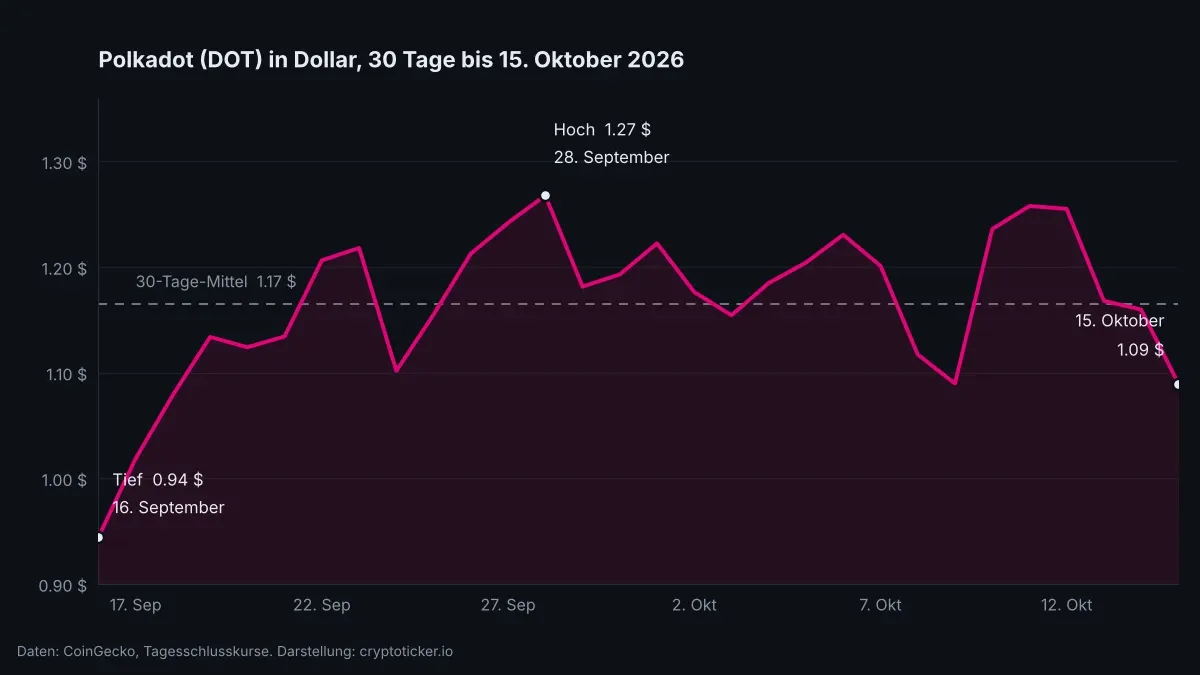
The DOT price over the past 30 days: low on September 16, high on September 28, today 14 percent below it. Drawn from CoinGecko daily closes.
Polkadot price at $1.08: 14 percent below the September 28 high
DOT trades at $1.082 on Thursday afternoon, 3.4 percent below the previous day. The high of the day was $1.16, the low $1.05. The wider market gave up considerably less that day: Bitcoin lost 0.5 percent, Ethereum 1.6 percent. Polkadot is therefore falling about six times as hard as Bitcoin.
Over 30 days the picture is the one in the chart above. CoinGecko daily closes give a low of $0.9441 on September 16 and a high of $1.2677 on September 28. DOT has recovered 15.4 percent from the low and is 14.1 percent short of the high. The average of those 30 days is $1.1652, putting today's price 6.5 percent below it.
From the all-time high of $54.98, reached on November 4, 2021, the price is around 98 percent away. That number belongs in any honest assessment of DOT, even if it says little about today's question.
Authorized participants: when a spot ETF has to buy DOT at all
The mechanism takes three sentences. A spot ETF creates and destroys shares through so-called authorized participants, large traders who deliver or take in coins in exchange for shares. When demand for shares appears, those traders have to source DOT in the market, and that purchase hits the order book. When demand stays away, nothing happens at this point.
What counts is the ratio between the volume to be moved and daily turnover. At a 0.069 percent share of trading volume, any move by the fund disappears into the noise of an ordinary morning. Even if TDOT had to sell its entire assets on a single day, that would be 7.2 percent of one day's turnover, spread across several venues. The daily range between $1.05 and $1.16 is 10.5 percent today. The fund's move would therefore stay inside what the market produces on a normal day anyway.
For the price question that means anyone betting on ETF inflows as a driver for DOT is waiting for leverage that does not work at this order of magnitude. This week's price move comes from the wider market and the futures market, not from Nasdaq share certificates.
Since October 13: what has changed since referendum 1954
We last wrote about Polkadot on October 13, then on the vote 1954 and the mandate of the DOT DAO, which stood at 73 percent against. The price that day was $1.1679. DOT has lost 6.7 percent since. The $1.10 level, which held twice over the past fortnight, was breached intraday today for the first time since October 9.
The governance question of then and the fund question of today are connected more loosely than they appear. Both are attempts to pull money and attention towards Polkadot, once through the treasury, once through the American capital market. The fund figures deliver a sober verdict on the second: the Wall Street route has produced $3.33 million in seven months.
0.30 against 2.50 percent: European investors pay eight times the rate
Here is the part that counts in practice. The American fund cannot be bought in Germany. US ETFs may not be offered to retail investors in the EU because they lack the key information document in German required under the PRIIPs regulation. Your broker will not put TDOT in your portfolio, however cheap the product is.
The route open to you runs through an exchange-traded product of European construction. 21Shares offers the 21Shares Polkadot ETP for that purpose, listed on the SIX Swiss Exchange in dollars and on Börse Stuttgart in euros, with the ISIN CH0593331561. The ongoing charges of that product are 2.50 percent a year. The same fund house charges 0.30 percent in America and more than eight times the rate in Europe.
What that difference adds up to over time is quickly worked out. Invest 5,000 euros and you pay 125 euros in the first year with the European product, against 15 euros with the American one. Over five years and at an unchanged price it is around 595 euros against 75 euros. That fee keeps running whether the price rises, falls or stands still. For a wider view of the products tradable in Germany, see our overview on buying crypto ETFs and ETPs in Germany.
The alternative is a direct purchase on an authorised exchange. There you pay a trading fee and a spread on the way in and on the way out, and no ongoing product fee after that, but you carry responsibility for custody yourself. Which providers are authorised in Germany and what their trading costs is set out in the comparison of regulated crypto exchanges.

The handling area stands ready, the traffic is missing: after seven months, $3.33 million has flowed into the fund.
How to check the delivery claim on your certificate
The second difference between the portfolio route and a direct purchase is a tax one, and over a longer holding period it weighs more than the fee. On a direct purchase the holding period under Section 23 of the German Income Tax Act applies: hold a crypto asset for more than a year and the gain is untaxed. That rule continues unchanged. The federal cabinet did not pass the decision on abolishing the holding period expected for October 14, the draft is stuck in departmental consultation, and the December 31, 2026 cut-off date named in it would separate old holdings from new ones.
With an exchange-traded product the position cannot be answered across the board. We set that out in detail on October 10 on the crypto offering at ING: whether the one-year period applies to your certificate depends on whether it grants you a delivery claim on the real coin. Certificates without that claim are treated as a capital claim, and there the flat-rate withholding tax applies with no one-year period. Certificates with a delivery claim are classed by parts of the advisory profession like a direct investment. There is no supreme court ruling covering every product design, and no issuer decides this for your tax office.
Three steps lead to a sound answer. First, take the ISIN of your certificate and read in the key information document which product type is stated there. Second, request the final terms from the issuer and look in them for a provision on physical delivery. Third, have the result confirmed for your case by a tax adviser before you rely on the one-year period. Document the acquisition dates with a tool from our comparison of crypto tax software, because with a savings plan the period runs separately for every instalment.
Our assessment: the fee is certain, the tax effect is not
In the view of the editorial team, the product question at Polkadot currently matters more than the price question, and the answer is an uncomfortable one. What is evidenced: the European product costs 2.50 percent a year, the American one 0.30 percent, and both come from the same provider. Evidenced too: the one-year holding period applies on a direct purchase, while on a certificate it depends on a delivery claim that few investors have checked. Our conclusion: hold DOT for longer than two years and you pay a certain fee in a securities account for an uncertain tax effect. There is a serious argument against, and we do not play it down: lose your private key and you lose everything, and not everyone wants to carry that responsibility. For investors who prefer the securities account for exactly that reason, the surcharge is the price of custody they need not attend to. This assessment weighs up the situation and is not a recommendation to buy or sell.
Polkadot in a securities account: 2.50 percent a year against an open tax question
The first American spot fund on DOT manages $11.57 million after seven months and trades $111,586 in a day, which is 0.069 percent of the spot market. For the price that carries no weight. What counts for you is the layer beneath: which product you buy, and what it costs over the years.
- Project the product fee onto your intended holding period. At 2.50 percent a year that is around 595 euros on 5,000 euros over five years. Set that against the one-off trading fee of a direct purchase, which you can look up in the comparison of regulated crypto exchanges.
- Settle the delivery claim before you rely on the one-year period. The ISIN, the key information document and the final terms supply the answer, and a tax adviser confirms it. Which products are tradable in Germany at all is set out in the overview of crypto ETFs and ETPs.
- Document every acquisition date from today. Should the draft with its December 31, 2026 cut-off arrive, that date decides between old and new holdings. A tool from the comparison of crypto tax software keeps track of the periods for you.
(As of October 15, 2026. This article is not investment advice. Prices and fee structures change; check the terms with the provider before you buy.)