Polkadot’s governance system approved the Polkadot Community Foundation’s new strategy on 11 November 2026 with 97% of the vote, and the approved text makes a dollar-pegged stablecoin the anc

Polkadot’s governance system approved the Polkadot Community Foundation’s new strategy on 11 November 2026 with 97% of the vote, and the approved text makes a dollar-pegged stablecoin the anchor of the network’s consumer push. The stablecoin, dotUSD, is to be backed by DOT. DOT traded at $0.7869 on 14 November, 98.6% below the $54.98 record it set on 4 November 2021, according to CoinGecko quotes timestamped 10:09 UTC.
Between those two facts sits the question the vote did not answer: what a dollar liability is worth when the asset behind it has already lost almost all of its dollar value once. The foundation’s announcement sets out intent, oversight and a demand thesis. It does not set a collateral ratio, name an auditor, or give a launch date. DOT’s price history is the useful place to start: the token sits 98.6% below that 2021 peak and closed at $1.2677 as recently as 28 September, before the November slide took it under $0.79.
What the 97% Vote Actually Approved
The foundation presents the result as a mandate rather than a technical specification. In its words, “The new strategy, proposed by the Polkadot Community Foundation (PCF), was approved by 97% of votes on 11 November via Polkadot’s decentralised governance system.” The announcement calls the outcome the DOTDAO mandate and sets it out in seven parts.
Five of those parts concern product and governance, not money. Polkadot is to build a product platform where, in the foundation’s phrasing, “people and products meet directly”. The flagship is a mobile app that would carry private messaging and digital cash payments, free to use, with simple usernames and a mobile-first design. Privacy is written in as a product requirement rather than a feature: “Privacy means that people decide for themselves what they disclose and when.”
The measure of success changes with it. “Given the previous technical focus, Polkadot used to measure progress by the number of developers building on the platform. The new measure is how many people use Polkadot,” the announcement states. Spending changes too. The document “advocates moving away from generic marketing retainers and towards incentive campaigns that tie funding directly to measurable user engagement”.
Those paragraphs are the substance of the turn. A network that spent a decade presenting technical capacity as its achievement now says it will be judged on consumer usage, and it has told its own treasury managers to stop buying retainers and start buying measured engagement. The foundation adds that it “is committed to providing marketing for the upcoming Polkadot app to increase visibility and user adoption worldwide.”
dotUSD Is Built to Pull Demand Into DOT
The remaining parts of the strategy concern money, and they are why the vote matters outside Polkadot’s own community. dotStables is the umbrella, dotUSD the first issue, and the design goal is stated without ambiguity: dotUSD “tracks the US dollar. It will be backed by DOT, Polkadot’s native currency, so every dollar of dotUSD held, strengthens the Polkadot economy.”
Oversight goes to the network’s technical body rather than to a company. “This fellowship will monitor and support dotUSD and other dotStables with independent audits and risk management,” the announcement states, describing the Polkadot Technical Fellowship as the group of core technical experts that would supervise the stablecoins.
The demand linkage appears in the final section: “Under the mandate, dotStables are to be designed so that this demand can ultimately translate into demand for DOT.” That sentence is the economic core of the plan. A user who wants a dollar balance on Polkadot would, under the described model, need DOT to exist behind that balance. Stablecoin growth becomes token demand by construction, which is a stronger promise than a fee-sharing arrangement and a harder one to keep.
It is also where the engineering detail stops. The announcement does not say whether the reserve would be over-collateralised, fully reserved or partly algorithmic, whether dotUSD would be redeemable at par and by whom, whether the DOT would be bought on the open market or drawn from the DOTDAO treasury, or which firms would conduct the audits the fellowship is said to oversee. A strategy document can leave such questions to a specification. Until that specification exists, the collateral arithmetic is the only part of the design an outside reader can test.
The Collateral Arithmetic Behind a DOT-Backed Dollar
Start with the supply. CoinGecko puts circulating DOT at 1,712,046,467 tokens against a maximum of 2.1 billion, worth $1.347 billion at $0.7869. Reserved one-for-one in DOT at 100%, the entire circulating supply would support $1.347 billion of dotUSD. At 150% collateral it supports $898 million. At 200% it supports $674 million.
Collateral ratio
dotUSD supported by all circulating DOT
DOT required per $1 million of dotUSD
100%
$1.347 billion
1,270,810
150%
$898 million
1,906,215
200%
$674 million
2,541,621
Against the existing dollar-token market those are small numbers. Tether’s USDT, the largest, carries a market value of $175.26 billion on CoinGecko at the same timestamp. A 150%-collateralised dotUSD absorbing every circulating DOT would equal 0.51% of USDT. The table is arithmetic, not a Polkadot commitment; no ratio appears in the announcement, and each row assumes a reserve held entirely in DOT with no other assets.
The reverse calculation matters more at today’s price. One million dollars of dotUSD at 150% collateral needs 1,906,215 DOT, or 0.11% of circulating supply. One billion dollars needs 1.906 billion DOT, more than the 1.712 billion that exist, unless the price rises first. At the current supply and a 150% ratio, a $1 billion dotUSD implies a DOT price near $0.876; a $10 billion dotUSD implies about $8.76.
History makes the ratio problem sharper. In November 2021, when DOT changed hands at $54.98, one dollar of backing cost 0.0182 DOT. Today it costs 1.2708 DOT, 69.9 times as many tokens for the same dollar of collateral. A stablecoin backed by DOT inherits that property in a way a Treasury-bill-backed token does not: the dollar value of the reserve is not fixed by policy, it is set by the market every second, and the number of tokens needed to hold the reserve constant rises as the price falls.
Where DOT Trades While the Mandate Becomes Code
DOT is not trading as though a demand mechanism has been switched on. The token changed hands at $0.7869 at 10:09 UTC on 14 November, down 4.66% in 24 hours, 12.79% over seven days and 28.21% over 30 days, inside a 24-hour range of $0.7810 to $0.8483 on $74.7 million of turnover, with a market value of $1.347 billion and a rank of 59. Bitcoin was down 2.83% over the same 24 hours at $67,254.
Computed from CoinGecko’s daily closes, DOT’s 20-day average sits at $0.9094 and its 50-day average at $1.0631. Spot is 13.5% below the shorter average and 26.0% below the longer one, a configuration that describes a downtrend rather than a base. The 30-session low of $0.7875 was printed on 14 November itself. The 90-session floor is $0.7510, set in the third week of August, and the 90-session high is $1.2677 from late September.
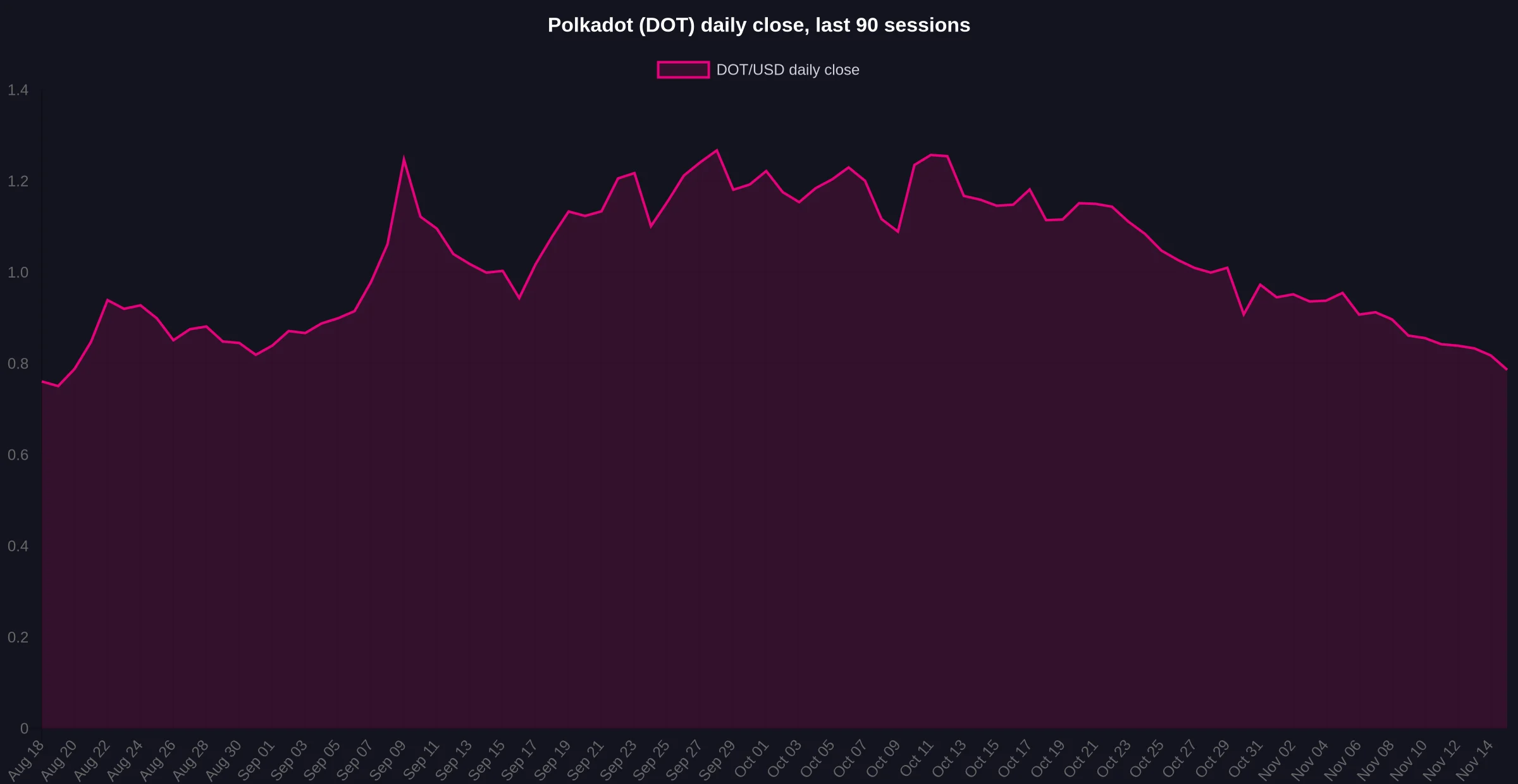
Those levels give the coming weeks a testable structure on a daily-close basis, with no claim about direction. A close below $0.7510 would put DOT at its weakest level since August and would make the collateral arithmetic above worse, since each dollar of dotUSD would then need still more tokens. A reclaim of the 20-day average near $0.91 would be the first evidence that the November slide has stalled. Both figures come from the same CoinGecko series. Neither is a target, and neither says anything about where the price goes next.
Data: CoinGecko.
Who Ends Up Carrying the Risk
DOT holders carry the reserve risk. Under a DOT-backed design, stablecoin adoption helps the token only while the reserve is accumulated rather than sold. The announcement is silent on where the DOT would come from, and the question is already being asked in public: a reply under the foundation’s post asks whether the project plans “to use presale money (bitcoin) as funding instead of selling DOT from the DOTDAO treasury”. No answer from the foundation appears in the thread.
Holders of dotUSD would carry a different risk, and the announcement gives them little with which to assess it. There is no stated redemption route, no named issuer, no reserve attestation schedule and no description of how a shortfall would be handled. The Technical Fellowship is described as providing oversight and risk management, which is not the same as a legal claim on assets, and the document does not present it as one.
The reflexivity is easy to state and hard to design around. At 150% collateral, a 20% fall in DOT takes coverage to 120%. A one-third fall takes it to 100%, the point at which the reserve equals the liability and nothing is left for volatility. DOT has fallen 28.21% in the past 30 days. Any ratio chosen when the mandate was written in November would have been tested within weeks of being written.
Polkadot’s ecosystem is contracting at the same time. Acala and Karura, two of its earliest parachains, are set to wind down both chains by 10 February 2027 after their own governance votes. A consumer strategy is partly a response to that attrition. The foundation’s framing is that a decade of infrastructure work now needs users rather than more infrastructure, and a payments app with a native dollar token is the shortest route it can see to acquiring them.
What the Vote Left Open
Three questions decide whether dotUSD becomes a payments product or a design document. The first is the peg mechanism and the ratio attached to it, since the ceiling calculations above move by hundreds of millions of dollars depending on the answer. The second is the reserve’s source, because buying DOT on the market supports the token while drawing it from a treasury changes the supply picture and, if sold, works against it.
The third is the schedule. As of 14 November 2026 the foundation has announced no launch date for dotUSD and no date for the Polkadot app. It directs readers to follow its accounts and YouTube channel “to be among the first to try the Polkadot app”, which describes a waitlist rather than a release. Nothing in the announcement states that dotUSD has been issued, audited or reviewed by any financial regulator, and no jurisdiction is named for its issuance.
The governance result itself rests on the foundation’s own account of the tally. The onchain referendum record is the authoritative source for the 97% figure; this article has relied on the foundation’s stated result rather than an independent count of the votes, and readers who need the vote weight, turnout and threshold should consult that record.
Frequently Asked Questions
What is dotUSD?
dotUSD is the first of Polkadot’s planned dotStables, a token designed to track the US dollar. The Polkadot Community Foundation says it will be backed by DOT, Polkadot’s native token, and overseen by the network’s Technical Fellowship.
Has dotUSD launched yet?
No. Polkadot governance approved the strategy behind it on 11 November 2026, but the foundation has not announced an issuance date, a supply target or an issuer as of 14 November 2026.
How would dotUSD be backed?
The mandate says dotUSD will be backed by DOT. It does not specify a collateral ratio, whether the reserve would be over-collateralised or algorithmic, which firms would audit it, or how redemption at par would work.
What DOT price would support a $1 billion dotUSD?
At a 150% collateral ratio and the current circulating supply of 1,712,046,467 DOT, a $1 billion dotUSD implies a DOT price of roughly $0.876, against $0.7869 on 14 November 2026. A $10 billion dotUSD implies about $8.76.
What happens to dotUSD if the DOT price falls?
Coverage falls with the collateral. Assuming a reserve held entirely in DOT, a 20% decline in the token takes a 150% ratio to 120%, and a one-third decline takes it to 100%, leaving no buffer for further volatility.