Polkadot is shrinking its circle of active validators. Referendum 1966 has been running since Tuesday and aims to cut the number of validators that produce blocks and earn rewards from 600 to
Polkadot is shrinking its circle of active validators. Referendum 1966 has been running since Tuesday and aims to cut the number of validators that produce blocks and earn rewards from 600 to 500. If approved, the change mathematically takes effect from Tuesday, November 10, at around 11 a.m. Central European Time. It is the first of three steps: by the end of November only 320 validators are to remain active. Anyone nominating DOT themselves may then be left without rewards if none of their chosen validators survives the cut. What is documented: content, timing and voting status come from the referendum itself, the roadmap from the proposal in the Polkadot forum of October 16, and the tax rules from the German Income Tax Act. Our assessment follows further down in a separate, clearly marked section.
The price offers the topic no tailwind. On Friday morning DOT trades at $0.92 or €0.82 according to CoinGecko, 3.1 percent lower than 24 hours earlier and almost 19 percent lower than a month ago. Bitcoin lost 6.1 percent over the same period and stands at $75,600.
Referendum 1966: what the first step of the validator set reduction changes
The referendum is titled "Step #1 of Validator Set Reduction" and runs in the "Whitelisted Caller" track. Polkadot uses this route for changes the Technical Fellowship has approved in advance. It is faster than the "Root" route but still requires a majority of DOT holders.
In substance the proposal does three things. It sets the number of active validators at 500. It reduces the budget from which validators are paid on top of their commission in the same proportion. And it adjusts two Relay Chain parameters that govern how many validators per core check blocks. A core, in Polkadot jargon, is a fixed slot for the computing work of a connected chain.
The timing is hard-coded: the change is set to take effect at block 33,814,400 of the Relay Chain. At six seconds per block, that was a good 58,000 blocks ahead on Friday morning, or around four days. The new number becomes effective in the first era after that. An era lasts 24 hours on Polkadot; at its start the network selects which validators are active.
The vote on Friday morning was clear-cut. Around 8.9 million votes stood in favour of the proposal and just over 26,000 against. Votes are weighted by lock-up period, so anyone committing their DOT for longer counts more. The amount actually participating, the "support" figure, is around 1.8 million DOT. The referendum is in its decision phase. Until it is confirmed, November 10 remains a planned date.
Validator set from 600 to 320: the roadmap to the end of November
The framework was presented by the user Jan-Jan in the Polkadot forum on October 16. The plan envisages three stages, each about a week apart: first 500, then 400 and finally 320 active validators. Each stage needs its own referendum with Fellowship approval and the consent of DOT holders. The step-by-step rollout is meant to allow the network's performance to be monitored and the process halted if problems arise.
According to the proposal, the existing election rule decides who stays. Polkadot elects its active validators through Nominated Proof of Stake, or NPoS: DOT holders nominate validators, and an election algorithm distributes the nominated DOT so that the elected validators are backed as evenly as possible. Validators with little backing drop out first. The smaller the set, the higher the threshold of nominated DOT a validator needs.
At 21,000 DOT per validator per year, the validator budget works out as follows: 12.6 million DOT a year today, 10.5 million after stage one and 6.72 million after stage three. The figure of 21,000 comes from the forum post itself; we calculated the totals from it.
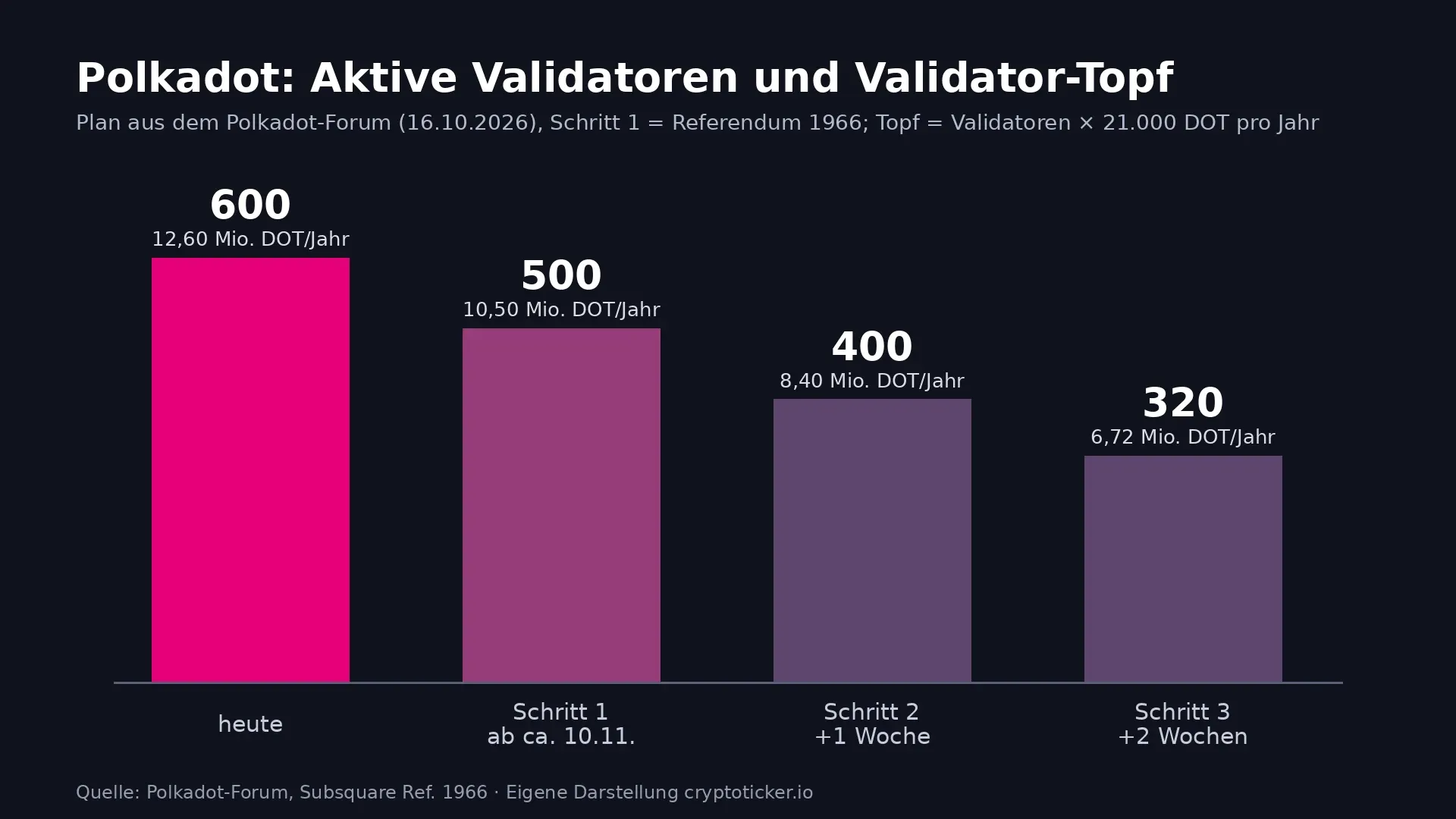
From 600 to 320 active validators in three weeks: the validator pot shrinks along with them, while the amount per slot stays the same.
The reason for the cut is called the metanode. By the end of 2026, validators are to take on more tasks than today: additionally running collators for Asset Hub and People Chain, answering requests from light clients and serving RPC requests from the Polkadot App. RPC stands for remote procedure call and refers to the interface through which a wallet queries a balance or submits a transfer. A collator gathers the transactions of a connected chain and passes them on to the validators for verification.
According to the proposal, 600 validators are more than Polkadot needs. The budget saved is later to compensate metanode operators for the more expensive hardware. As the minimum specification for a single machine, the developer alexggh names, in the same forum thread, 16 cores, 64 gigabytes of RAM, at least 2.4 terabytes of NVMe storage and a symmetrical 1 gigabit per second connection.
There are objections in the forum too. The user pmensik asks how the quality of RPC services is to be measured, how weak operators will be removed from the set, and whether the cut excludes good operators before metanodes launch. No answer setting out a measurement method has yet appeared in the thread.
Nomination and staking: which DOT could go unrewarded from November 10
For DOT holders, one question matters: where are your own DOT staked? There are three routes, and the cut affects them differently.
Direct nomination
Anyone nominating directly selects up to 16 validators. Rewards are paid only for eras in which at least one of them is in the active set and the DOT are assigned to it. If all selected validators drop out of the set of 500, or later 320, the DOT stay bonded but earn nothing. The staking dashboard then shows the status "inactive". A new selection takes effect from the next era.
Nomination pool
A nomination pool bundles the DOT of many holders, and the pool operator chooses the validators. Here the work lies with the operator. Checking is still worthwhile: a pool whose validators have weak backing will earn less after the cut, or at times nothing at all.
Staking via an exchange
Anyone staking DOT through an exchange or broker does not nominate themselves. The platform distributes holdings across its own or third-party validators. Whether it adapts its selection to the smaller set is its own decision; the yield paid out will show it with some delay. Which platforms offer DOT staking and on what terms is shown in our comparison of staking providers.
Exiting has no longer been a major risk since the summer. With Referendum 1910, Polkadot abolished slashing for nominators and shortened the unbonding period from 28 days to at most two eras. Anyone wanting to switch validators or exit entirely can therefore access their DOT within about two days.

Each stage removes around 100 slots from the active validator set; anyone who nominated there loses their claim to rewards.
Polkadot staking yield: the validator pot shrinks, the stakers' share does not
Since Referendum 1909, Polkadot has distributed newly issued DOT according to a fixed formula. According to the calculation by the user Northvane in the forum thread, 45.2 percent goes to stakers, 22.6 percent to validators as an incentive and 32.2 percent into a buffer. The cut only changes the middle item: after stage one it falls to 18.8 percent, after stage three to around 12 percent. The freed-up portion is to flow into the buffer for now and later go to collators and RPC services.
The stakers' share stays at 45.2 percent. For nominators with an active validator, the yield changes little on paper; spread across fewer validators, the reward per nominated DOT may even rise slightly. The proposal gives no yield figure, and we do not calculate one. The price of the stable yield is the risk of dropping out of the set entirely with a weak validator.
What the yield is worth in euros depends on the price. At €0.82 per DOT, a return of 100 DOT a year brings in around €82; a month ago it would still have been just over €100.
XCM incident in October: $1.38 million loss for the Treasury
The same weeks saw a glitch that has nothing to do with the validator cut but touches on confidence in the technology. Between October 24 and 26, an attacker exploited a flaw in Cross-Consensus Messaging, or XCM, the message format Polkadot chains use to exchange value. The attacker thereby lowered the recorded supply of the new stablecoin dotUSD on Asset Hub, without tokens disappearing from user accounts. The price in the DOT/dotUSD pool became distorted, and traders swapped at artificial rates.
According to the post-mortem by the developer firm Parity, published in the Polkadot forum on November 2 and reported by CryptoSlate on November 4, the Treasury, as the pool's sole liquidity provider, suffered a loss of around $1.381 million. According to Parity, no user funds were lost. The flaw had been fixed in the code in June, but the correction had not reached the running software. The fix came on October 26 with runtime 2.5.1, and on October 30 runtime 2.5.2 corrected the recorded dotUSD supply.
DOT price on Friday: $0.92 and the levels since Wednesday
On Wednesday DOT stood at $0.96. Our article five years after the 2021 record named $0.92 as the downside level and $1.04 at the 20-day average as the upside level at the time. The lower level has since been reached. Over the past 24 hours the low was $0.889 according to CoinGecko, just below it; on Friday morning DOT is trading slightly above it again.
The move follows the broader market. On Thursday, losses in chip stocks on the Nasdaq pulled Bitcoin below $77,000, and leveraged long positions were forcibly closed. At 3.1 percent in 24 hours, DOT fell only half as much as Bitcoin. DOT worth around $105 million changed hands over this period, and market capitalisation stands at just under $1.58 billion, rank 57.
Two levels matter for the coming days. Below, the range between $0.89 and $0.92, which held twice this week; should DOT close below it, the coin would trade lower than it has in years, and there would be no tested support. Above, $0.96, the high of the past 24 hours and Wednesday's level. Only above that would the 20-day average come back within reach. The validator cut itself changes neither the supply nor the issuance of DOT and is therefore not a direct price factor.
Polkadot staking and tax: the rules for rewards in Germany
In Germany, staking rewards are income under Section 22 No. 3 of the Income Tax Act. What counts is their euro value on the day they are received. If all income of this kind together stays below 256 euros a year, it is tax-free. This threshold is an exemption limit rather than an allowance: if the total exceeds it, the entire amount is taxed, not just the part above 256 euros.
On a later sale, the one-year holding period under Section 23 of the Income Tax Act applies to each tranche. Staked DOT do not extend this period; the Federal Ministry of Finance dispelled earlier concerns about an extension to ten years in its guidance on crypto assets. Whether the tax-free holding period survives at all is politically open. Our page on the crypto holding period reform summarises the state of the debate.
Switching validators now does not trigger a sale. Nominating anew or changing pools is not a taxable disposal, as long as the DOT are not exchanged for euros or another token.
Polkadot validator reduction: our assessment
Our assessment: the cut is technically understandable and manageable for investors, provided they keep an eye on their nominations. In its favour are the vote of around 8.9 million to 26,000 and the staged process with separate referendums. Also in its favour is that the stakers' yield remains untouched. Against it is the fact that Polkadot, with 320 instead of 600 validators, has a narrower base, and the measurement rules for metanodes are still open in the forum. The XCM incident also shows that fixes do not always reach the running software in time. We do not derive a buy recommendation from this; the price is currently following the broader market rather than the technology, and a total loss remains possible with any crypto asset.
Polkadot staking: four days remain for new nominations before November 10
- Review your nominations. Open the staking dashboard and see how many DOT back your validators. Those at the bottom drop out first at 500 or 320 slots. If you prefer to stake via a platform, you will find providers in the staking comparison.
- Check how you buy. Anyone looking to buy more DOT or reallocate should use an exchange licensed under the EU's MiCA regulation. Which providers are licensed is listed in our comparison of regulated crypto exchanges.
- Record your rewards. Note every inflow with date and euro value so that the 256-euro threshold and the holding period per tranche can be documented. A tax tool does this automatically; our comparison of crypto tax tools lists suitable programs.
(As of November 6, 2026. This article is not investment advice. Prices and fee structures change; check the terms with the provider before you buy.)