Polygon's Ithaca Upgrade: Why Payment Reliability Matters Blockchain payment networks are judged on one thing: whether a transaction clears when it is supposed to. A single stalled block or a
Polygon's Ithaca Upgrade: Why Payment Reliability Matters
Blockchain payment networks are judged on one thing: whether a transaction clears when it is supposed to. A single stalled block or an unusually large transaction can slow an entire chain during the exact moment users need speed the most.
The Polygon Ithaca upgrade was built to close gaps like these. This blog explains what shipped with Ithaca, how it works, and what it means for anyone building or running payments on the network Chain.
Source: X Post
What Is the Polygon Ithaca Upgrade
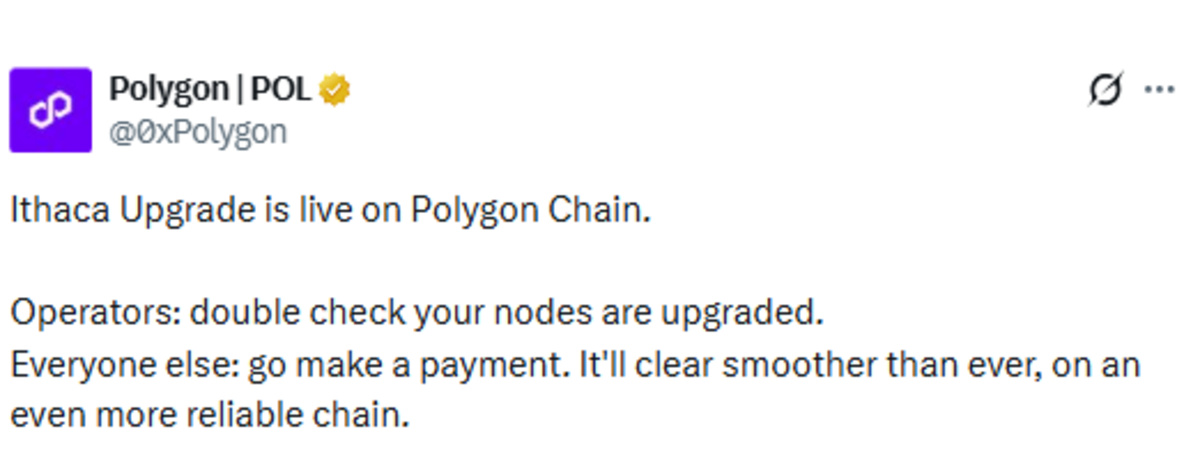
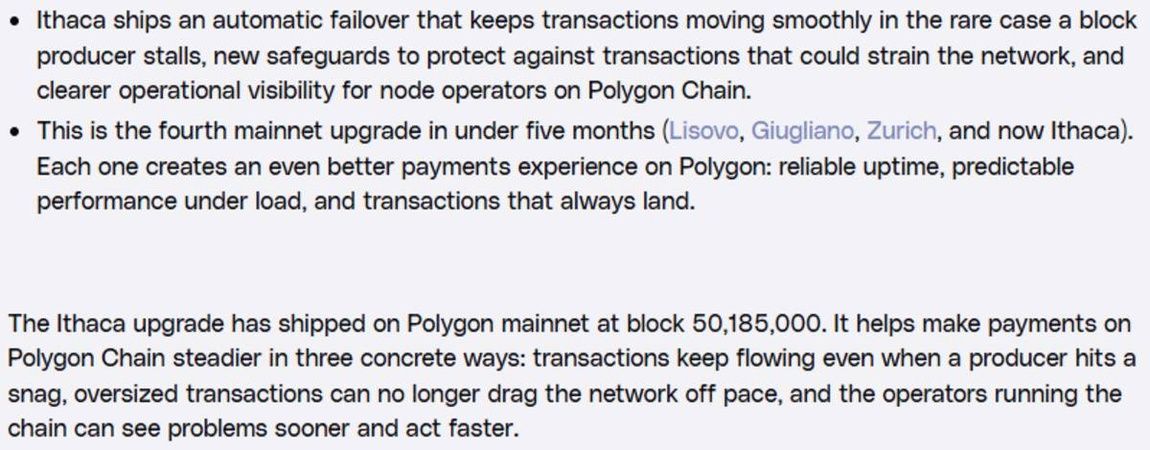
Ithaca is a mainnet upgrade to the protocol Chain, activated on July 30, 2026, at block 50,185,000, according to Polygon Labs' official blog. It focuses on one outcome: keeping payments moving smoothly, even when something goes wrong at the infrastructure level.
The Polygon Ithaca upgrade is the fourth mainnet upgrade the protocol has shipped in under five months, following Lisovo, Giugliano, and Zurich.
Source: Official Website
Each of these upgrades has targeted a different part of the payments experience, from confirmation speed to fee predictability. Ithaca's focus is reliability under stress.
Why Protocol Built the Ithaca Upgrade
Before Ithaca, if the node responsible for producing blocks ran into trouble, the network could stall for close to 15 minutes with no automatic recovery. For everyday use, that is a long pause.
For a business processing payroll, handling a sales rush, or running checkout at scale, a 15-minute stall can mean lost transactions and frustrated users.
The protocol Labs describes reliability as trust that compounds over time. A payment that clears cleanly once builds confidence. The same result repeated thousands of times becomes something businesses build on without thinking about it.
One bad stall at the wrong moment can undo that. The Ithaca upgrade was designed to remove that specific risk from Polygon Chain.
Key Features of the Ithaca Upgrade
According to the official website, the release ships three core improvements:
Feature
What It Does
Automatic failover
Rotates in a healthy block producer automatically if one stalls, so transactions keep moving
Oversized transaction safeguards
Blocks or intercepts unusually large transactions before they can slow or destabilize the network
Operator visibility
Gives node operators clearer, real-time insight into infrastructure so issues get caught and fixed faster
Together, these changes are meant to make the protocol Chain behave the same way under heavy load as it does during a quiet period. For payment systems, that kind of consistency matters more than raw speed.
How the Ithaca Upgrade Works
The core fix in the Polygon Ithaca upgrade addresses block producer downtime directly. Previously, a stalled producer meant the network simply waited.
With Ithaca live, a healthy producer is rotated in automatically, cutting out the manual recovery step that used to cause delays.
The oversized transaction safeguards work as a filter layer. New technical checks flag or intercept anomalous, unusually large transactions before they reach a point where they could strain the network or slow down block production for everyone else.
Operator visibility improvements give the people running the network infrastructure better real-time data. This means operational issues can be spotted and resolved before they turn into a broader outage.
Part of a Longer Update Series
The release is not a standalone fix. Polygon Labs frames it as part of an ongoing effort to strengthen every part of the chain that payments depend on.
The team behind Polygon Chain has repeated the same update pattern four times in five months: identify where payments can break, then close that gap before it affects users. Lisovo, Giugliano, and Zurich each addressed a different weak point, and release continues that same line of work.
What This Means for Node Operators
Node operators running Polygon infrastructure need to upgrade to Heimdall v0.10.0 to stay compatible with release.
The protocol Labs has stated that running mixed versions across the activation height is not supported, so operators should complete the update before or at the activation block. Full technical instructions are available on the official Polygon forum.
Challenges and Risks
Operator coordination: the mandatory Heimdall v0.10.0 update requires all operators to upgrade in sync, which carries execution risk if some operators lag.
Real-world testing: automatic failover and transaction filtering systems need sustained mainnet activity to prove they work as intended under genuine stress, not just planned tests.
Ongoing dependency: each upgrade adds complexity to the chain's infrastructure, which places more responsibility on operators to stay current.
Expert Opinion
The Polygon Ithaca upgrade fits a broader industry pattern among payment-focused chains: infrastructure reliability is becoming as important as transaction throughput.
Automatic failover mechanisms are common in traditional financial systems, where downtime has a direct cost. Bringing a similar mechanism to a public blockchain addresses a gap that has historically separated crypto rails from card networks and bank transfer systems.
Whether the release measurably reduces network stalls in practice will depend on real-world data over the coming months, which has not yet been independently published.
Future Outlook
The protocol Labs has signalled that the release is not the final step in this reliability push. With four upgrades shipped in five months, the pace suggests further updates aimed at payments infrastructure are likely.
The company has also invited payments builders to reach out directly, positioning reliability as a core differentiator for Polygon Chain going forward.
Final Thoughts
The Polygon Ithaca upgrade addresses a specific, practical problem: what happens when something goes wrong at the infrastructure level during a payment? By automating failover, filtering oversized transactions, and giving operators clearer visibility, Polygon Chain aims to make payment reliability less dependent on manual intervention.
As part of a longer series of updates, The release points to where Polygon's development priorities currently sit.
Disclaimer: This article is for informational and educational purposes only. It does not constitute financial advice. Readers should conduct their own research before making any decisions related to cryptocurrency or blockchain technology.