Why Did Polygon Permanently Burn 100M POL Tokens? Polygon news today centers on a completed token burn. Polygon Foundation CEO Sandeep Nailwal confirmed on September 23, 2026, that 100 millio
Why Did Polygon Permanently Burn 100M POL Tokens?
Polygon news today centers on a completed token burn. Polygon Foundation CEO Sandeep Nailwal confirmed on September 23, 2026, that 100 million POL was permanently burned.
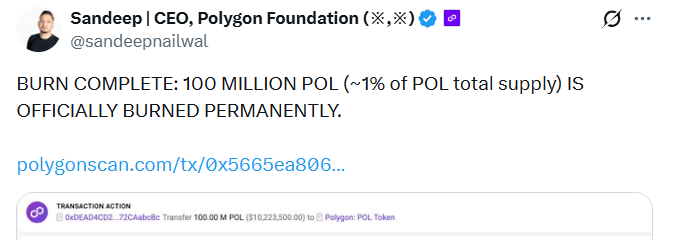
The burned amount equals about 1% of POL's original 10 billion supply. PolygonScan values the transfer at $10,223,500. The burn-follows the Polygon burn plan announced on September 18, when the contracts still awaited final approval.
Nailwal shared the result in a post on X. He said the burn is complete and permanent, and he attached an image of the transaction.
Source: Official X Post
What the On-Chain Record Shows
The PolygonScan transaction record lists a successful transfer of 100,000,000 POL. It sits in block 94312922, with a timestamp of September 23, 2026, 02:41:29 PM UTC.
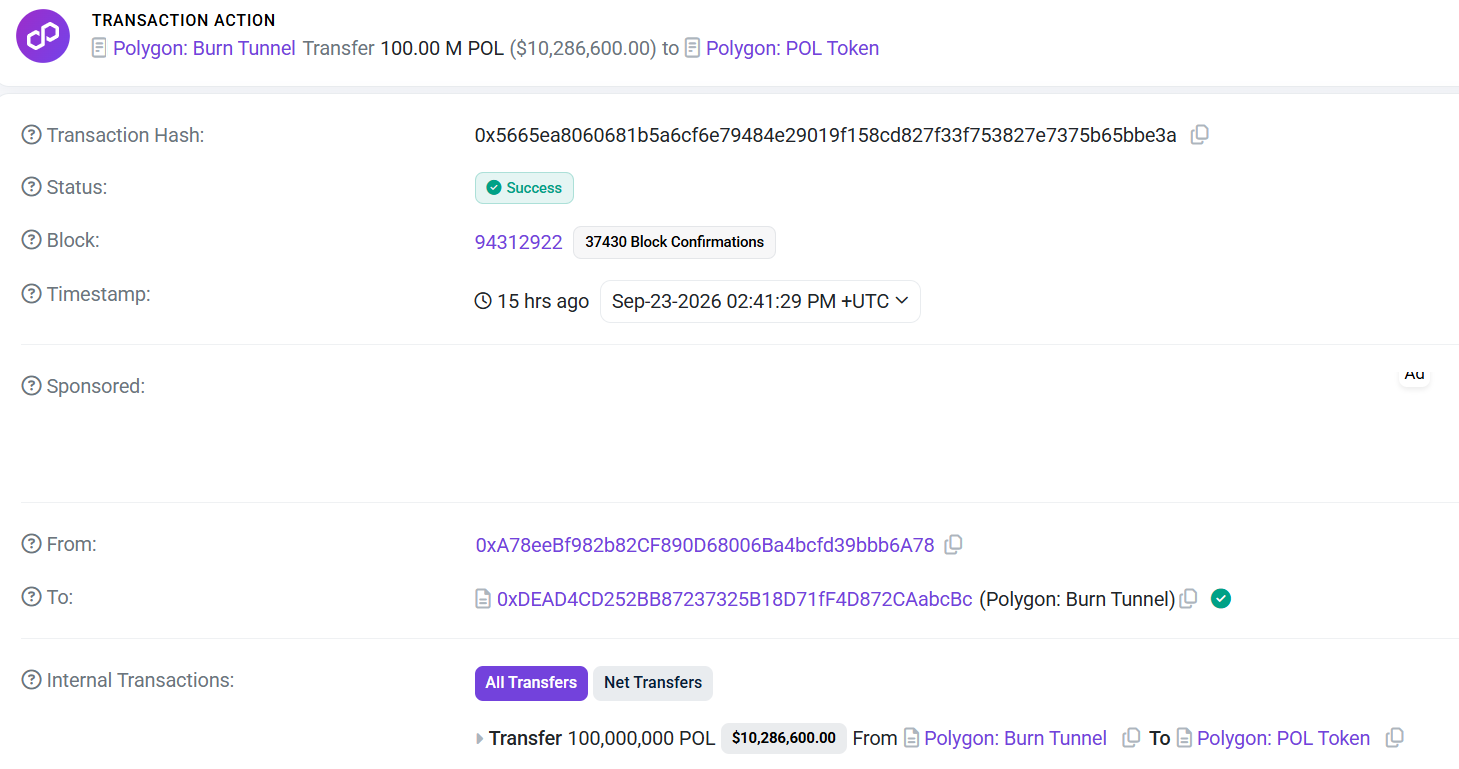
The listed value implies a POL-price near $0.102 at that moment. The explorer uses its own pricing, so the figure may differ slightly from exchange rates.
Detail
Information
Tokens burned
100 million Token
Value at burn
About $10.22 million (PolygonScan)
Share of supply
About 1% of the original 10 billion supply
Block
94312922
Status
Success
Why Did Polygon Burn 100 Million POL?
The POL-token-burn draws on Polygon's base-fee system. Each transaction pays a base fee in POL, and that POL-collects in a fee contract. Nailwal said on September 18 that the collector held about 121 million-POL.
The burn-contracts first sat on testnet. They needed final Security Council signatures before moving to mainnet. Once live, any community member could trigger the burn. Further burns can follow each quarter.
Nailwal also says Pol-Token has been deflationary since January 2026. That is a project claim, and readers can check fee data on-chain.
What Does the POL Supply Reduction Mean?
Effect on Polygon Token Supply
The burn-permanently removes 100 million tokens from circulation. That is a clear, verifiable cut. But It still has a 2% annual emission under its tokenomics, so new tokens keep entering supply.
A 1% burn is smaller than one year of emissions. Whether net supply falls depends on how much base-fee POL gets burned over time.
Market Reaction
POL rose after the plan surfaced on September 18. Confirmation day looked weaker. CoinMarketCap Data showed-POL near $0.1028 on the morning of September 24. That was down 6.46% in 24 hours but up nearly 10% over the week.
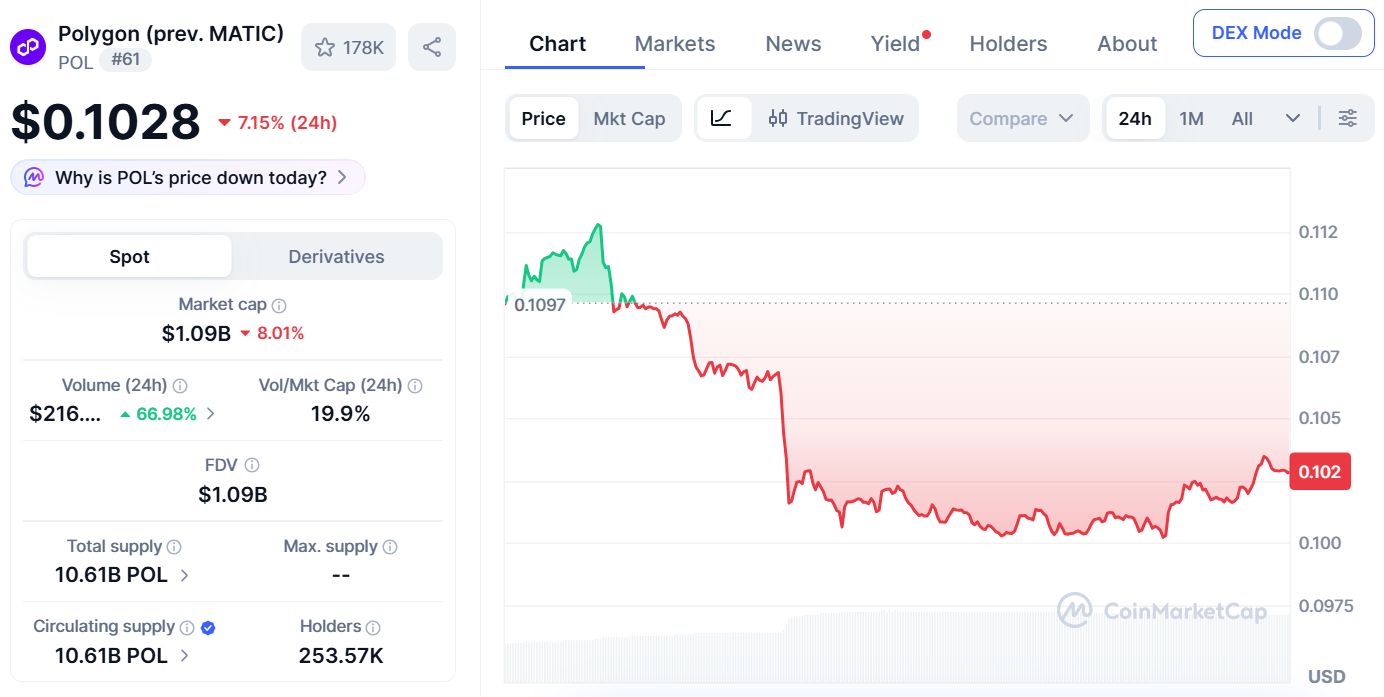
The wider market was soft too. Daily crypto news todaydata shows the global market cap down 2.6% to $2.96 trillion, with Bitcoin also down 2.6%.
The price move is a fact. Whether the burn-caused it is not established.
Polygon News Today: What Happens Next?
Three checkpoints will shape the Polygon's latest news cycle:
Next quarterly-burn:Any community member can trigger it if the process works as described.
Fee collector balance:Subtracting from the reported 121 million suggests about 21 million-POL remains. That is not confirmed.
Net supply: Base-fee burns need to be compared with the 2% emission over several quarters.
What Remains Unclear
This Polygon burn update still leaves a few points open. The date of the next-burn is not set. No governance proposal number was linked to the-burn. The revenue and deflation claims from the project also lack independent verification.
Expert Take: What Should POL Holders Watch Next?
The data suggests this is modest in size but important in design. For Polygon crypto news, the bigger story is the process, since it turns fee collection into a repeatable, community-run-burn.
The key number is the gap between 100 million burned and yearly emissions. The key signals are the next quarterly-burn, the collector balance, and network activity.
The main risk is that fee burns fall short of new issuance. Thin liquidity can also distort price moves. The main uncertainty remains whether higher network use can raise base fees enough to offset emissions.
Conclusion
Polygon burned 100 million-POL on September 23, 2026, and the on-chain record backs the announcement. The event shows the burn-contract works as designed. Whether it changes the long-term supply path depends on future burns and network fees.
Disclaimer
This article is for informational purposes only and is not financial or investment advice. Crypto assets are volatile and carry risk of loss. Do your own research before making any decision.