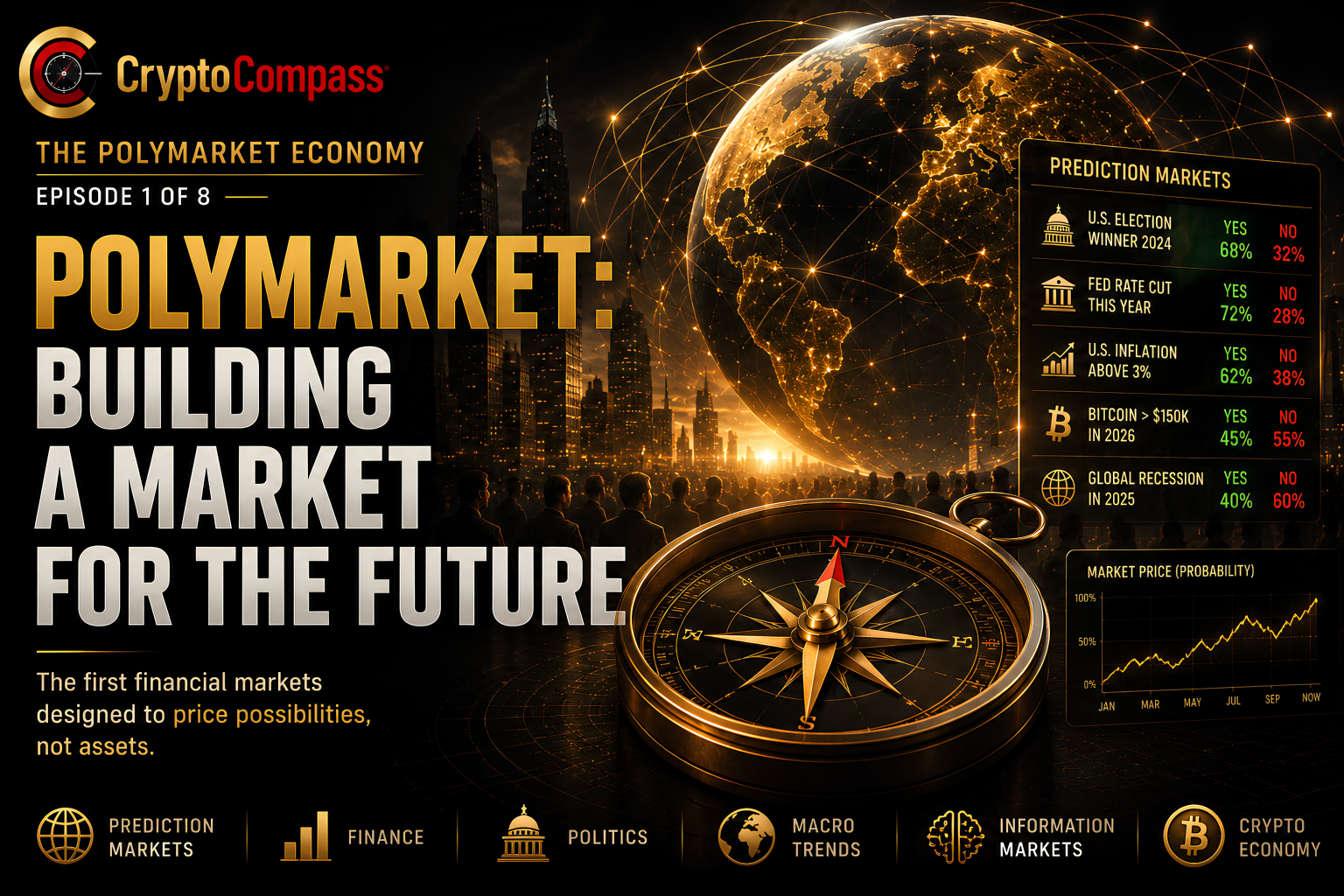
For centuries, financial markets have priced assets. Polymarket is attempting something entirely different: pricing future events. If successful, it could transform how society forecasts elections, economic trends, geopolitical risks, and even reality itself.
Most people encounter Polymarket for the first time through headlines.
An election.
A Federal Reserve decision.
A geopolitical crisis.
A prediction about Bitcoin.
The platform is often described as a betting market.
That description is technically correct.
It is also profoundly incomplete.
What Polymarket is attempting to build is not simply a place to wager on outcomes.
It is attempting to build a market for the future itself.
That may sound like a philosophical statement.
In reality, it may become one of the most important financial experiments of the digital age.
Financial Markets Have Always Priced The Unknown
Every financial market is ultimately a prediction market.
Stock prices reflect expectations about future earnings.
Bond markets forecast inflation and interest rates.
Commodity markets anticipate future supply and demand.
Currency markets price expectations about economic strength.
Markets have never been about the present.
They have always been about the future.
The difference is that traditional markets express these expectations indirectly.
Polymarket expresses them directly.
Instead of asking investors to infer probabilities from asset prices, prediction markets place probabilities at the center of the product itself.
The result is a completely different type of market.
One where information becomes the asset.
Turning Uncertainty Into A Tradeable Asset
Every market on Polymarket begins with uncertainty.
Will inflation remain above target?
Will the Federal Reserve cut rates?
Will a political candidate win?
Will Bitcoin reach a specific price?
Will a company launch a product?
Will a war escalate?
Each question creates a market.
Participants buy and sell contracts representing different outcomes.
Prices continuously adjust as new information enters the system.
Unlike traditional polling, the market never stops updating.
Unlike expert forecasts, there is no single authority.
The crowd becomes the forecaster.
The market becomes the scorekeeper.
Why Money Changes Everything
Information is abundant.
Reliable information is scarce.
Prediction markets introduce a powerful filter.
Participants are not simply expressing opinions.
They are risking capital.
This distinction is what fascinates economists.
People frequently state what they hope will happen.
Markets force them to consider what they believe will happen.
When money is involved, incentives change.
Noise declines.
Conviction becomes measurable.
The result is a continuously evolving probability generated by thousands of independent decisions.
The Return Of The Wisdom Of Crowds
The intellectual foundation behind prediction markets predates crypto by decades.
Researchers have long observed that large groups can outperform experts under certain conditions.
A single analyst may possess exceptional expertise.
A market aggregates thousands of perspectives simultaneously.
Political analysts.
Macro investors.
Industry specialists.
Journalists.
Researchers.
Traders.
Ordinary citizens.
Each contributes a fragment of information.
The market combines those fragments into a single price.
Polymarket represents one of the largest real-world attempts to operationalize this concept at global scale.
The Election That Put Polymarket On The Map
For years, prediction markets remained largely confined to academic discussions and niche communities.
That changed dramatically during the 2024 U.S. presidential election.
Suddenly, prediction markets became part of mainstream conversation.
Television networks referenced market probabilities.
Journalists cited prediction data alongside polling averages.
Investors monitored political contracts as closely as economic indicators.
For many observers, it was the first time they encountered a market explicitly designed to forecast reality.
The event transformed Polymarket from a crypto curiosity into a globally recognized information platform.
A New Asset Class: Probability
Perhaps the most important innovation behind Polymarket is conceptual.
Traditional markets trade ownership.
Prediction markets trade probability.
That distinction creates an entirely new category of economic activity.
Participants are no longer speculating on the value of a company.
They are trading expectations about future events.
The asset is not equity.
The asset is information.
The product is not ownership.
The product is probability.
This is why many investors believe prediction markets could evolve far beyond their current form.
Beyond Politics
Political forecasting attracts attention.
The larger opportunity may lie elsewhere.
Prediction markets can theoretically be applied to almost any uncertain event.
Economic growth.
Inflation.
Corporate earnings.
Technology launches.
Scientific breakthroughs.
Regulatory decisions.
Climate events.
Public health outcomes.
In a world increasingly driven by data, prediction markets may become a critical layer of information infrastructure.
Not because they eliminate uncertainty.
But because they quantify it.
CryptoCompass View
Bitcoin transformed money into digital property.
Ethereum transformed software into programmable infrastructure.
Polymarket is pursuing a different ambition.
It is attempting to transform uncertainty into a financial market.
Whether prediction markets become mainstream remains unknown.
Whether regulators fully embrace them remains uncertain.
Whether markets consistently outperform experts remains an open question.
Yet the significance of the experiment is difficult to ignore.
For the first time in history, global participants can collectively price future events in real time, creating a living market of expectations.
The long-term impact may extend far beyond crypto.
Because if markets are humanity's most effective mechanism for processing information, then prediction markets may ultimately become the most direct expression of that idea ever created.
NEXT IN THE SERIES
THE POLYMARKET ECONOMY
Episode 2 of 8
Why Wall Street Is Watching Polymarket
Coming This Week.
By CryptoCompass