A BNB Chain incident involving Pots Money’s IBS token has reportedly resulted in a liquidity pool being drained after a governance-enabled account minted a large amount of new tokens and swap
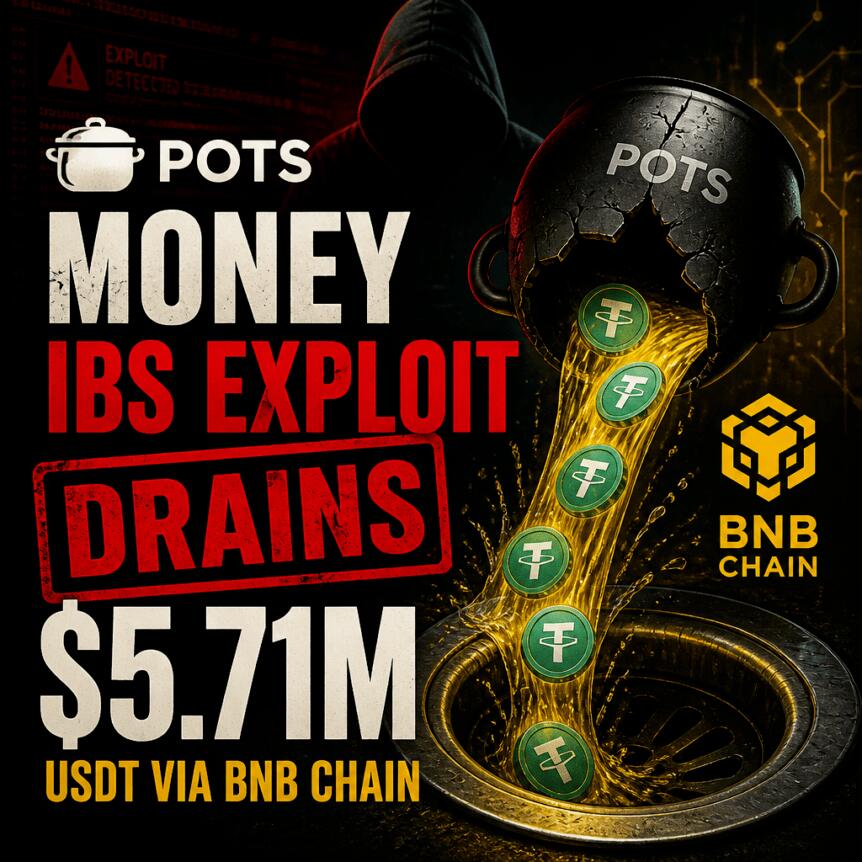
A BNB Chain incident involving Pots Money’s IBS token has reportedly resulted in a liquidity pool being drained after a governance-enabled account minted a large amount of new tokens and swapped them for USDT. Onchain monitors say the maneuver effectively converted freshly created IBS into Tether already sitting in the pool, leaving the token’s market liquidity critically damaged.
According to reports shared by PeckShieldAlert, the account minted 1 billion IBS tokens and traded them for roughly $5.71 million in USDT. PeckShieldAlert further stated that the stolen funds remained in an identified wallet and that IBS dropped 100%—a sign that the token’s tradable supply and/or pricing mechanism was severely impacted immediately after the exploit.
Key takeaways
- A governance-enabled account minted 1 billion IBS on BNB Chain and swapped the new tokens for about $5.71 million in USDT, draining liquidity in an IBS/USDT pool.
- Security monitoring cited by PeckShieldAlert says the USDT remained in an identified wallet and that IBS fell to 0%—indicating a rapid collapse in token usability or market demand after the attack.
- TokenPost reported the exploit ran across two mint-and-sell rounds designed to extract USDT held by the pool.
- Pots Money has not, as of press time, identified affected liquidity providers or published a clear recovery plan.
How the exploit reportedly worked
The core of the incident, as described by multiple monitoring and reporting outlets, was a minting-and-swapping loop that targeted existing liquidity. After a governance-enabled account created 1 billion IBS tokens, those tokens were immediately exchanged for USDT held by the IBS/USDT liquidity pool.
TokenPost reported that the attacker executed two rounds of minting and selling. The strategy mattered because the mechanism allowed newly minted IBS to be sold into the pool to retrieve USDT that was already there—rather than forcing a market buy based on external demand. In practice, that means the pool can be depleted quickly when newly created tokens can be liquidated directly against pooled stablecoins.
In the same reporting thread, PeckShieldAlert said the stolen funds stayed in a known wallet and that the token’s value dropped to zero. While precise details of the IBS contract and pricing curve weren’t provided in the excerpt, the reported outcome aligns with a scenario where the pool’s balance is overwhelmed by sell pressure from minted supply.
Why governance-enabled minting raised the stakes
The most consequential aspect of this incident is not only the size of the minted amount, but the fact that the exploit reportedly used a governance-enabled account as the minting source. Governance-enabled minting systems are designed to allow protocol parameters and supply changes under predefined controls. When those controls are misconfigured, compromised, or otherwise accessible to an attacker, the resulting damage can be immediate and outsized.
In this case, the governance mint appears to have acted as the “entry point” to create liquidity-absorbing inventory—IBS—at the exact moment it could be dumped into a USDT pool. That combination can turn a supply function into a direct drain mechanism for any paired assets where swaps are executed against existing reserves.
Investors and liquidity providers watching token ecosystems that include collateral-backed or algorithmic-style activity tokens should pay close attention to how minting power is controlled and how minted supply interacts with onchain market liquidity. The exploit illustrates how an onchain design can fail even when the token’s narrative includes collateralization or predefined floors, if the attack path bypasses the intended safeguards at the trading and liquidity layer.
What is IBS, and what liquidity providers may be facing
Pots Money describes IBS as its algorithmic, collateral-backed activity token with a $1 floor. That framing suggests the token is intended to maintain a stable minimum value under normal conditions. However, the reported outcome—IBS dropping 100% and USDT being extracted from the pool—indicates the floor did not prevent the immediate liquidity depletion in the traded pair.
TokenPost’s account specifically points to two mint-and-sell rounds as the driver behind drained USDT from the IBS/USDT liquidity pool. The practical implication is that liquidity providers likely bore the direct impact of reduced pool reserves and distorted pricing after the attacker converted minted IBS into stablecoins.
As of the time of reporting in the excerpt, Pots Money had not identified which liquidity providers were affected, and it had not disclosed a recovery plan. That absence is important: in incidents where liquidity is drained from a pool, recovery often depends on whether the protocol can negotiate restoration, reimburse impacted providers, or redesign parameters to stop repeat exploitation. Without transparency on the scope of harm and the path to remediation, affected users may struggle to assess their exposure or timeline for any potential compensation.
Broader warning signs from recent crypto hacks
This exploit arrives during a period of heightened hack activity across decentralized finance and related infrastructure. Cointelegraphreported last month that hacks totaled $1.18 billion across 107 recorded incidents in the third quarter, citing security company Hacken. In Hacken’s Q3 report, the firm attributed 77% (about $906 million) of losses to compromised suppliers or developer tools, along with publicly disclosed fixes that had not been deployed or components outside security reviews.
Hacken also reported a median loss of $670,000 across those 107 incidents. While the IBS incident described here is smaller in scale than the quarter-wide totals, it fits a broader pattern: attackers often exploit systemic weaknesses in operational and governance-related surfaces—especially when newly authorized actions (like minting) can be rapidly monetized via onchain trading.
For the market, that means security isn’t only about code vulnerabilities in isolation. It also involves access control, governance permissions, tooling integrity, and liquidity design that can resist fast extraction under stress. The IBS/USDT drain is a reminder that even collateral-backed narratives and stated token “floors” do not automatically translate into protection if the token’s minting mechanics and market interactions can be turned into an extraction engine.
Going forward, traders and liquidity providers should watch for (1) whether Pots Money publishes a detailed incident report, (2) any identification of affected pools and wallets, and (3) whether governance and minting controls are adjusted to prevent repeat mint-and-sell cycles. Until those answers are provided, the incident’s aftershocks—especially around liquidity recovery and token valuation stability—may remain the biggest open questions.
This article was originally published as Pots Money IBS Exploit Drains $5.71M USDT via BNB Chain on Crypto Breaking News – your trusted source for crypto news, Bitcoin news, and blockchain updates.