What the Prediction Market Insider Trading Bill Would Do Prediction markets could get a federal tipster program. Reps. Sean Casten (D-IL) and Ted Lieu (D-CA) introduced the prediction market
What the Prediction Market Insider Trading Bill Would Do
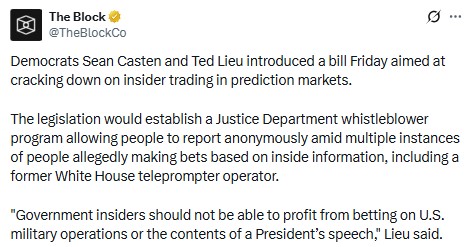
Prediction markets could get a federal tipster program. Reps. Sean Casten (D-IL) and Ted Lieu (D-CA) introduced the prediction market insider trading bill on November 20, 2026. It would let the Justice Department (DOJ) pay tipsters 10% to 30% of the sanctions in a successful case. The tip must lead to that result. The case must bring over $1 million in sanctions.
The sponsors name Kalshi and Polymarket as sites where insiders may trade on secret facts. Both let users trade event contracts. These pay out on real events, such as elections or military action.
Lieu said government insiders should not profit from bets on U.S. military operations. He made the point in the lawmakers' press release.
The Block also reported the introduction on X.
The prediction market insider trading bill is a proposal, not law. The House and Senate must both pass it. The president must then sign it. It adds to the crypto regulation news from Washington this year.
How the Proposed DOJ Whistleblower Award Program Would Work
The draft text sets out the main rules of the prediction market insider trading bill.
Item
What the draft says
Award size
10% to 30% of total sanctions: fines, repaid profits, interest, and seized assets
Funding
Justice Department Assets Forfeiture Fund
Covered case
A criminal case or settlement over federal fraud on an event-contract site, with over $1 million in sanctions
Eligible tip
Original facts: the tipster's own knowledge or analysis, new to agencies, not just from public sources
Anonymity
Anonymous tips if a lawyer represents the tipster; name disclosed before any payment
Appeals
Within 60 days, then court review
Job protection
Employers could not fire, demote, harass, or threaten a tipster.
Rulemaking
Guidance due within 180 days of enactment
No award would go to a tipster convicted of a related crime. The department would also report each year to the House and Senate Judiciary Committees.
The press release cites four cases for the prediction market insider trading bill:
An anonymous trader who made nearly $1 million on bets tied to U.S. military action against Iran.
A trader who made more than $550,000 betting that Iran's Supreme Leader would be removed.
A White House teleprompter operator who earned over $100,000 betting on words in speeches.
A new account that made over $50,000 on a Nobel Peace Prize bet, which the Nobel Institute is reviewing.
Only the teleprompter case has a public regulator record in the material reviewed. On August 28, 2026, the CFTC ordered former operator Gabriel Perez to pay $172,000. It said he traded Kalshi contracts on presidential speeches. The trades ran from December 2025 to February 2026.
The release links no records for the other three. Those figures remain the sponsors' claims.
Prosecutors also filed criminal charges against a soldier accused of using classified information to win over $400,000 on Polymarket. Reports say he has pleaded not guilty.
Where the Draft Could Limit Awards for Crypto Tipsters
In the prediction market insider trading bill, the $1 million floor matters most. The Perez order was a CFTC settlement of about $172,000. A similar case would fall outside the draft, so tips on small trades may not qualify.
The original-information rule matters too. A tip built only on public data, such as wallet activity on a blockchain, may not count. The tipster would need to add independent knowledge or analysis.
The draft also defines a platform as any site, app, exchange, or protocol that facilitates event contracts. On paper, that wording reaches on-chain protocols. The text does not say how offshore operators would be reached.
Anonymity has limits as well. The press release says tips can be anonymous. The draft requires a lawyer for that route, and the tipster must be named before an award is paid.
How This Measure Differs From Other Congress Proposals
Other proposals focus on who may trade. A Senate act on public integrity would make officials disclose their bets, Bloomberg reported. The Gillibrand-McCormick act would bar senior officials from event contracts. It would also tell the CFTC to write insider trading rules.
The prediction market insider trading bill takes a different path. It pays tipsters who bring cases to prosecutors.
What Comes Next for the Prediction Market Insider Trading Bill
The text posted by Casten's office carries an October 8, 2026 draft stamp. It lists no number or committee. Check Congress.gov for the final version and any update. Six groups, including CREW and POGO, back the prediction market insider trading bill, the sponsors say.
If it became law, the department would have 180 days to issue guidance. Awards would come after that. For more prediction market news, see the latest coverage.
Disclaimer: This article is for educational and informational purposes only and should not be considered financial or investment advice. Always conduct your own research before making investment decisions.