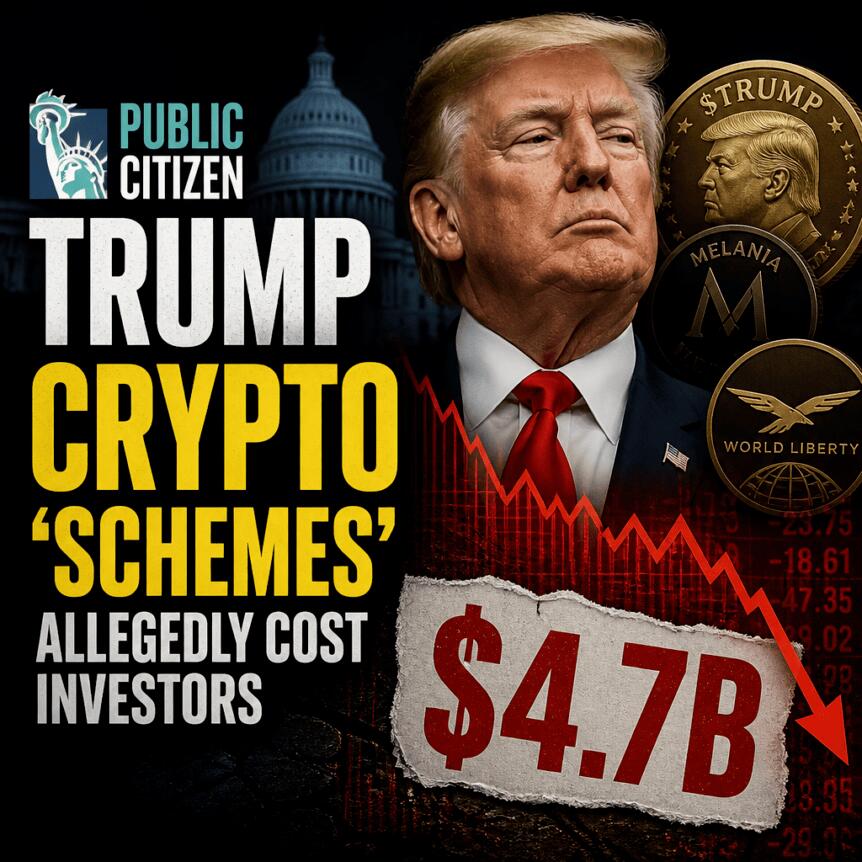
US consumer advocacy group Public Citizen says investors involved in Donald Trump’s digital asset activities since 2022 have collectively lost an estimated $4.7 billion. The figure, published
US consumer advocacy group Public Citizen says investors involved in Donald Trump’s digital asset activities since 2022 have collectively lost an estimated $4.7 billion. The figure, published in a report by the nonprofit, centers on the Trump family’s World Liberty Financial token initiatives, Trump’s 2022 NFT trading cards, and the president’s memecoin, Official Trump (TRUMP), alongside revenue tied to World Liberty’s USD1 stablecoin.
Public Citizen’s analysis claims that most of the losses fall on TRUMP memecoin buyers, while it also argues that purchases of World Liberty Financial’s USD1 stablecoin have not “suffered major losses.” The group further contends that the gains earned by Trump through licensing, royalties, and token-related sales did not fully reflect the ongoing risk borne by outside investors.
Key takeaways
- Public Citizen estimates investor losses of at least $4.7 billion tied to Trump family crypto ventures since 2022.
- The largest share of the losses—$3.2 billion—is attributed to investors in the TRUMP memecoin.
- Public Citizen says investors in World Liberty Financial’s USD1 stablecoin have not faced major losses.
- The advocacy group renews pressure for ethics provisions in the Digital Asset Market Clarity (CLARITY) Act.
- Cointelegraph reported earlier that Trump met with crypto executives and called for a “fair version” of the CLARITY Act to advance; a scheduled cloture vote is set for Sept. 15.
Where Public Citizen says investor losses came from
In its report, Public Citizen argues that a combination of Trump-linked digital asset products and related activity has left investors underwater by at least an estimated $4.7 billion since 2022. The group points to several components: the World Liberty Financial governance token, the president’s NFT trading cards launched in 2022, the TRUMP memecoin, and Trump Media’s digital asset treasury.
The report’s central breakdown is stark. Public Citizen says TRUMP memecoin investors account for $3.2 billion of the estimated losses, presenting it as a case where value was transferred to early buyers rather than disappearing entirely. In contrast, the group says buyers of World Liberty Financial’s USD1 stablecoin have not seen “major losses,” implying that price deterioration—rather than systemic failure—has been the dominant issue for the higher-risk products in the portfolio.
Public Citizen also highlights that its estimate concerns “left investors…underwater,” framing the problem as a mismatch between investor outcomes and the perceived benefits accruing to the Trump family through various mechanisms.
How the report ties losses to revenue and licensing
Alongside the loss estimate, Public Citizen describes revenue streams it says Trump earned during the same period. According to the nonprofit, the president collected $7.2 million from NFT licensing fees and royalties. It also cites more than $600 million from World Liberty token sales and the sale of an equity stake, $635 million in licensing fees for the memecoin, and $197 million in revenue from capital contributions to World Liberty.
The organization stresses that these totals do not incorporate the value or stakes tied to ventures that Trump continues to hold. Some figures, Public Citizen notes, were reflected in disclosures discussed in earlier coverage; Cointelegraph previously reported on 2025 filing disclosures that included earnings tied to crypto.
For investors, the implication is not simply that digital assets can be volatile, but that governance, incentives, and monetization structures may concentrate upside for promoters while leaving retail participants exposed to downside. Public Citizen’s framing underscores a familiar tension in crypto markets: whether token launches and monetization pathways generate benefits broadly—or primarily reward early participants and project insiders.
Why ethics provisions in the CLARITY Act matter now
Public Citizen’s renewed criticism extends beyond individual products and into proposed crypto regulation. The nonprofit says the US needs ethics provisions in the Digital Asset Market Clarity (CLARITY) Act, arguing that “the president’s policy choices and personal portfolio cannot be separated.” It calls for legislation that would require a US president and his family to divest from projects in the industry.
This push reflects a broader concern among critics of US policy conflicts: in fast-moving sectors like digital assets, the line between market participation and policymaking can shape outcomes. Public Citizen’s argument suggests that even if a bill is technically neutral, the political actor’s direct exposure could alter incentives for how rules are designed, timed, or implemented.
Supporters of engagement may argue that experience or involvement can inform policy. But Public Citizen’s position is that divestment requirements are an essential safeguard—particularly where a president’s policy choices could influence investor confidence, market structure, and enforcement priorities.
Legislation still moving—timing and political pressure
Public Citizen’s renewed call comes as it characterizes additional crypto-related activity as “potentially on the way.” The group also links its push to momentum around the CLARITY Act.
Cointelegraph reported that Trump met with crypto company executives last week and urged passage of a “fair version” of the CLARITY Act once the Senate returns to session next month. The bill is scheduled for a cloture vote on Sept. 15. Advancing would require at least 60 senators to vote in favor, meaning the measure’s next step depends on securing broad support rather than a simple party-line outcome.
The combination of Public Citizen’s critique and the legislative calendar is likely to keep the ethics debate in focus. If the CLARITY Act proceeds on the timetable described, lawmakers may face pressure—publicly and politically—to address conflict-of-interest concerns before the bill’s substance locks in.
Meanwhile, Public Citizen’s estimate is likely to remain a reference point in future discussions because it connects consumer-outcome claims with specific categories of products—memecoin versus stablecoin—and with monetization mechanisms such as royalties, licensing fees, and token sales.
Investors and builders should watch whether the CLARITY Act’s handling of conflicts of interest evolves as the Sept. 15 cloture vote approaches, and whether additional disclosures or market data clarify the extent to which losses were driven by general volatility versus design choices tied to early participation. The next phase will test whether ethics safeguards become part of crypto market structure—or remain optional in practice.
This article was originally published as Public Citizen: Trump Crypto ‘Schemes’ Allegedly Cost Investors $4.7B on Crypto Breaking News – your trusted source for crypto news, Bitcoin news, and blockchain updates.