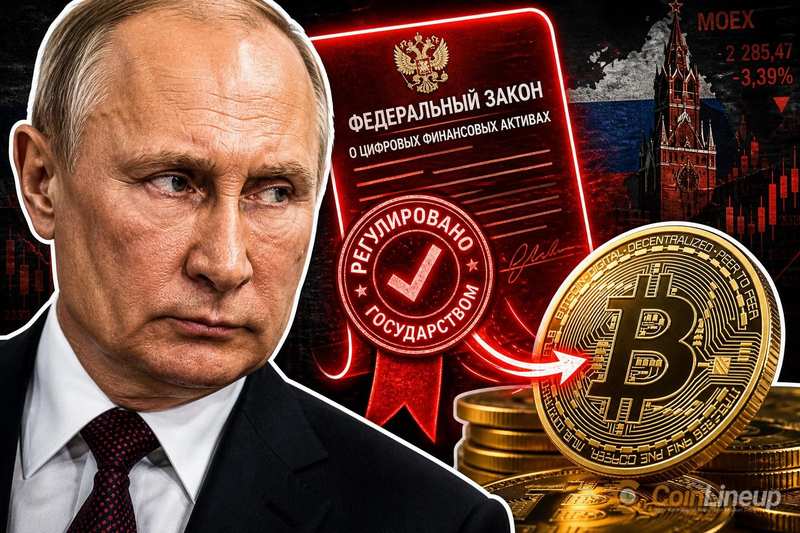
Russian President Vladimir Putin has signed a law opening regulated crypto trading to retail investors in Russia, formalizing state oversight of an activity that had previously operated in a
Russian President Vladimir Putin has signed a law opening regulated crypto trading to retail investors in Russia, formalizing state oversight of an activity that had previously operated in a legal grey zone.
What the New Russia Crypto Trading Law Changes
The measure was published on Russia's official legal information portal, confirming that the change is now tied to a signed and enacted law rather than a pending bill, according to the government publication. For related coverage, see Coinbase to Suspend Six Crypto Trading Pairs on August 6 After Market Review.
The legislation is described as establishing regulated trading, meaning access comes with a defined rulebook rather than unrestricted market activity. Reporting characterized the framework as Russia's first comprehensive legal structure for cryptocurrencies and digital assets, according to Anadolu Agency. For related coverage, see Nigeria Sets 1% Crypto Tax Withholding for Exchanges, P2P.
The shift follows the earlier legislative stages that moved the bill through parliament before reaching the president's desk, a sequence covered when Russia's State Duma passed the crypto bill and sent it for Putin's signature.
How Retail Investors in Russia Could Be Affected
Retail investors, meaning individual private participants rather than institutions or a narrow set of qualified entities, are the group named as gaining access under the signed law.
By opening regulated trading to that audience, the law appears to widen participation in a domestic Russian market that previously lacked a clear legal channel for everyday buyers. The broader framework and its earlier drafting were detailed when the Russia crypto exchange law was signed by Putin.
Practical eligibility and trading conditions still depend on how the final regulatory framework is implemented. Earlier versions of Russia's approach included participation limits, such as reporting that the Duma crypto law would cap citizens at $3,800 a year.
Why This Move Matters for Russia's Crypto Market
A signed law represents an official policy step rather than a proposal, giving the Russian market a formal legal reference point for regulated retail crypto trading.
Regulated retail access signals a notable shift in market posture for a major jurisdiction, which is why the development is relevant to crypto readers tracking how large economies formalize digital asset rules.
The change lands as Bitcoin held steady above the $64,000 level in broader market trading, according to CoinDesk. What remains open is the rollout detail: the confirmed change is the law itself, while the specific mechanics of how and where Russian retail investors will trade are still governed by the regulatory framework that follows.
Disclaimer: This article is for informational purposes only and does not constitute financial or investment advice. Cryptocurrency and digital asset markets carry significant risk. Always do your own research before making decisions.
Read original article on coinlineup.com