QOR Network Tokenomics: Understanding the $QOR Economy QOR Network isn't pitching itself as another Layer 1 or another DeFi app. It's pitching a wallet that skips seed phrases entirely, letti
QOR Network Tokenomics: Understanding the $QOR Economy
QOR Network isn't pitching itself as another Layer 1 or another DeFi app. It's pitching a wallet that skips seed phrases entirely, letting users open an account with a fingerprint or face scan instead.
QOR Network tokenomics sit underneath that pitch, built around a familiar payment idea: charge a small fee on transactions, then use that fee to support the token. According to the project's own tokenomics page, $QOR has a fixed supply of 250 million, with no further minting planned.
This article walks through where that supply is meant to go and how the project's buyback-and-burn model is described to work. As of August 2026, QOR is in an internal, invite-style launch phase rather than a fully public exchange listing.
What Is QOR Network and How Does It Work?
QOR describes itself as a biometric wallet and payments layer built on Solana. The stated goal is to replace the 12-word seed phrase with a face or fingerprint scan tied to a device's Secure Enclave hardware chip.
The project ties its design to SIMD-0075, a proposed Solana upgrade for native biometric signature verification. That's a real, publicly discussed proposal, though "purpose-built around SIMD-0075" is the project's own framing rather than a confirmed dependency until the upgrade activates.
QOR's homepage also references an Android app, a P2P marketplace, staking, and a cross-chain bridge called Octane. Most of these appear as ecosystem components rather than finished, independently verified products.
How Is the 250M $QOR Supply Allocated?
QOR's published tokenomics list a fixed total supply of 250 million $QOR, allocated as follows:
Allocation
Percentage
Tokens
Stated Purpose
Node Bonding
20%
50M
Locked permanently by relayer node operators
Community & Ecosystem
30%
75M
Rewards, grants, partnerships (4-year vesting)
Treasury
15%
37.5M
Multi-sig reserve for development and audits
Team & Advisors
15%
37.5M
12-month cliff, 36-month linear vesting
Liquidity
10%
25M
DEX/CEX liquidity provisioning
Public Sale
10%
25M
Public launch allocation
Two details stand out. The node bonding share isn't held by a treasury or team; it's locked by whoever runs relay nodes, tying a fifth of the supply to infrastructure operation rather than a sale.
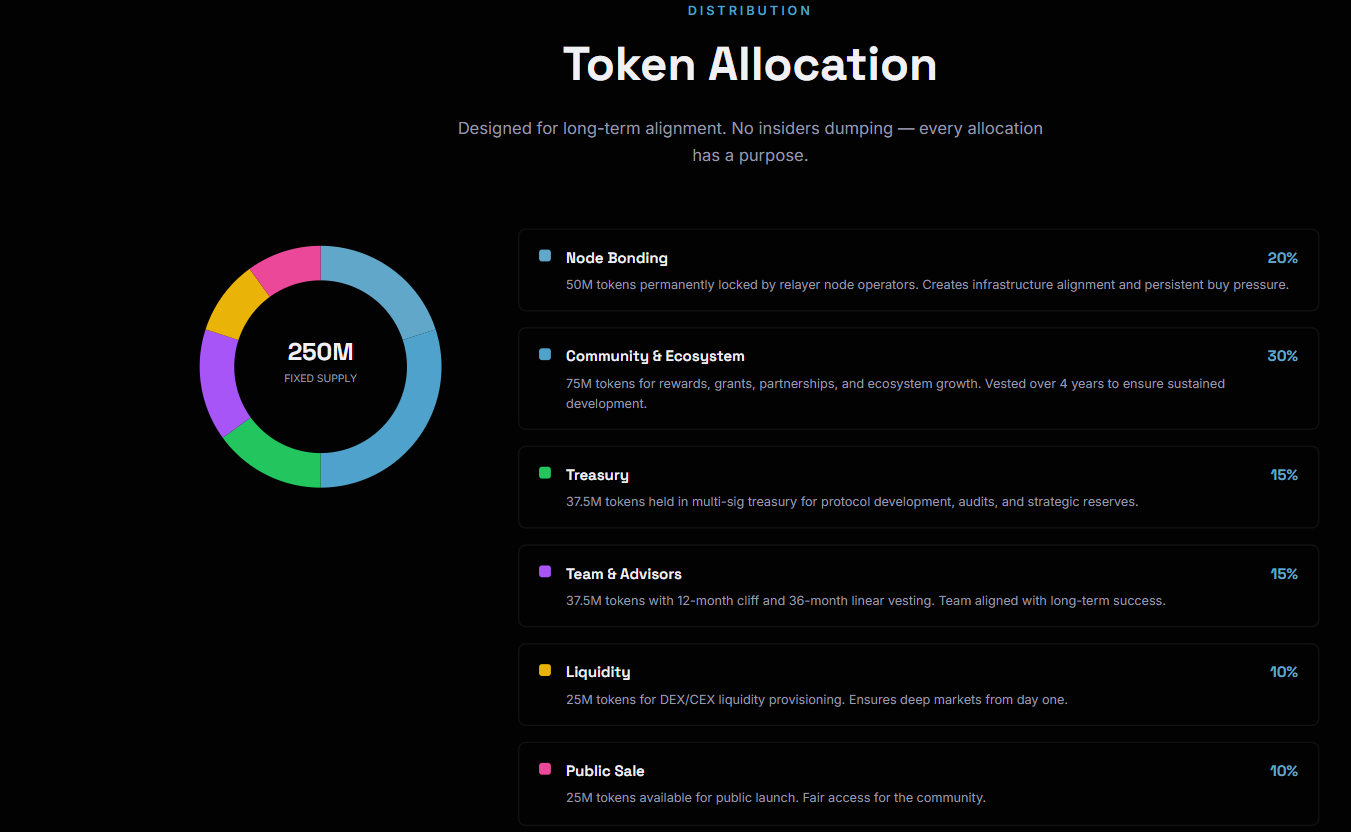
The team allocation also carries a 12-month cliff, a waiting period before any locked tokens start releasing, followed by three years of linear vesting. That keeps team tokens out of circulation for a full year after the vesting clock starts, though the project hasn't published the exact date that clock begins.
How Does QOR’s 1% Merchant Fee Work?
QOR describes a 1% fee on merchant transactions, split three ways:
0.6% — Junction fees: paid in USDC to relayer node operators who bonded $QOR to run infrastructure
0.3% — Protocol fees: used to buy $QOR on the open market and burn it, removing supply permanently
0.1% — Network fees: distributed to $QOR stakers as yield
The project calls this "real yield," meaning staking rewards would come from transaction fees rather than newly minted tokens. That's a meaningful distinction: inflationary rewards dilute every holder's share over time, while fee-funded rewards don't create new supply.
How Does QOR Staking Compare to Traditional Staking?
Most staking programs pay in newly minted tokens, which dilutes a holder's share of total supply as the pool expands. QOR's tokenomics page contrasts the two models directly:
Typical Staking
QOR's Stated Model
Reward source
Newly minted tokens
Merchant transaction fees
Effect on supply
Inflationary
Non-dilutive
Holder's share over time
Shrinks
Stays constant, or grows as burns reduce supply
If it works as described, a staker's percentage ownership wouldn't shrink from emissions, and burns would push the opposite way. It's a coherent design on paper, still unproven without real transaction data behind it.
How Does QOR’s Buyback-and-Burn Model Work?
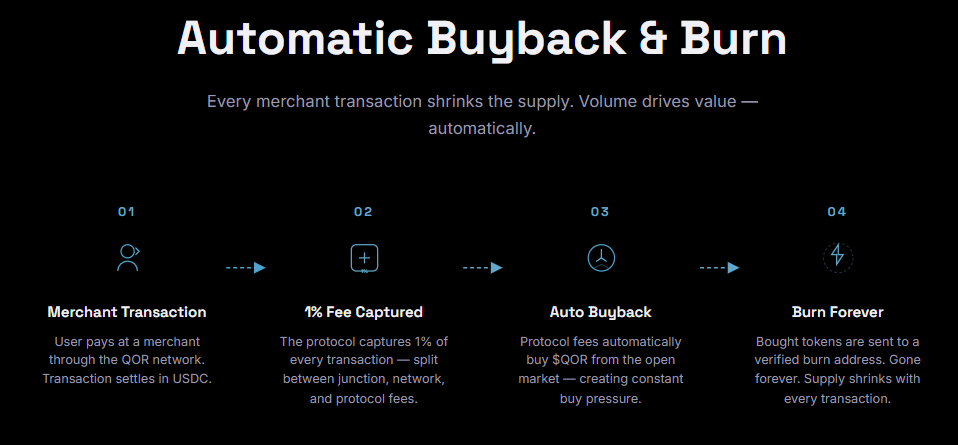
Token burn is when tokens move to an address no one can spend from, permanently cutting supply. QOR's stated engine runs in four steps: a user pays a merchant, the protocol captures its fee, that fee buys $QOR on the open market, and the purchased tokens get burned.
The project frames this as tying scarcity to real transaction activity instead of arbitrary emission schedules. More volume would mean more buybacks, meaning a smaller circulating supply over time, according to the stated model.
QOR's materials also describe a loop connecting every piece: users transact, fees generate, buyback-and-burn runs, supply shrinks, stakers earn yield, and node operators bond more $QOR to handle added volume. Each step is meant to feed the next. It's a coherent structure mechanically. Whether it plays out depends entirely on transaction volume, which isn't independently observable yet.
What Is QOR’s Current Launch Status?
QOR's homepage describes an "Internal Launch" dated June 11, 2026, with buy-in opening once that countdown ends. The site also lists an Android app at version 1.0.1, with iOS listed as coming later.
This points to an early, gated access phase rather than open trading on major exchanges. No exchange listing appears in the project's own materials as of this writing.
A separate, unrelated Layer 1 project called QoreChain also uses the QOR ticker and began exchange trading around August 20, 2026. The two are different projects with different tokens, despite the shared abbreviation.
QOR Network Tokenomics: Key Factors to Consider
The stronger signal is the structure itself. A fixed 250 million supply, a fee model tied to transactions instead of inflation, and a sizable node-bonding lockup point to a design built around avoiding low-float, high-FDV launch patterns.
The main gap is timing. QOR is still in an internal launch phase, with no independently confirmed transaction volume, no published third-party audit, and no public team page yet — the About section states team details are "launching soon." Every yield and burn figure in the tokenomics material is a stated model, not a demonstrated result.
The biggest open question is adoption. A merchant-fee-funded token only functions if merchants and users actually route payments through QOR. Until that volume shows up in verifiable data, the buyback-and-burn mechanic remains a design on paper rather than a proven outcome.
Conclusion
QOR Network's tokenomics center on a 250 million fixed supply, a 1% merchant fee split across node operators, buyback-and-burn, and staker yield, plus a node-bonding structure locking 20% of supply into infrastructure. The notable part is the attempt to tie token value to transaction activity rather than emissions.
What remains open is everything downstream of the design itself: audit status, team transparency, and real transaction volume once the network moves past its internal launch phase.
Disclaimer
This article is for informational purposes only and does not constitute financial advice. QOR is in an early launch phase, and its tokenomics and stated timelines may change.