TLDR Apple and Qualcomm extended their global patent licensing partnership, starting April 1, 2027. Shares of QCOM climbed 0.2% on the announcement, bucking a broader Nasdaq 100 decline. Spec
TLDR
- Apple and Qualcomm extended their global patent licensing partnership, starting April 1, 2027.
- Shares of QCOM climbed 0.2% on the announcement, bucking a broader Nasdaq 100 decline.
- Specific financial details and the agreement’s exact duration remain undisclosed.
- Despite Apple developing proprietary modem technology, Qualcomm’s cellular patents remain essential.
- The semiconductor company aims for $15 billion in data center revenues by fiscal year 2029.
Shares of Qualcomm (QCOM) edged 0.2% higher Thursday following confirmation that the semiconductor giant has extended its patent licensing partnership with Apple (AAPL). The renewed arrangement becomes effective April 1, 2027, providing investors with greater visibility into a relationship that has experienced significant turbulence over the past decade.
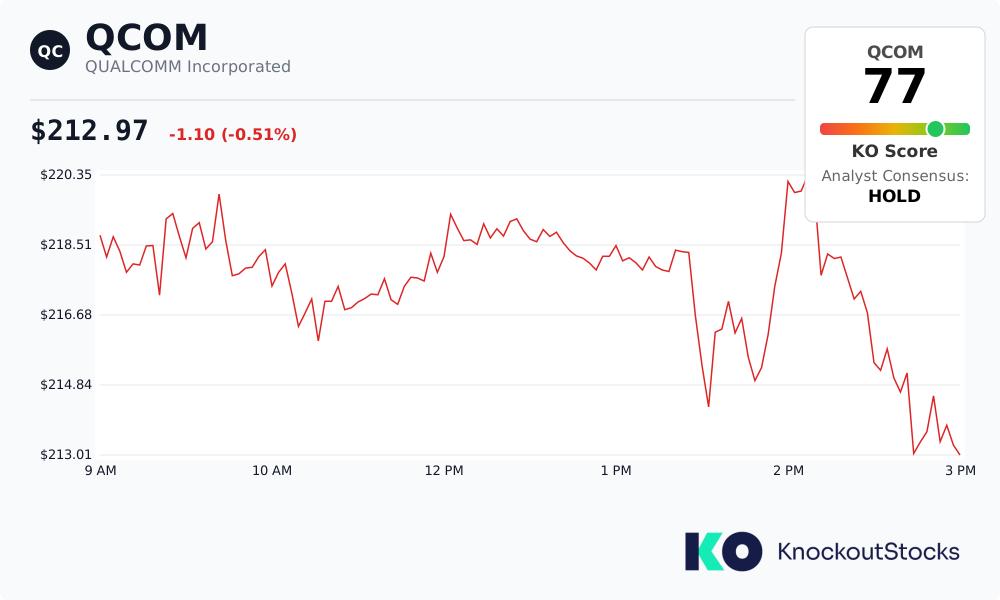 QUALCOMM Incorporated, QCOM
Both corporations declined to reveal monetary terms or the precise timeline of the extended arrangement. Nevertheless, the mere announcement provided enough support for Qualcomm shares to gain modest ground on a challenging trading session for the technology-heavy Nasdaq 100.
The history between these two tech giants has been marked by conflict and reconciliation. In 2017, Apple initiated legal proceedings against Qualcomm, alleging that its licensing fee structure was anticompetitive. After two years of bitter courtroom battles, the companies reached a settlement in 2019, establishing the foundation for their current business relationship.
Following that settlement, Apple has aggressively pursued independence from Qualcomm. The iPhone maker acquired Intel’s modem operations and has been systematically deploying its proprietary “C1” cellular chipsets. Apple’s objective is straightforward: eliminate ongoing payments to Qualcomm for every iPhone unit sold.
That strategy hasn’t completely materialized yet. Currently, only the U.S. versions of the iPhone 18 Pro Max continue utilizing Qualcomm modems, while other models now incorporate Apple’s homegrown technology. However, Qualcomm maintains ownership of fundamental cellular connectivity patents that Apple cannot circumvent through engineering alone.
This extended agreement specifically addresses those patent rights. The arrangement isn’t focused on chip supply—it concerns the intellectual property that Apple’s products depend on, irrespective of which company manufactured the internal modem.
“We are pleased to extend the Apple license agreement,” said John Han, Qualcomm’s Executive Vice President and General Manager of Technology Licensing.
Qualcomm charts course beyond Apple dependency
Qualcomm CFO Akash Palkhiwala emphasized that the Apple announcement represents merely one element of a broader strategic transformation. During remarks at the Snapdragon Summit 2026, he outlined the company’s vision to evolve into what CEO Cristiano Amon describes as a “platform company.”
“In the next two years, we’ll become this company with three major businesses: data center, smartphones, and auto/IoT,” Palkhiwala said. “Think of it as three legs of the stool with each almost equal in size.”
The mobile handset division has faced headwinds recently. Qualcomm’s smartphone processor revenues declined 20% year-over-year to $5.1 billion during the fiscal third quarter, attributed partially to softening demand and elevated memory component prices.
The automotive segment has emerged as a significant success story. This division generated $1.59 billion in quarterly revenue, representing 61% growth compared to the previous year, with Qualcomm projecting it will reach $10 billion in annual sales by fiscal 2029.
Aggressive data center expansion strategy
While data center revenues weren’t broken out in July’s quarterly results, this business line represents a cornerstone of Qualcomm’s future strategy. Palkhiwala revealed that the data center segment is projected to contribute $15 billion toward the company’s $40 billion non-handset revenue objective by fiscal 2029, a substantial increase from the previous $22 billion target.
“We were previously not in the data center business, so that drives most of the increase,” he said.
This month, Qualcomm announced a partnership with Amazon (AMZN) to develop specialized processors for artificial intelligence data center applications. Palkhiwala confirmed ongoing collaborations with Meta (META) and another major cloud service provider that hasn’t been publicly identified.
He dismissed concerns about potential reductions in AI infrastructure investments. “These companies are excited to be working with us and we see data center and AI as a tremendous opportunity,” Palkhiwala noted, highlighting that robotics represents another potential growth avenue that hasn’t been incorporated into current revenue projections.
The post Qualcomm (QCOM) Stock Gains as Apple Partnership Extended Through 2027 appeared first on Blockonomi.